受胎告知
ニコラ・プッサン · 1650s
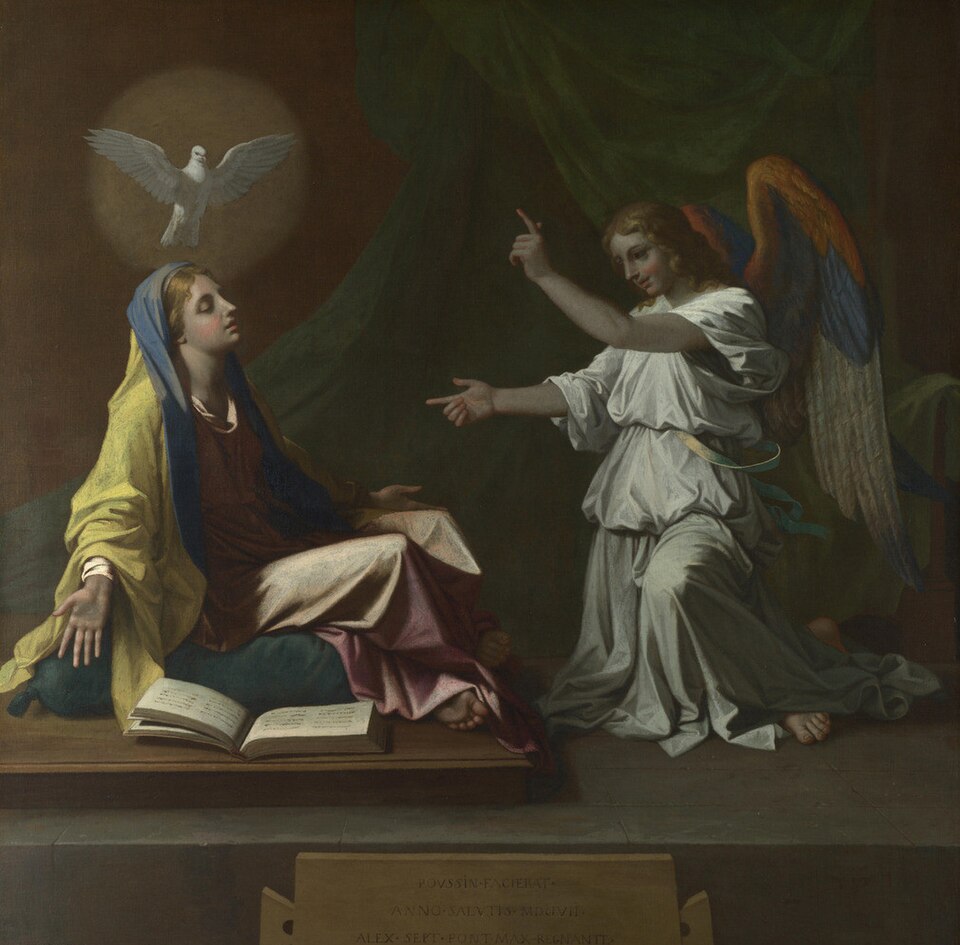
Mary sits barefoot on a cushion, eyes closed, hands open, wrapped not in the usual blue but in yellow. In one of his late works Poussin quietly breaks almost every convention of the Annunciation.
The story behind the painting
French Wikipedia dates the painting to 1657, near the end of Poussin's life, while Wikidata gives only the 1650s. Its purpose is debated. In 1947 Anthony Blunt wrote that it once hung in a chapel of Pope Alexander VII, whose name appears on the painted cartellino at the bottom. In 1965 Jane Costello proposed instead that it was painted for the tomb of Cassiano dal Pozzo, Poussin's friend and patron, an idea taken up by Jacques Thuillier and Alain Mérot. Erick Wilberding returned to the papal theory.
What to look for
The archangel Gabriel points both at Mary and at the dove of the Holy Spirit. Unusually, the angel stands on the right rather than the left. The dove does not dive from the sky but sits with wings spread inside a circle, a literal image of the Gospel words that the Holy Spirit will overshadow her. Mary keeps her back straight, eyes closed, hands open. She sits on a cushion with bare feet, not on a high seat, and her mantle is yellow instead of the nearly universal blue. The canvas is almost square, about 104 by 103 cm.
Meaning and intent
Some see Mary's ecstatic pose as a reply to Bernini's Ecstasy of Saint Teresa, finished a few years earlier, though Teresa's head falls back while Mary stays upright. Poussin may have wanted a Near Eastern Annunciation, borrowing from Islamic images where Mary also sits on a cushion, and dressing her in the colour Jewish women in Rome were required to wear in his time. Jane Costello thought instead of the pose of Egyptian scribes, noting links between Mary, Minerva and Isis. The yellow may also stand for hope and purity.
Legacy
Whatever its first home, the painting probably belonged in the 18th century to the collection formed by the British diplomat John Udny. Today it is in the National Gallery in London. It remains a picture that invites argument: about whom it was made for, about why Mary looks the way she does, and about how much an old painter could still reinvent one of the most familiar scenes in Christian art. Its quiet, almost geometric stillness rewards a long, slow look.
豆知識
- Dated 1657 by French Wikipedia; Wikidata gives the 1650s.
- The angel is on the right and Mary wears yellow, both unusual.
- Its patron, Alexander VII or Cassiano dal Pozzo, is debated.
- Now in the National Gallery, London.
画家について
ニコラ・プッサン (1594-1665)
同じ画家の作品: ニコラ・プッサン
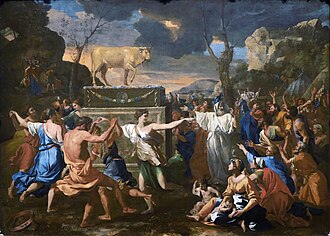 黄金の子牛の礼拝 - Nicolas Poussin (1634)
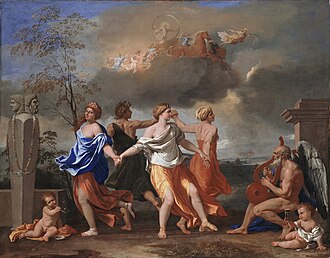 人生の踊り - Nicolas Poussin (1630s)
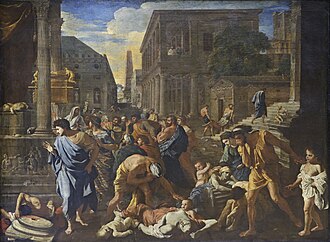 アシドドのペスト - Nicolas Poussin (1630)
.jpg) ソロモンの審判 - Nicolas Poussin (1649)
ソロモンの審判 - Nicolas Poussin (1649)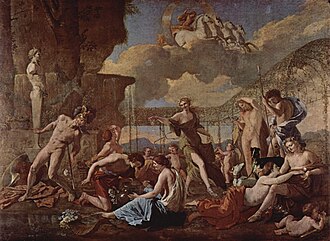 フローラの王国 - Nicolas Poussin (1631)
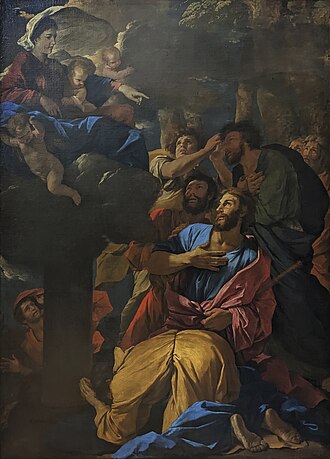 聖ヤコブによる聖母マリアの幻視 - Nicolas Poussin (1620s)
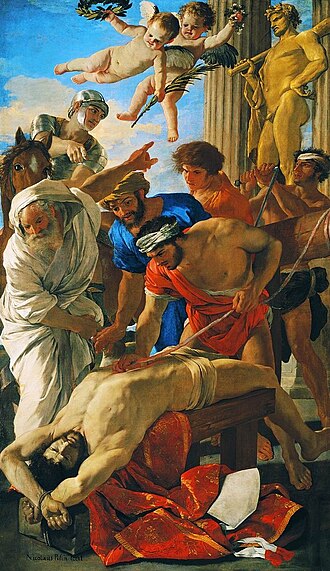 聖エラスムスの殉教 - Nicolas Poussin (1628)
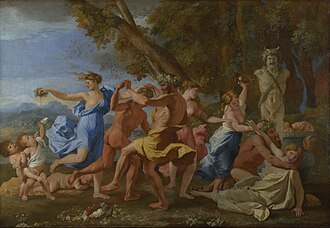 境界標の前のバッカナーレ - Nicolas Poussin (1630s)