ボルハの聖フランシスコと悔悛しない瀕死の病人
Francisco Goya · 1788
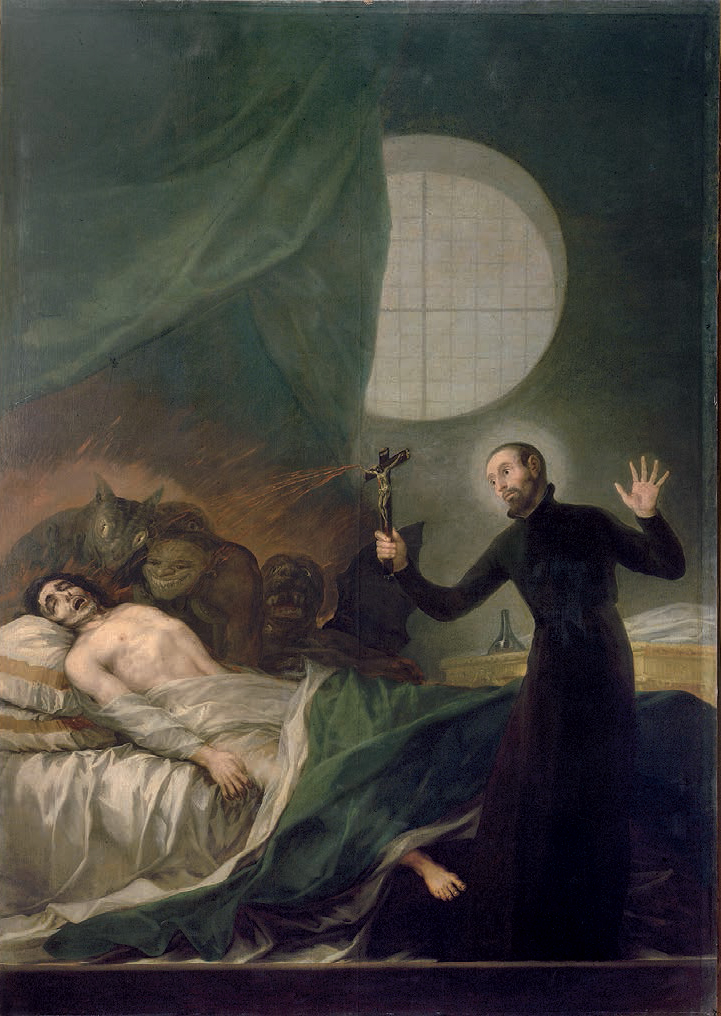
A saint holds up a crucifix to a dying man who will not confess, while grotesque creatures wait for his soul. In 1788 Goya painted one of his first truly terrifying pictures for a cathedral chapel.
The story behind the painting
Goya painted the picture in 1788, commissioned by the ninth Duke of Osuna for his chapel in Valencia Cathedral. The theme is rooted in traditional popular imagery which, as far back as Gonzalo de Berceo's Miracles of Our Lady, tells of the struggle between heavenly and demonic forces for the soul of a dying person. The saint is Francis Borgia, and the dying man refuses the sacrament, which turns the scene into a contest for his soul.
What to look for
Francis Borgia holds out a crucifix, trying to persuade the dying man to confess, while grotesque beings, probably demons, wait to take his soul. The lighting is sharply contrasted. The man's deathly rigidity shows in a dramatic grimace and a theatrical light in yellows and whites, the same tones as the aura around the saint's head, set against warm greens. The caricatured figures in the background are said to represent fear.
Meaning and intent
This is one of the first paintings that can be placed in the eighteenth century aesthetic of the Terrible, which Anton Raphael Mengs linked to the style of Michelangelo. Goya goes beyond what his contemporaries called the Sublime Terrible. Pedro de Silva, another contemporary, wrote that the viewer sees the terrible signs of a soul violently shaken by cruel remorse for its crimes and the desperate certainty of its coming damnation.
Legacy
For these reasons the French Wikipedia article counts it among the most original religious paintings. Its small size, 29 by 38 cm, contrasts with the force of the scene. The work is linked to Valencia Cathedral, where the duke's chapel stood, and it is still recorded there. Pedro de Silva's reaction shows that viewers of Goya's own time already felt its power. The scene of saint, dying man and demons stays in the memory long after.
豆知識
- Painted in 1788 for the ninth Duke of Osuna.
- Made for his chapel in Valencia Cathedral.
- Demons wait for the soul of the dying man.
- An early example of the aesthetic of the Terrible.
画家について
Francisco Goya (1746-1828)
同じ画家の作品: Francisco Goya
 1808年5月3日 - Francisco Goya (1814)
 裸のマハ - Francisco Goya (1800)
 我が子を食らうサトゥルヌス - Francisco Goya (1819)
 カルロス4世の家族 - Francisco Goya (1800)
 着衣のマハ - Francisco Goya (1800)
 1808年5月2日、エジプト人親衛隊との戦闘 - Francisco Goya (1814)
 犬 - Francisco Goya (1819)
 魔女の夜宴 - Francisco Goya (1820s)
関連する画家の作品
 雲海の上の旅人 - Caspar David Friedrich (c. 1818)
 楡の木のある僧院 - Caspar David Friedrich (1800s)
 民衆を導く自由の女神 - Eugène Delacroix (1830)
 サルダナパールの死 - Eugène Delacroix (1827)
 戦艦テメレール号 - J. M. W. Turner (1839)
 雨、蒸気、速度 - グレート・ウェスタン鉄道 - J. M. W. Turner (1844)
 青衣の少年 - Thomas Gainsborough (1770)
 アンドリューズ夫妻 - Thomas Gainsborough (1748)