捨てられたプシュケ
ジャック=ルイ・ダヴィッド · 1795
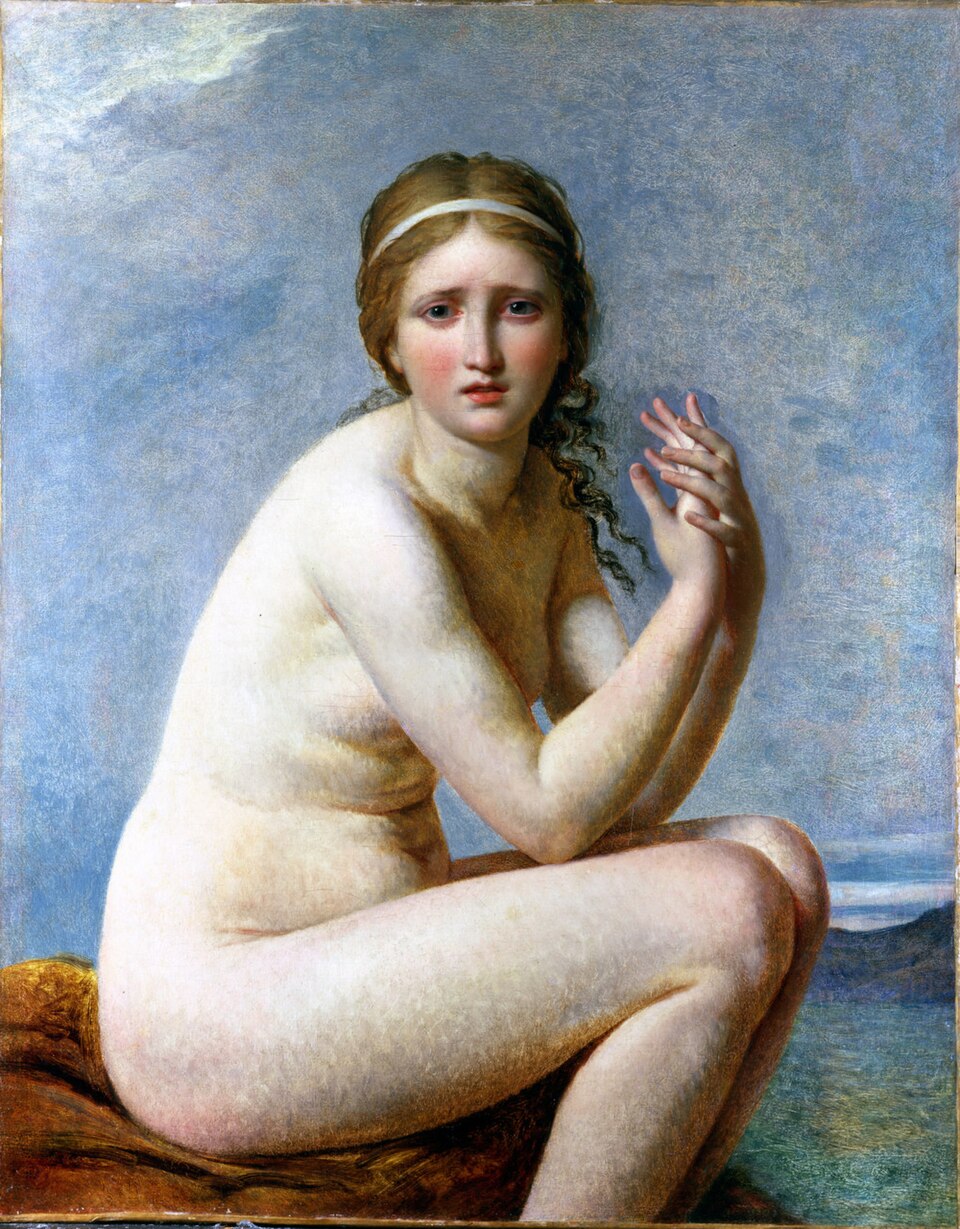
A naked young woman crouches against a blue sky and looks at us with loss, pain and betrayal. David is thought to have painted her while he himself sat in prison, cut off from everyone he knew.
The story behind the painting
After the fall of Robespierre in 1794, David was arrested and imprisoned with other Jacobins. In September 1794 he was moved from the Hôtel des Fermes, where friends, family and students could visit, to the Hôtel du Luxembourg, where he was isolated with no hope of early release. In a letter to a former fellow prisoner, M. de Mainbourg, he described this as abandonment. Psyche Abandoned is thought to have been painted there, in 1794 or 1795, and like other works from his imprisonment it is considered unfinished. He meant it for his return to the Salon after his release in 1795, but chose to show other pictures instead.
What to look for
Psyche is a crouching nude seen in profile against a blue sky, with a hill behind her. The canvas is vertical, which breaks with the academic conventions for showing the female nude. Her body bends forward and her arms cover her chest. Look at her face: she turns to stare straight at the viewer. Scholars have noted how little sensuality the figure has; apart from her missing clothes, the pose speaks of desperation more than seduction. Some see a source in the grieving Andromache of David's earlier Andromache's Grief, and in the pose of Crito in The Death of Socrates.
Meaning and intent
In the myth, popularised in France by La Fontaine, Psyche was forbidden to look at her lover Cupid. When she did, he left her, taking her palace, belongings and attendants, and she was left naked and distraught. The sculptor Pajou's marble Psyche Abandoned is seen as an important precedent. Scholars compare Psyche's expression to David's own feelings of abandonment, and Ewa Lajer-Burcharth links her uncertain sexuality to a crisis in David's sense of masculine stoicism while imprisoned. A 2011 exhibition in Houston set the work against The Oath of the Horatii as a turn from heroic virtue toward private emotion.
Legacy
For a long time the painting was known only from David's own lists of his works, where it was called a painted study of Psyche and a pendant to The Vestal Virgin. Thought lost, it was rediscovered in 1991 and shown at the Louvre in 2010 in the exhibition L'Antiquité rêvée. It is now in a private collection. It remains less known than the other works of his imprisonment, his Self-portrait and The Intervention of the Sabine Women, yet it offers one of the most personal glimpses of David at his lowest point.
豆知識
- Painted around 1794 to 1795, probably during David's imprisonment.
- Considered unfinished.
- Long thought lost, rediscovered in 1991.
- Shown at the Louvre in 2010; now in a private collection.
画家について
ジャック=ルイ・ダヴィッド (1748-1825)
女性 · 神話画 · 座法 · ヌード · ロングヘア · 新古典主義 · 裸 · 海 · チェスナット・ヘアー · ヘアバンド
同じ画家の作品: ジャック=ルイ・ダヴィッド
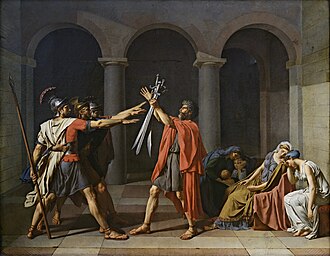 ホラティウス兄弟の誓い - Jacques-Louis David (1784)
.jpg) サビニの女たち - Jacques-Louis David (1799)
サビニの女たち - Jacques-Louis David (1799) ヴィーナスと三美神に武器を取り上げられるマルス - Jacques-Louis David (1824)
 レカミエ夫人の肖像 - Jacques-Louis David (1800)
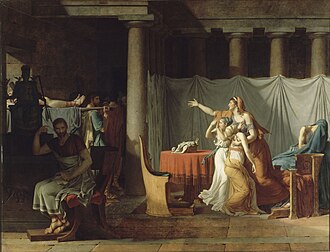 ブルートゥス邸に息子たちの遺骸を運ぶ警士たち - Jacques-Louis David (1789)
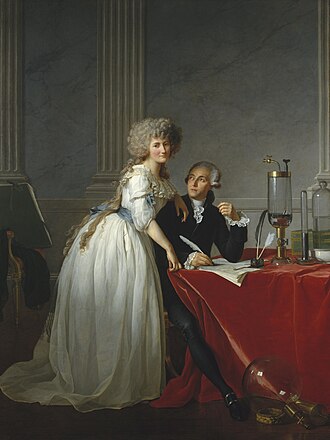 アントワーヌ=ローラン・ド・ラヴォアジエ (1743–1794年)とその妻 (マリー・アンヌ・ピエレット・ポールズ、(1758–1836年)の肖像画 - Jacques-Louis David (1788)
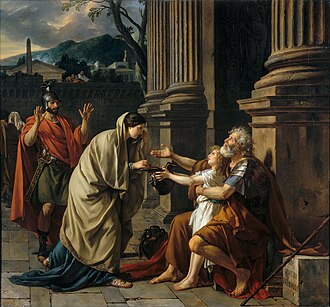 施しを乞うベリサリウス - Jacques-Louis David (1781)
クピードーとプシューケー - Jacques-Louis David (1817)
 泉
泉 玉座のナポレオン
 1808年5月3日
.jpg) 裸のマハ
裸のマハ