書斎のナポレオン
ジャック=ルイ・ダヴィッド · 1812
%20-%20National%20Gallery%20of%20Art%20(Samuel%20H.%20Kress%20Foundation).jpg)
The clock reads 4:13 in the morning, the candles are burning low, and Napoleon is still in uniform at his desk. David painted not the conqueror on horseback but the tireless lawmaker, for a Scottish duke who admired him.
The story behind the painting
The portrait was a private commission from Alexander Hamilton, 10th Duke of Hamilton, a Scottish nobleman and admirer of Napoleon, ordered in 1811 and finished in 1812. Despite all its detail, it is unlikely that Napoleon actually posed for it. The painting first hung at Hamilton Palace. In 1882 it passed to Archibald Primrose, 5th Earl of Rosebery, and in 1954 it was bought from the Rosebery family by the Samuel H. Kress Foundation, which deposited it in the National Gallery of Art in Washington, where it hangs today. It measures about 204 by 125 cm.
What to look for
Napoleon stands three-quarters life size in the blue uniform of a colonel of the Imperial Guard Foot Grenadiers, with white facings and red cuffs, the Legion of Honour and the Order of the Iron Crown, gold epaulettes, white culottes and stockings. He faces us, his right hand tucked into his jacket. On the desk lie a pen, books, dossiers and rolled papers; more papers and a map spill onto the green carpet, and on them David signed LVDci DAVID OPVS 1812. Look closely at the unbuttoned cuffs, the wrinkled stockings, the untidy hair, the flickering candles and the clock at 4:13. The word Code stands out on the rolled papers, and a sword rests on the armrest of the chair.
Meaning and intent
Every detail tells us he has worked through the night, writing laws such as the Code Napoléon. The picture builds a civil image of the emperor, unlike the heroic one in Canova's Napoleon as Mars the Peacemaker or the military one in David's own Napoleon Crossing the Alps. Still, the sword on the chair recalls his victories, and the fleurs-de-lys and heraldic bees suggest a stable imperial dynasty. Study of the canvas shows David revised it several times: an earlier version framed the upper body between two fluted columns, later replaced by a shadowed panel and a clock, which was itself repainted smaller and higher, drawing the eye to Napoleon's face.
Legacy
The revisions improved the balance of the upper half and let David add new symbols, most notably the hour on the clock, while many fleurs-de-lis were painted over and are now conspicuously rare. While working on the picture, David also produced a repetition in which the clock was changed from 4:13 to 4:00 and Napoleon wore the hunter-green uniform of a colonel of the Chasseurs à cheval of the Imperial Guard. The painting remains one of the best-known images of Napoleon as a hard-working statesman, a portrait in which the hour on a clock carries as much meaning as the face.
豆知識
- Commissioned in 1811 by the 10th Duke of Hamilton, finished in 1812.
- The clock shows 4:13 am, implying a night of work on the laws.
- Napoleon probably did not pose for it.
- Now in the National Gallery of Art, Washington, through the Kress Foundation.
画家について
ジャック=ルイ・ダヴィッド (1748-1825)
肖像 · ナショナル・ギャラリー・オブ・アート · 剣 · サミュエル・H・クレス・コレクション · ナポレオン・ボナパルト · 絨毯 · fauteuil
同じ画家の作品: ジャック=ルイ・ダヴィッド
 ソクラテスの死 - Jacques-Louis David (1787)
 ホラティウス兄弟の誓い - Jacques-Louis David (1784)
 マラーの死 - Jacques-Louis David (1793)
 ナポレオン一世の戴冠式と皇妃ジョゼフィーヌの戴冠 - Jacques-Louis David (1807)
.jpg) サビニの女たち - Jacques-Louis David (1799)
サビニの女たち - Jacques-Louis David (1799)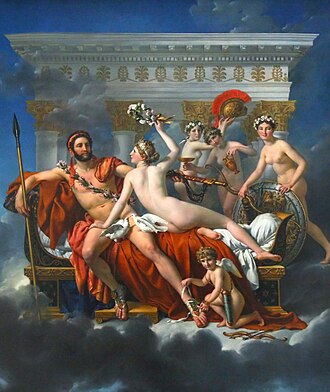 ヴィーナスと三美神に武器を取り上げられるマルス - Jacques-Louis David (1824)
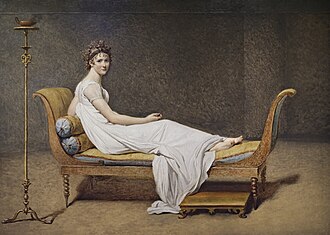 レカミエ夫人の肖像 - Jacques-Louis David (1800)
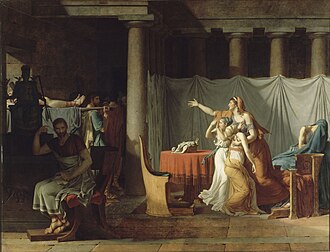 ブルートゥス邸に息子たちの遺骸を運ぶ警士たち - Jacques-Louis David (1789)
関連する画家の作品
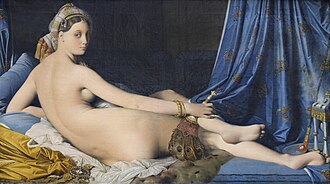 グランド・オダリスク - Jean-Auguste-Dominique Ingres (1814)
 泉 - Jean-Auguste-Dominique Ingres (1856)
 1808年5月3日 - Francisco Goya (1814)
.jpg) 裸のマハ - Francisco Goya (1800)
裸のマハ - Francisco Goya (1800)