教皇ピウス7世の肖像
ジャック=ルイ・ダヴィッド · 1805
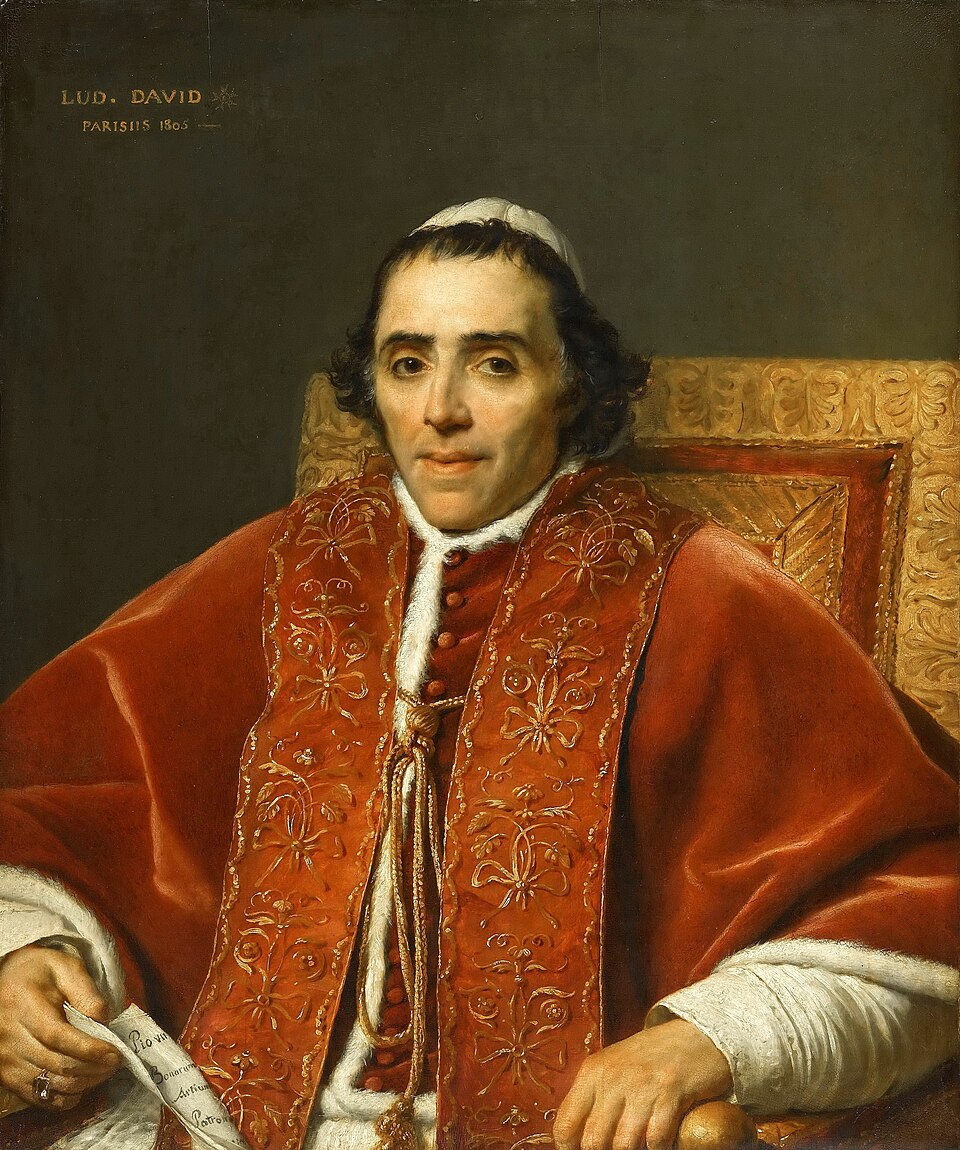
The most powerful prelate in Christendom, painted quietly, hands resting, eyes turned inward. David met Pius VII in Paris for Napoleon's coronation and seems to have been won over by the man himself.
The story behind the painting
Pope Pius VII came to Paris to assist at the coronation of Napoleon I. In David's vast Coronation of Napoleon he appears blessing the Emperor, although in fact he was a spectator, with a resigned expression throughout the ceremony. This separate portrait was painted as a thank you to the pope. It seems to have been commissioned by Count Charles Fleurieu, Napoleon's quartermaster general, though no written record of a commission survives. David painted it from life at the Tuileries Palace around the end of February 1805.
What to look for
The format is vertical, the background brown. Pius sits three-quarter-length on a red velvet chair embroidered with gold. He wears a white zucchetto, a white rochet of which only the sleeves show, a red velvet cape with ermine cuffs, and a red stole embroidered in gold. His arms rest on the chair, and his right hand holds a paper inscribed in Latin, calling him Patron of the Fine Arts. Look at the expression: peaceful and calm. The signature, top left, reads LUD. DAVID PARISIIS 1805.
Meaning and intent
David seems to have been impressed by the pope's simplicity and deep humanity, and he chose to show him in an introspective pose rather than as the most powerful prelate in Christianity. The paper in his hand honours him as a patron of the arts rather than a ruler. Not everyone approved: some critics of the time disliked the tight cropping of the picture, which they thought made the pope look cramped. The contrast with his staged role in the Coronation makes this quieter image all the more personal.
Legacy
The portrait was shown in the gallery of the French Senate in the Luxembourg Palace, then assigned to the Musee Napoleon, now the Louvre. It was displayed again at the Luxembourg in 1824 before returning permanently to the Louvre in 1827. David made three copies with the help of a student, probably Georges Rouget. Napoleon commissioned two of them, for the palaces of Fontainebleau and Versailles. David kept the third and took it with him into exile in Brussels; that copy is now lost.
豆知識
- Painted from life at the Tuileries around February 1805.
- A thank you for the pope's part in Napoleon's coronation.
- In the Louvre since 1827.
- Three copies were made; the one David took to Brussels is lost.
画家について
ジャック=ルイ・ダヴィッド (1748-1825)
同じ画家の作品: ジャック=ルイ・ダヴィッド
 ソクラテスの死 - Jacques-Louis David (1787)
 ホラティウス兄弟の誓い - Jacques-Louis David (1784)
 マラーの死 - Jacques-Louis David (1793)
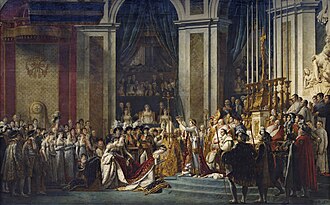 ナポレオン一世の戴冠式と皇妃ジョゼフィーヌの戴冠 - Jacques-Louis David (1807)
 サビニの女たち - Jacques-Louis David (1799)
 書斎のナポレオン - Jacques-Louis David (1812)
 ヴィーナスと三美神に武器を取り上げられるマルス - Jacques-Louis David (1824)
 レカミエ夫人の肖像 - Jacques-Louis David (1800)
関連する画家の作品
 グランド・オダリスク - Jean-Auguste-Dominique Ingres (1814)
 泉 - Jean-Auguste-Dominique Ingres (1856)
 1808年5月3日 - Francisco Goya (1814)
 裸のマハ - Francisco Goya (1800)