Portrait of Francisco de Pisa
エル・グレコ · 1610
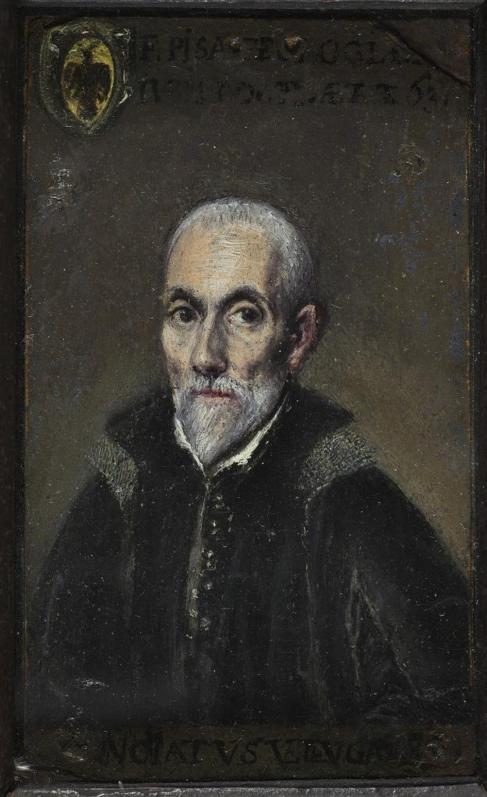
Barely 9.5 centimetres tall, this tiny portrait shows a white bearded scholar in black against dark green. It is one of the few miniatures attributed to El Greco, and it shows his friend Francisco de Pisa of Toledo.
The story behind the painting
Francisco de Pisa was a doctor of canon law, dean of the faculties of theology and liberal arts at the Royal University of Toledo, and Mozarabic chaplain of Toledo Cathedral. He wrote the Description of the Imperial City of Toledo, published in 1605. He was a great friend of El Greco, who also portrayed him in a larger portrait now at the Kimbell Art Museum in Fort Worth. In an unpublished part of his book Pisa praised The Burial of the Count of Orgaz, and he may even be one of its figures, though younger. The Spanish Wikipedia dates this miniature to around 1604, while Wikidata gives 1610.
What to look for
This is a playing card sized miniature painted in oil on paper glued to a panel, 9.5 by 5.8 cm, and it is unsigned. At the top, beside a shield with a double headed eagle, is the text F.PISA AETAT.63, his age. At the bottom another inscription reads LICENCIATUS VE-LUGA, which has led some to question who the sitter really is. The black clothing and white beard stand out against a dark green ground. The face is modelled with small brushstrokes, and the neutral background makes the gaze the centre of everything.
Meaning and intent
Made for an intimate circle, this small work has a different sensibility from official portraits. It was something to hold in the hand rather than to hang in a hall, a likeness of a friend rather than a statement of rank. That intimacy, and the closeness between painter and sitter, is part of what makes it moving: El Greco painted the man who wrote about his city and admired his greatest painting. The puzzle of the lower inscription reminds us that even small objects can keep their secrets.
Legacy
It is one of the few works in this format generally included in El Greco's body of work, number X-206 in Harold Wethey's catalogue. In 1916 Joaquín Ezquerra del Bayo showed it in an exhibition of portrait miniatures in Spain as a work by El Greco owned by the Marquis de la Vega Inclán. It probably came from the Beaterio de Santa Ana, which Pisa himself founded, then passed through Benigno de la Vega Inclán and Gregorio Marañón and was auctioned in 2015. In 2019 it was declared a Bien de Interés Cultural for its historical, iconographic and artistic value.
豆知識
- Oil on paper glued to panel, 9.5 by 5.8 cm, unsigned.
- Dated around 1604 by the Spanish Wikipedia, 1610 by Wikidata.
- Number X-206 in Harold Wethey's El Greco catalogue.
- Declared a Bien de Interés Cultural in 2019.
画家について
エル・グレコ (1541-1614)
同じ画家の作品: エル・グレコ
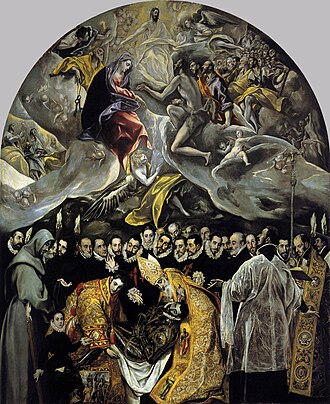 オルガス伯の埋葬 - El Greco (1586)
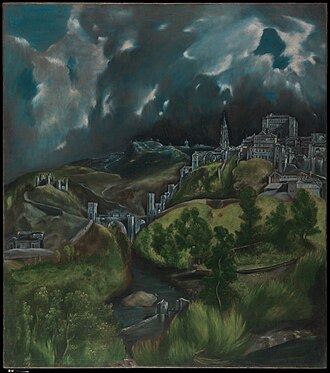 トレドの風景 - El Greco (1596)
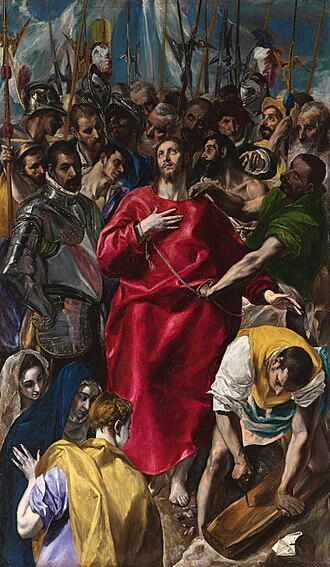 聖衣剥奪 - El Greco (1570s)
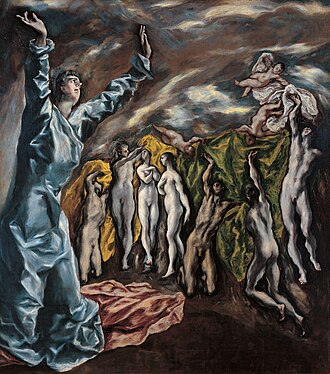 黙示録第5の封印 - El Greco (1610)
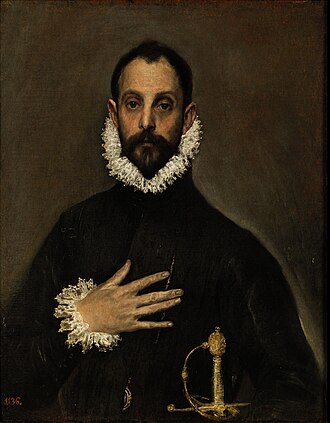 胸に手を置く騎士 - El Greco (1580)
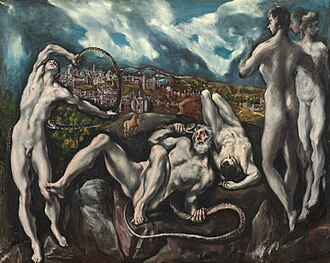 ラオコーン - El Greco (1610s)
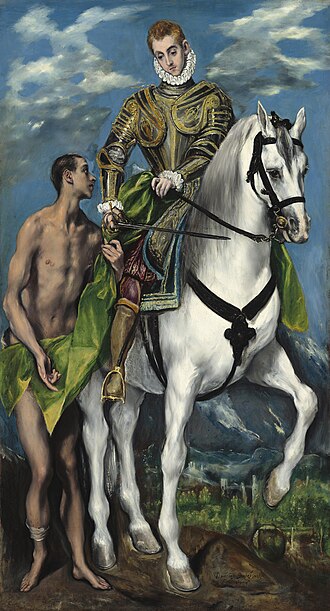 聖マルティヌスと乞食 - El Greco (1597)
 羊飼いの礼拝 - El Greco (1612)
関連する画家の作品
 カナの婚礼 - Paolo Veronese (1560s)
 レヴィ家の饗宴 - Paolo Veronese (1573)
 最後の晩餐 - Jacopo Tintoretto (1563)
 奴隷を解放する聖マルコ - Jacopo Tintoretto (1540s)
 ウルビーノのヴィーナス - Titian (1538)
 聖母被昇天 - Titian (1510s)
 エマオの晩餐 - Caravaggio (1601)
 聖マタイの召命 - Caravaggio (1609)
 大使たち - Hans Holbein the Younger (1533)
 墓の中のキリストの屍 - Hans Holbein the Younger (1520s)