若い女性の肖像
ロヒール・ファン・デル・ウェイデン · 1440s
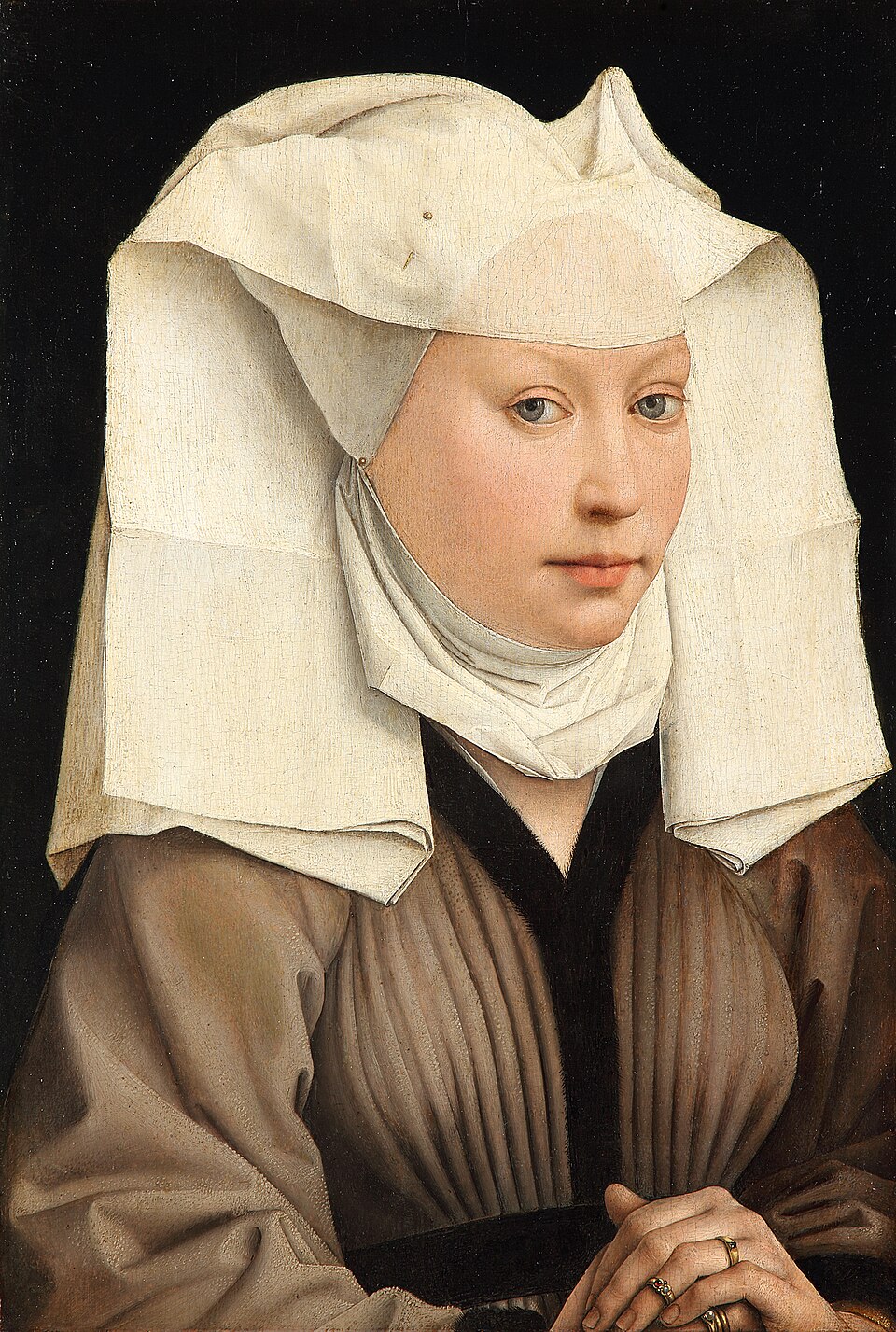
Under a great white headdress, a young woman with bright blue eyes looks straight at us, hands clasped in prayer. Many believe she was the painter's own wife.
The story behind the painting
Rogier van der Weyden completed this small portrait between 1435 and 1440, according to Wikipedia, while Wikidata places it in the 1440s. It is also known as Lady Wearing a Gauze Headdress. Given the individuality of her features, Rogier was clearly working from a life study of a real person. It is widely believed that the model was his wife, Elisabeth Goffaert, though this has never been proven. Her plain dress and matronly features suggest a woman of the middle class.
What to look for
She wears a wide white headdress, folded in layers, over a brown dress with a black-lined V neckline. Her hands are clasped tightly in prayer. Her large, bright blue eyes are rendered unusually: Rogier did not shrink her left eye to match the turn of her head. Light falls from above on the viewer's right, setting the vivid white of veil and skin against the dark dress. Notice how the vertical lines of the headdress flow into her shoulders, while the horizontal folds of the veil echo the line between her lips.
Meaning and intent
Like other female portraits by Rogier, her expression is humble. Yet unusually for him, she does not bow her head or gaze into the distance. She looks directly at us, creating an intimate bond between sitter, viewer and artist that the curator Lorne Campbell calls appealing and vibrant. The picture joins close observation of a real face with elements of abstraction in its geometry. If she was truly his wife, that direct, quiet gaze becomes even more personal.
Legacy
The portrait is so close to female portraits by Robert Campin that works by the two artists were sometimes mistaken for each other, one painter credited with the other painter's work. It was held in the collection of a Princess Soltikoff in Saint Petersburg until the Berlin State Museums acquired it in 1908. Today it hangs in the Gemäldegalerie in Berlin, where the steady blue eyes still meet every visitor who stops in front of it.
豆知識
- Painted between 1435 and 1440 (Wikipedia) or in the 1440s (Wikidata).
- Possibly modelled on Rogier's wife, Elisabeth Goffaert, though unproven.
- The sitter looks directly at the viewer, rare in his portraits.
- Acquired by the Berlin State Museums in 1908.
画家について
ロヒール・ファン・デル・ウェイデン (1390s-1464)
同じ画家の作品: ロヒール・ファン・デル・ウェイデン
 十字架降架 - Rogier van der Weyden (1440s)
 女性の肖像 - Rogier van der Weyden (1460)
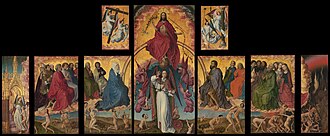 最後の審判 - Rogier van der Weyden (1443)
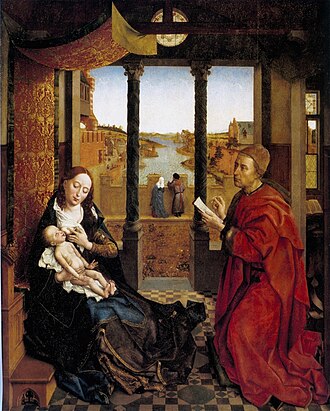 聖母を描く聖ルカ - Rogier van der Weyden (1490)
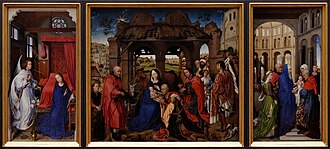 コルンバ祭壇画 - Rogier van der Weyden (1450s)
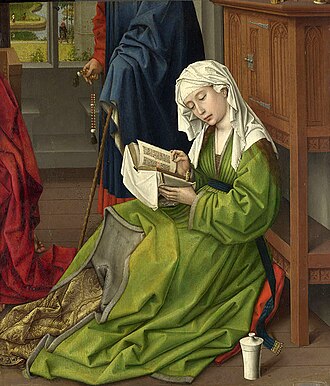 読書するマグダラのマリア - Rogier van der Weyden (1435)
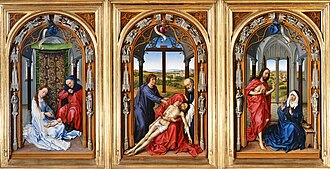 ミラフロレスの祭壇画 - Rogier van der Weyden (1443)
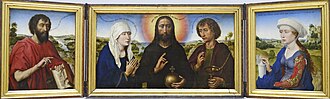 ブラック家の祭壇画 - Rogier van der Weyden (1452)
関連する画家の作品
 アルノルフィーニ夫妻像 - Jan van Eyck (1434)
 ヘントの祭壇画 - Jan van Eyck (1432)
 受胎告知 - Hans Memling (1480s)
 キリストの受難の場面 - Hans Memling (1470)
 快楽の園 - Hieronymus Bosch
 愚者の船 - Hieronymus Bosch (1500s)
 雪中の狩人 - Pieter Bruegel the Elder (1565)
 ネーデルラントの諺 - Pieter Bruegel the Elder (1551)