Penitent Magdalen
エル・グレコ · 1600s
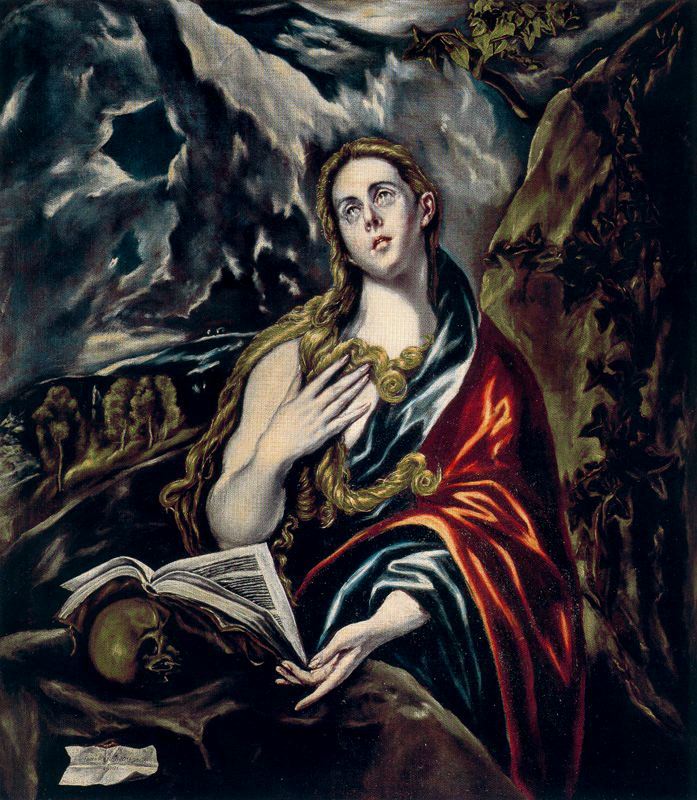
Mary Magdalene sits before a dark cave, one hand on her heart, the other pointing to a skull and a book, while a storm of reddish clouds rolls behind her. In this late version El Greco let the sky itself mirror her inner turmoil.
The story behind the painting
El Greco returned to the Penitent Magdalene again and again. In his catalogue of the painter's works, Harold Wethey distinguished five models of the subject, with only one certain example of each. According to Wethey, this canvas is the prototype of model V, and several copies of it exist. The Spanish Wikipedia article dates it to around 1605 to 1610, while Wikidata gives only the 1600s. It is signed in cursive Greek letters on the paper at the left with the painter's full name, Doménikos Theotokópoulos. Wethey recorded it in the collection of Félix Valdés Izaguirre, and it remains in a private collection.
What to look for
Mary Magdalene is shown as a woman still young and beautiful, but without sumptuous clothes, as befits a hermit. She wears a blue tunic and a red mantle that stand out against the brown rocks. Her shoulder and breast are bare. With her right hand on her chest, she points with her left to the book and the skull resting on a rock at the left. The entrance to the cave is on the right, in a rocky wall where ivy grows. Above her, on the left, is a landscape with threatening clouds in a reddish brown and grey sky, very different from all the earlier versions.
Meaning and intent
The Magdalene of tradition combines three Gospel figures that Pope Gregory the Great recognised as one person: Mary of Bethany, the woman who anointed the feet of Jesus and dried them with her hair, and the woman at the cross who was the first to see him after the Resurrection. The Spanish Counter-Reformation promoted devotion to her as a model of repentance and meditation. Here the folds of her clothes and the blue of her tunic merge with the stormy clouds of the expressionist landscape, as if the cosmos reflected her inner world. Unlike the type III Magdalene in Budapest, she lacks its light eroticism.
Legacy
El Greco here returns to the general scheme of his first versions of the theme, the Worcester and Kansas Magdalenes, types I and II, but without their theatrical and somewhat mannered elegance, and with a quite different human type and emotional atmosphere. With works like this one he entered a new phase that the scholar Álvarez Lopera called one of exaltation and intensification. Five copies are known, of low quality and generally hard to see; one of them, perhaps from the seventeenth century, measures 105 by 80 cm and its whereabouts are unknown. Wethey catalogued the original as number 264.
豆知識
- Prototype of El Greco's type V of the Penitent Magdalene, per Harold Wethey.
- Dated around 1605 to 1610 by Spanish Wikipedia, the 1600s by Wikidata.
- Signed in Greek letters on the paper at the left.
- In a private collection; five weaker copies are known.
画家について
エル・グレコ (1541-1614)
宗教美術 · 女性 · ロングヘア · マグダラのマリア · 本 · ヒトの頭蓋骨 · 肉体の難行
同じ画家の作品: エル・グレコ
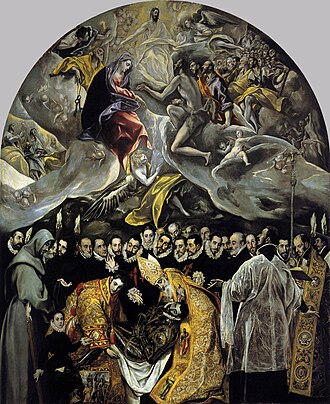 オルガス伯の埋葬 - El Greco (1586)
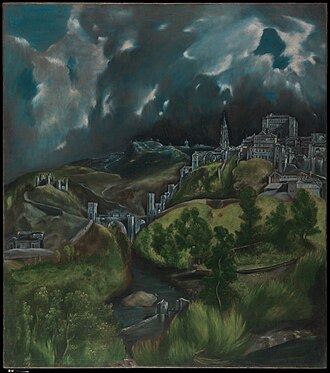 トレドの風景 - El Greco (1596)
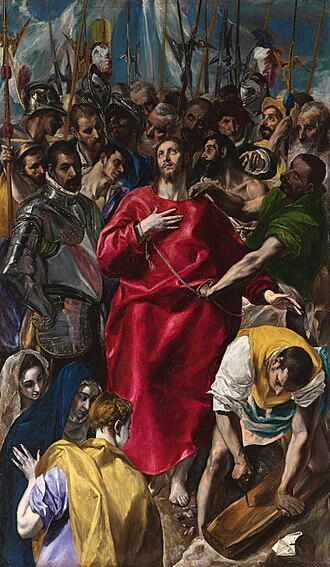 聖衣剥奪 - El Greco (1570s)
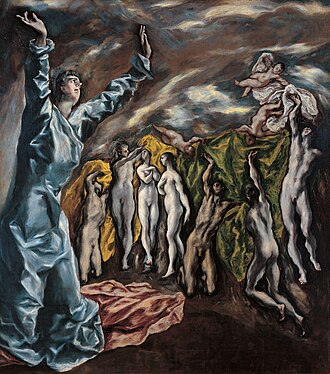 黙示録第5の封印 - El Greco (1610)
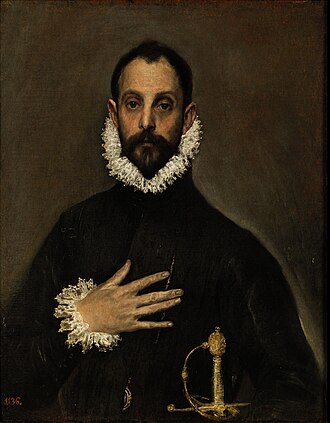 胸に手を置く騎士 - El Greco (1580)
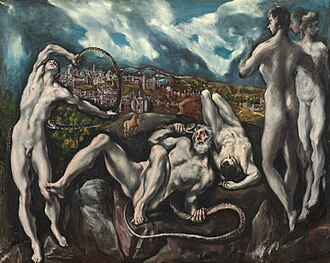 ラオコーン - El Greco (1610s)
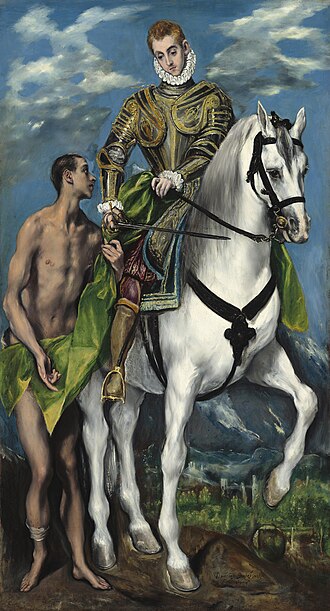 聖マルティヌスと乞食 - El Greco (1597)
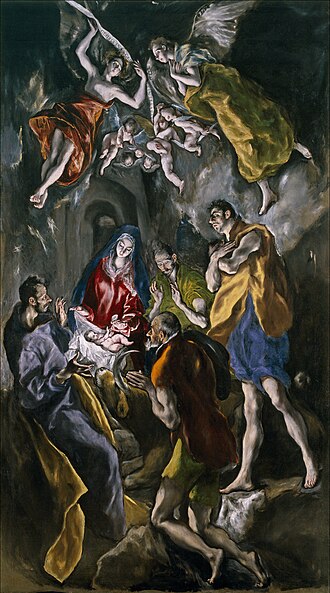 羊飼いの礼拝 - El Greco (1612)
関連する画家の作品
 カナの婚礼 - Paolo Veronese (1560s)
 レヴィ家の饗宴 - Paolo Veronese (1573)
 最後の晩餐 - Jacopo Tintoretto (1563)
 奴隷を解放する聖マルコ - Jacopo Tintoretto (1540s)
 ウルビーノのヴィーナス - Titian (1538)
 聖母被昇天 - Titian (1510s)
 エマオの晩餐 - Caravaggio (1601)
 聖マタイの召命 - Caravaggio (1609)
 大使たち - Hans Holbein the Younger (1533)
 墓の中のキリストの屍 - Hans Holbein the Younger (1520s)