Painted Cross
ジョット・ディ・ボンドーネ · 1315
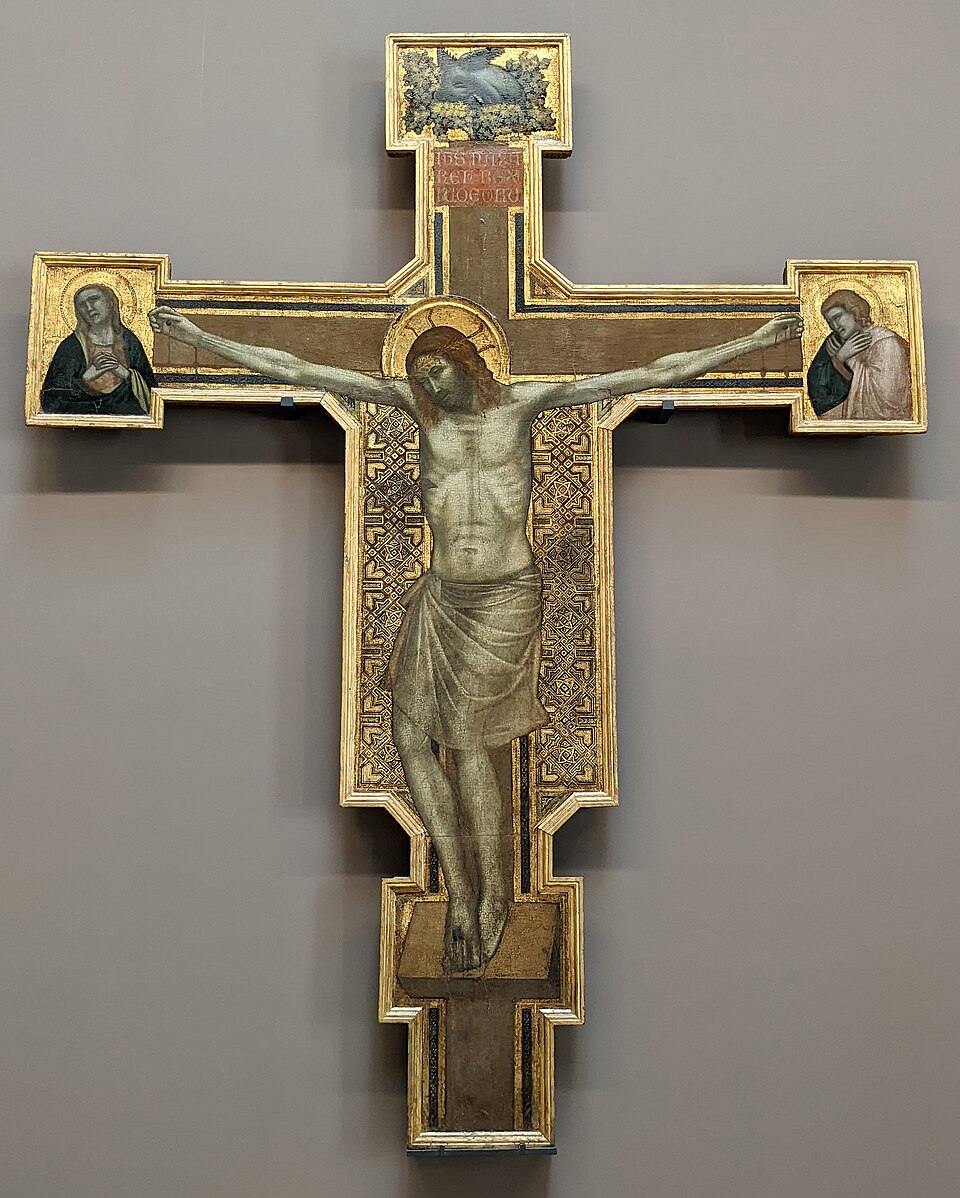
Christ hangs heavy on a cross painted on wood and gold, his head sinking onto his shoulder. Above him, a small pelican wounds itself to feed its young.
The story behind the painting
This large painted crucifix, about 277 by 225 cm according to Wikidata, was made around 1315 in tempera and gold on wood panel. It is attributed to Giotto and his assistants, but the source is careful: its several attributions make the link to Giotto himself uncertain, and it is less distinctive in style than his crucifix in Santa Maria Novella, where Christ's body sways more. The cross came to France when the collections of the Marquis Campana were bought in 1861 under Napoleon III, and it has belonged to the Louvre in Paris since 1862.
What to look for
The cross follows the monumental type of its time. Christ is shown dolens, suffering: the body sags, the belly pushes forward above the loincloth, the head bends forward to touch the shoulder, the ribs stand out, the wounds bleed, and the feet are placed one over the other. Behind his body runs a background of engraved patterns on gold. At the ends of the arms are small panels, called tabelloni: the Virgin Mary on the left and Saint John the Apostle on the right. At the top, under the inscription, is a panel with the pelican sacrificing itself to feed its young.
Meaning and intent
Such crosses were meant to be seen and shared by a community, and this one was intended for processions, carried through the streets above the faithful. Its imagery speaks plainly about sacrifice. The pelican, believed to feed its young with its own blood, mirrors the suffering Christ below it. Mary and John, his mother and his closest disciple, keep watch from the sides as the two witnesses of the Crucifixion. At the foot of the cross there would usually be a panel with Adam's tomb and skull; here it is missing, perhaps lost, so the cross ends without that final reminder.
Legacy
Because its authorship is debated, this crucifix is a useful lesson in how art historians work: they compare details of style, such as the more restrained pose of this Christ against the version in Florence, and remain honest when certainty is impossible. Whatever share Giotto's own hand had, the cross shows the workshop's way of giving the suffering body weight and gravity. Its journey, from a processional object in Italy to the Campana collection and finally the Louvre, also tells the story of how such sacred works became museum treasures, now seen up close by visitors from around the world.
豆知識
- Tempera and gold on wood, around 1315
- Attributed to Giotto and assistants; attribution uncertain
- In the Louvre since 1862, from the Campana collection bought in 1861
- Wikidata size: 277 x 225 cm
画家について
ジョット・ディ・ボンドーネ (1267-1337)
宗教美術 · 男性 · イエス・キリスト · ルーヴル美術館絵画部門 · 光背
同じ画家の作品: ジョット・ディ・ボンドーネ
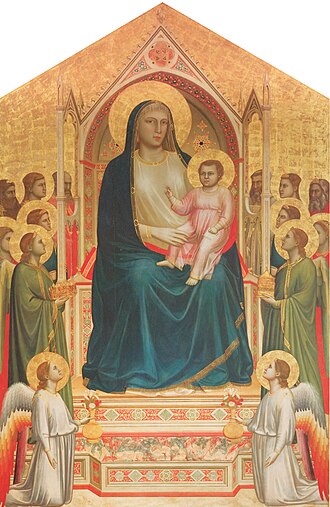 オンニサンティの聖母 - Giotto (1300s)
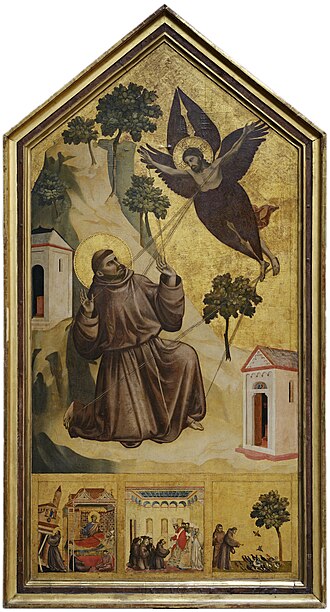 聖痕を受けるフランチェスコ - Giotto (1290s)
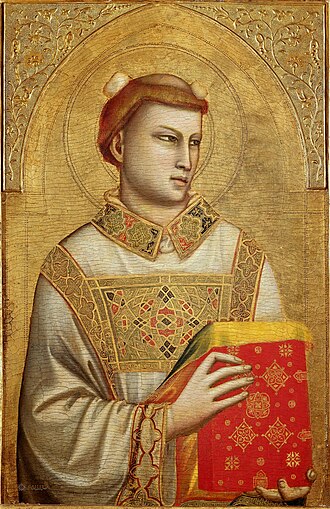 聖ステファノ - Giotto (1320)
 磔刑 - Giotto (1315)
 バディア多翼祭壇画 - Giotto (1300s)
 磔刑 - Giotto (1310s)
 Coronation of Mary with Angels and Saints - Giotto (1328)
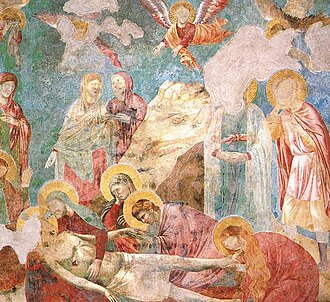 Scenes from the New Testament: Lamentation - Giotto (1291)