Scenes from the New Testament: Lamentation
ジョット・ディ・ボンドーネ · 1291
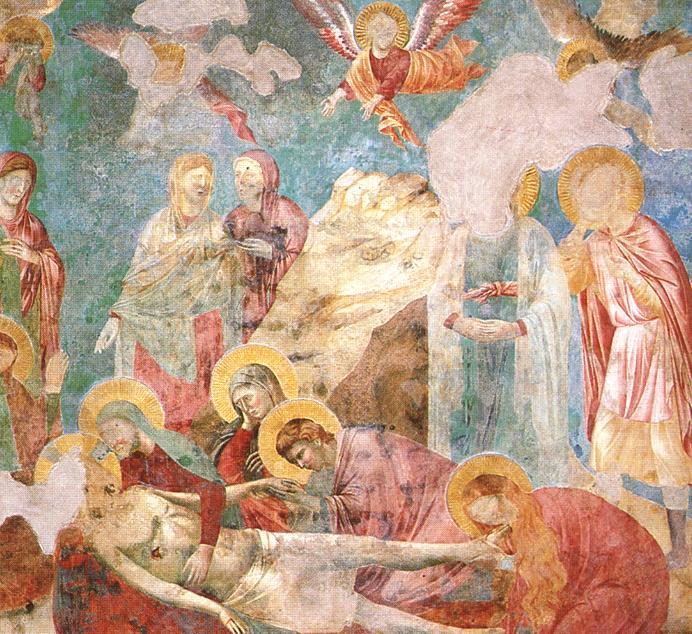
High on a wall of the basilica at Assisi, women bend over the body of Christ while angels fly above them. Time has taken Christ's head from the plaster, yet the grief of the mourners still reaches us.
The story behind the painting
This fresco is in the upper church of the Basilica of San Francesco in Assisi, in the upper part of the left wall, in the fourth bay. Its Italian title, Deposizione dalla croce, and the French Wikipedia name it a Deposition, while Wikidata lists it as a Lamentation, part of the Scenes from the New Testament. The attribution is not settled: it is given to Giotto di Bondone, though Pietro Cavallini has also been proposed. It is dated to around 1291-1295; Wikidata gives 1291. The source notes that the strong expressiveness of the figures and the solid spacing of the scene argue in favour of the young Giotto.
What to look for
In the foreground lies the body of Christ. Around him are the three Marys, prostrate in mourning, with Saint John the apostle, and Mary Magdalene, who holds Jesus up. Behind them rise other figures against a mountainous background: a veiled woman, two other female figures and two haloed figures. Above, four angels fly. The fresco is large, about three metres square according to Wikidata. Sadly it is in poor condition. Part of the plaster has come away, and with it the head of Christ and two figures on the right have been lost. What remains asks us to imagine what is missing.
Meaning and intent
The scene is the moment after the Crucifixion, when those closest to Jesus gather around his body. The painter's interest lies in human feeling. The mourners lie low beside him, and the Magdalene supports him in her arms; even the angels above share in the sorrow. Placed in a church dedicated to Saint Francis, a sequence of New Testament scenes like this one would have invited worshippers to remember Christ's suffering and to share the grief of his friends. The loss of Christ's head, though an accident of time, now leaves the grief of the living at the centre of what we see.
Legacy
Scholars value this fresco for what it may reveal about the beginnings of Giotto. The question of who painted it is still open. The French source places this work with the young Giotto because of its expressive intensity and the solidity of its figures in space, while recording the alternative name of Cavallini. For visitors who look up from the nave, it is a damaged but moving witness to that moment, a scene of mourning painted more than seven hundred years ago.
豆知識
- Fresco in the upper church of San Francesco, Assisi, fourth bay of the left wall
- Dated about 1291-1295 (Wikidata: 1291)
- Attributed to Giotto; Pietro Cavallini has also been proposed
- Plaster loss has destroyed Christ's head and two figures on the right
画家について
ジョット・ディ・ボンドーネ (1267-1337)
同じ画家の作品: ジョット・ディ・ボンドーネ
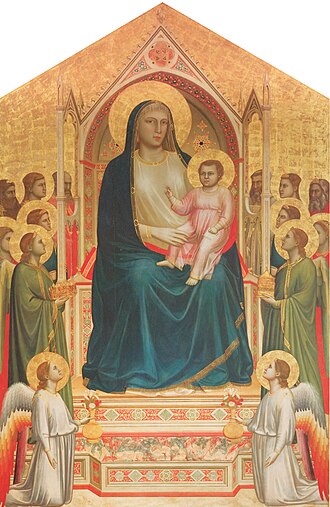 オンニサンティの聖母 - Giotto (1300s)
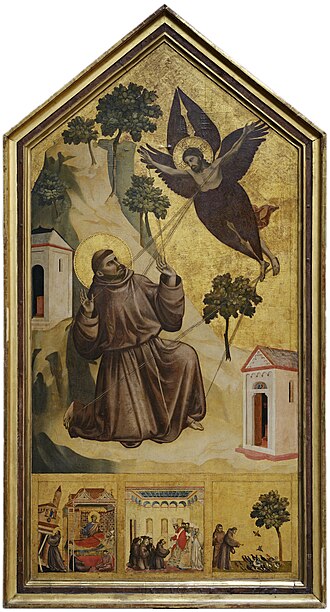 聖痕を受けるフランチェスコ - Giotto (1290s)
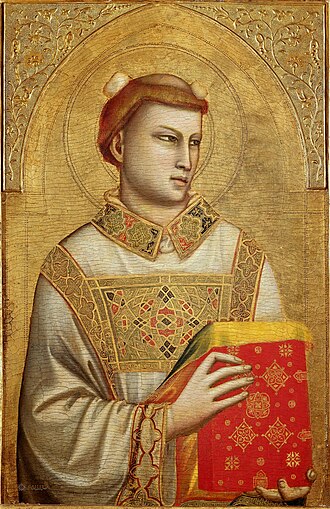 聖ステファノ - Giotto (1320)
 磔刑 - Giotto (1315)
 バディア多翼祭壇画 - Giotto (1300s)
 磔刑 - Giotto (1310s)
 Coronation of Mary with Angels and Saints - Giotto (1328)
 聖母子 - Giotto (1295)