バディア多翼祭壇画
ジョット・ディ・ボンドーネ · 1300s
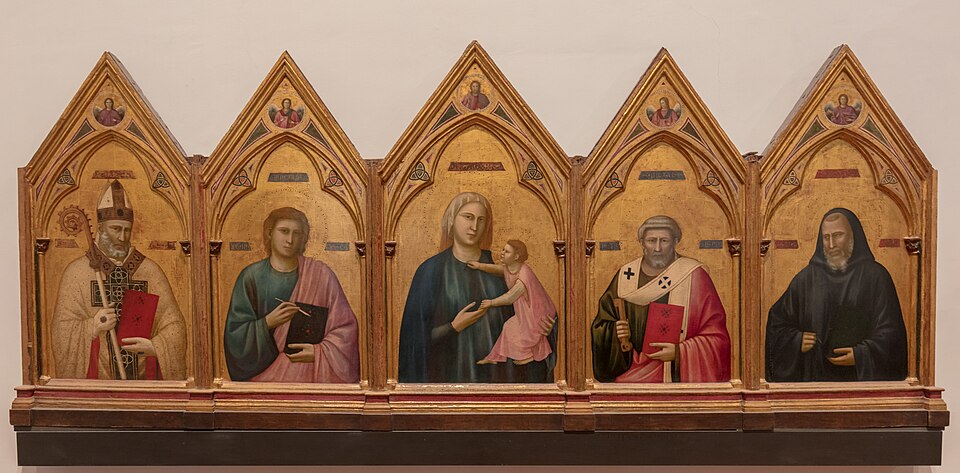
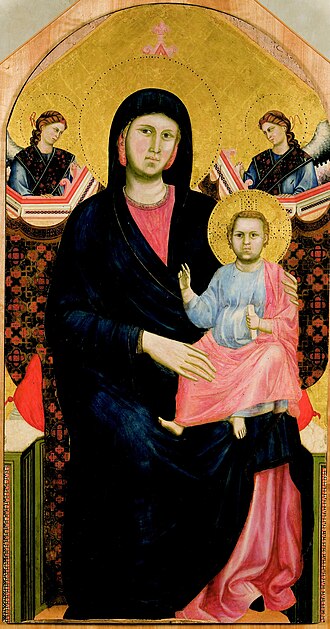
Five gold-pointed panels, five half-length figures, and a child reaching for his mother's neckline: Giotto's Badia Polyptych was lost for centuries before a chance sighting during wartime helped tell its story.
The story behind the painting
Giotto painted this polyptych around 1300 for the high altar of the Badia Fiorentina, the ancient abbey church of Florence. Lorenzo Ghiberti in his Commentarii and Giorgio Vasari in his Lives both mention a polyptych by Giotto there. Yet for centuries the work went undocumented and was considered lost. In the nineteenth century it turned up in the stores of the Museum of Santa Croce in Florence, identified by a cartouche reading Badia di Firenze that had been added in 1810. Then in 1940, as artworks were being hidden for safety during the Second World War, Ugo Procacci saw it being carried out of Santa Croce. He reasoned that it had been taken from the Badia during the Napoleonic occupation and mistakenly installed at Santa Croce.
What to look for
The work is made of five framed panels, each topped by a triangular point. At the centre is the Virgin Mary, shown half-length with the Child. To the left and right stand, in order, Saint Nicholas of Bari, Saint John the Evangelist, Saint Peter and Saint Benedict, each named beneath and recognisable by traditional attributes. Look closely at the details the source singles out: the rich garments and crosier of Saint Nicholas, the stole of Saint Peter, and above all the gesture of the Child grasping at his mother's neckline, a tender, human touch. Notice too how Giotto uses light and shade, chiaroscuro, to give the figures weight against their frames.
Meaning and intent
These details matter to scholars because they help with dating, which remains disputed. Proposals range from the early fourteenth century to a time after Giotto's frescoes in the Scrovegni Chapel. Similar details appear in Giotto's Rimini Crucifix and his Stigmata of Saint Francis, and these comparisons have led to a fourteenth-century date; Wikidata gives the 1300s. The choice of saints also speaks to its home: Saint Benedict, at the far right, fits a panel made for an abbey. The Child's small gesture shows Giotto's interest in making holy figures feel close and real.
Legacy
Procacci's sighting led to more than one discovery. He realised the altarpiece was too large for the Badia's existing altar, and found that a renovation in 1628 had moved the altar's position, which in turn led him to uncover a hidden fresco in the Badia. The polyptych was restored in 1958, when layers of overpaint and a later top hiding the pointed gables were removed. It survived the Arno flood of 1966 and was restored again in 2000. Today it hangs in the Uffizi Gallery in Florence, a 91 by 334 centimetre reminder that masterpieces can be lost and found again.
豆知識
- Painted around 1300; dating is disputed.
- Rediscovered in the 19th century at Santa Croce, Florence.
- Size: 91 x 334 cm.
- Uffizi Gallery, Florence.
画家について
ジョット・ディ・ボンドーネ (1267-1337)
女性 · 宗教美術 · 聖母マリア · 少年 · イエスの幼少時代 · ウフィツィ美術館
同じ画家の作品: ジョット・ディ・ボンドーネ
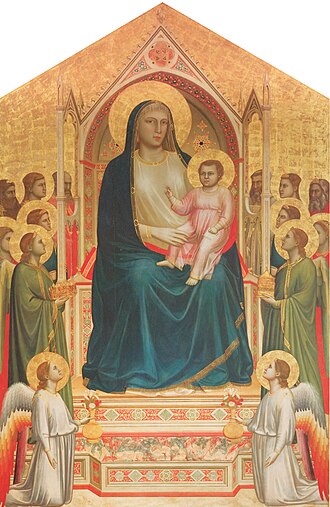 オンニサンティの聖母 - Giotto (1300s)
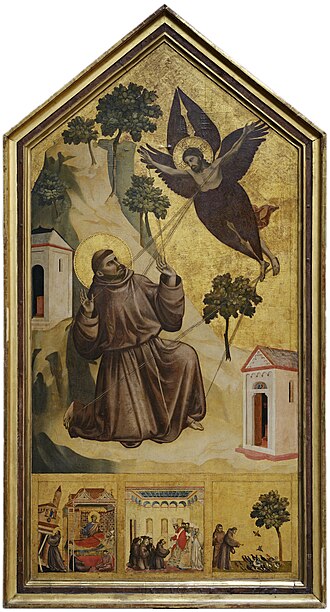 聖痕を受けるフランチェスコ - Giotto (1290s)
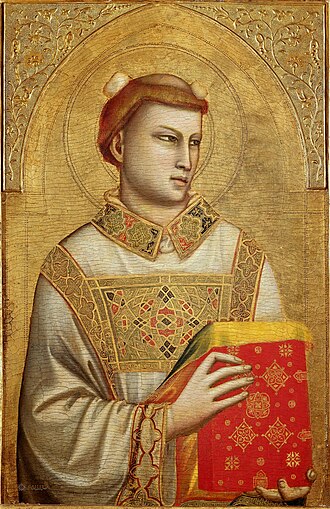 聖ステファノ - Giotto (1320)
 磔刑 - Giotto (1315)
 磔刑 - Giotto (1310s)
 Coronation of Mary with Angels and Saints - Giotto (1328)
 Scenes from the New Testament: Lamentation - Giotto (1291)
 聖母子 - Giotto (1295)