読書
Francisco Goya · 1819
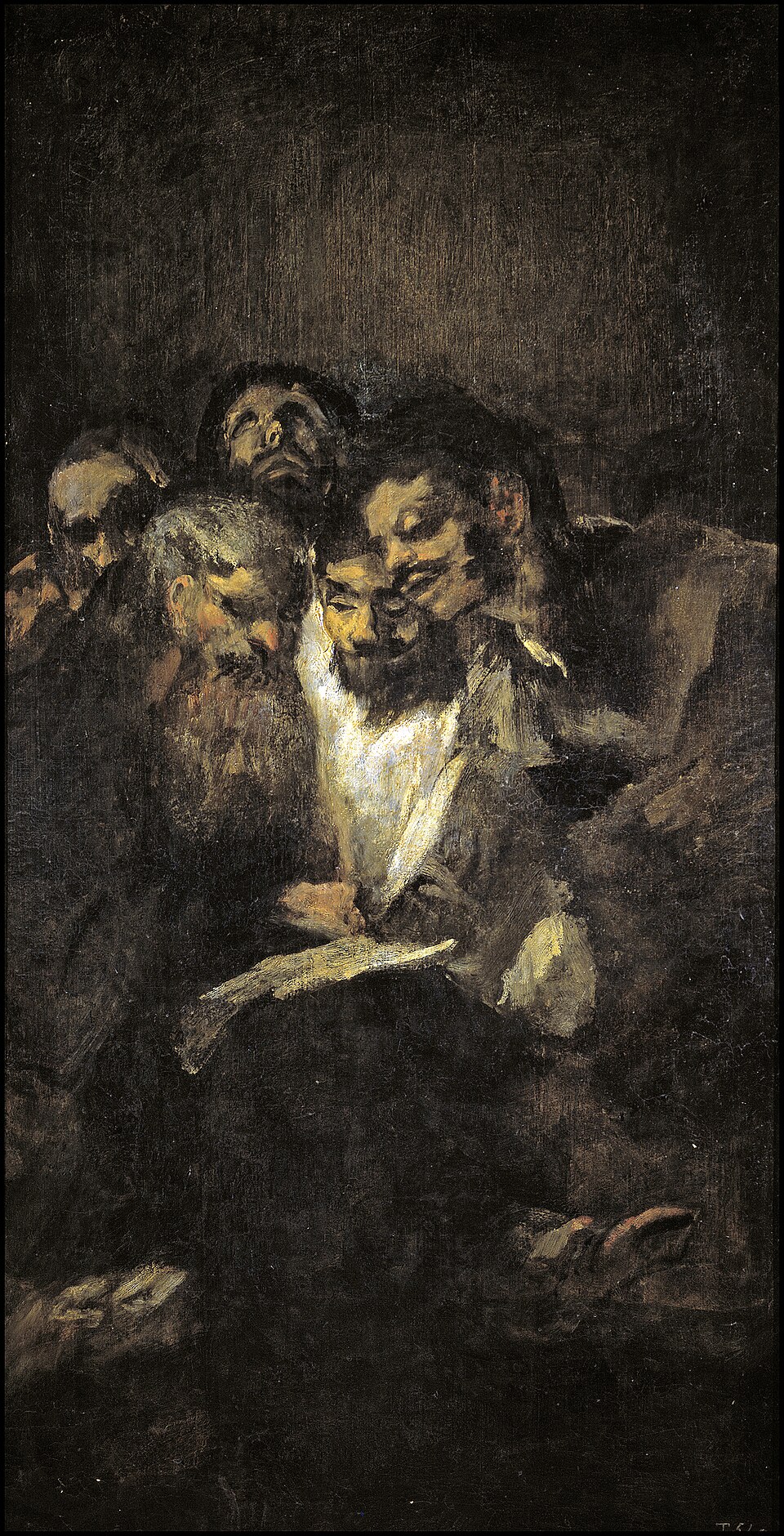
Six men press their heads together over a single printed page, lit from above in the dark. Goya painted them straight onto the wall of his own house, as one of the Black Paintings he never meant to show anyone.
The story behind the painting
Late in life, living alone outside Madrid in physical pain, spiritual torment and disillusionment with the political direction of Spain, Goya covered the walls of the Quinta del Sordo, the House of the Deaf Man, with fourteen bleak frescoes. Men Reading, also called The Reading or Politicians, is one of them. Wikipedia says it was likely completed between 1820 and 1823, while the museum date recorded on Wikidata is 1819. In 1873 and 1874 the murals were transferred to canvas under the supervision of Salvador Martinez Cubells, a curator at the Prado.
What to look for
Look at how tightly the six men are huddled, all eyes drawn to the page resting in the lap of the seated central figure. The light falls from the upper left, exactly as in its companion piece Women Laughing. Both pictures are vertical and smaller than the other Black Paintings, less dark in theme but darker in colour. X-rays show Goya changed a great deal: a landscape with a mounted rider once filled the background, and the central figure in white at one point had large horns, or perhaps bird wings, growing from his head.
Meaning and intent
No one knows for certain who these men are. They are often thought to be politicians reading and commenting on a newspaper article about themselves. Goya most likely placed the work on a smaller wall on the first floor of the house, beside Women Laughing and opposite The Dog and Two Old Men Eating Soup. The writer Francisco-Xavier de Salas Bosch linked the pair: the endless talk of the politicians was perhaps, in Goya's eyes, as sterile as the solitary act the laughing women mock in the companion picture.
Legacy
The owner of the murals, Baron Emile d'Erlanger, donated them to the Spanish state in 1881, and they are now shown at the Prado in Madrid. Studying the X-rays, the art historian Carmen Garrido found a large white lead impasto at the centre of the image, starting at the head of the man looking upwards. She noted that this area has neither the texture nor the usual structure of Goya's authentic brushstrokes, a finding that keeps scholars looking closely at how these private walls became museum pictures.
豆知識
- One of Goya's 14 Black Paintings, made for the walls of his house near Madrid.
- Transferred from wall to canvas in 1873-1874.
- Donated to the Spanish state in 1881, now in the Prado.
- X-rays reveal a rider and a horned or winged figure painted over.
画家について
Francisco Goya (1746-1828)
同じ画家の作品: Francisco Goya
 1808年5月3日 - Francisco Goya (1814)
 裸のマハ - Francisco Goya (1800)
 我が子を食らうサトゥルヌス - Francisco Goya (1819)
 カルロス4世の家族 - Francisco Goya (1800)
 着衣のマハ - Francisco Goya (1800)
 1808年5月2日、エジプト人親衛隊との戦闘 - Francisco Goya (1814)
 犬 - Francisco Goya (1819)
 魔女の夜宴 - Francisco Goya (1820s)
関連する画家の作品
 雲海の上の旅人 - Caspar David Friedrich (c. 1818)
 楡の木のある僧院 - Caspar David Friedrich (1800s)
 民衆を導く自由の女神 - Eugène Delacroix (1830)
 サルダナパールの死 - Eugène Delacroix (1827)
 戦艦テメレール号 - J. M. W. Turner (1839)
 雨、蒸気、速度 - グレート・ウェスタン鉄道 - J. M. W. Turner (1844)
 青衣の少年 - Thomas Gainsborough (1770)
 アンドリューズ夫妻 - Thomas Gainsborough (1748)