自慰する男を嘲る二人の女
Francisco Goya · 1819
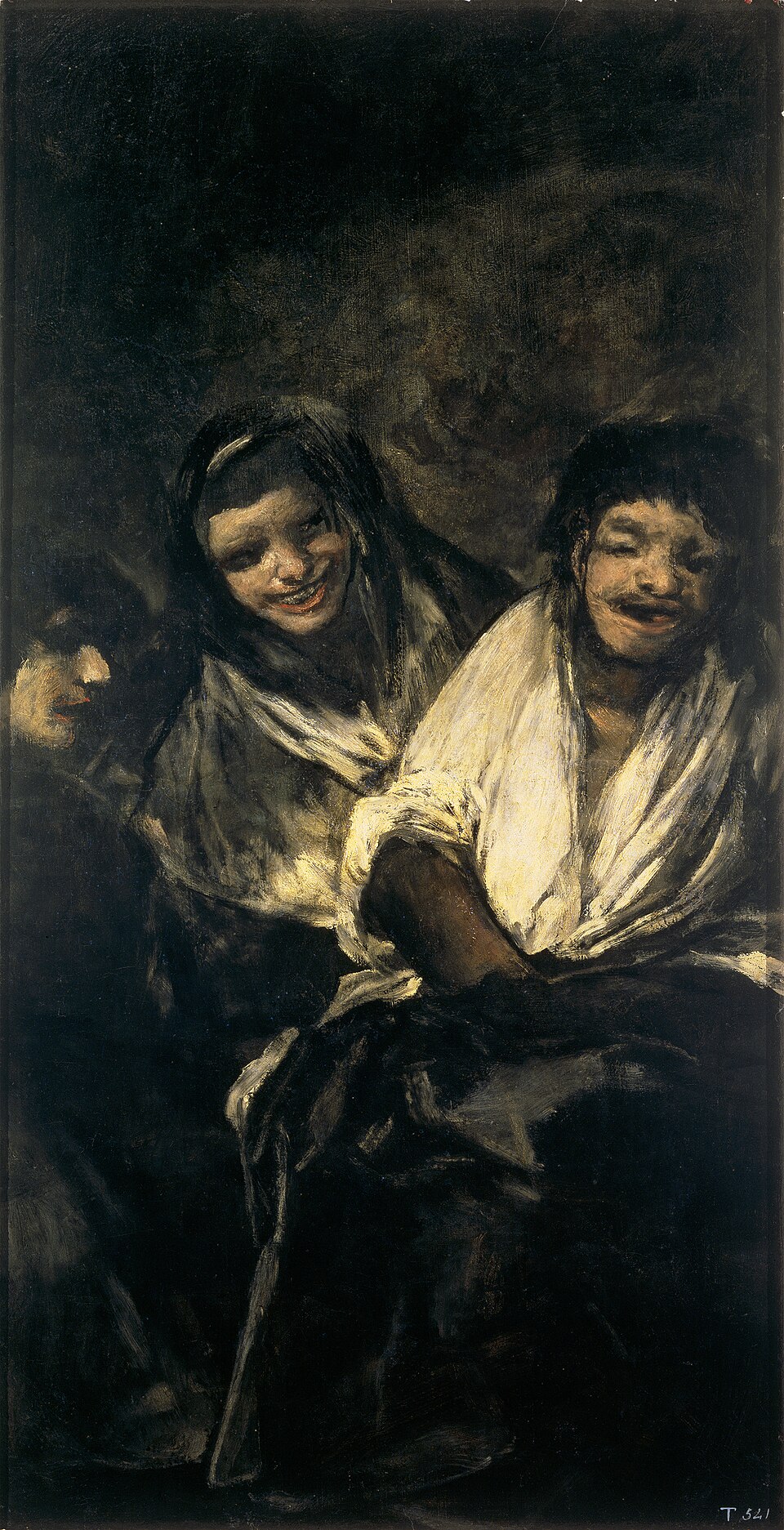
Two women with wide, sinister grins leer at a man with a sickly smile, all three huddled against pure black. Goya painted this on the wall of his own house and never said a word about it.
The story behind the painting
The work is one of Goya's fourteen Black Paintings, painted in oil directly onto the plaster walls of his house, the Quinta del Sordo outside Madrid. Goya was then about 75, living alone in mental and physical despair, and he never meant these works to be seen or spoke or wrote about them. Wikipedia dates the painting probably between 1820 and 1823, while Wikidata gives 1819. It is known by several names: Man Mocked by Two Women, Women Laughing, or Two Women and a Man.
What to look for
Three figures crowd together against a black background, lit from the front left, with no setting or detail around them. The man on the right faces us, his hands at his crotch, and the critic Fred Licht saw sexual compulsion in his grin. The two women, likely prostitutes, mock him with broad smiles. As in the whole series, Goya began with thick black and drew the figures in whites, greys, blues and greens with broad slashing strokes. X-rays show the hand was moved, and an earlier version may have shown the women reading a book on a man's knees. It measures about 125 by 66 cm.
Meaning and intent
Its meaning is very obscure. Some critics think the hidden lower part conceals that the woman on the left is also masturbating, which would make the scene futile and sterile. Licht saw possible self-mockery, comparing the lonely exhibitionist with the artist who also bares himself and is condemned as an aberration. He also noted that Goya, unflinching about humanity, was often reserved in depicting sex. Goya himself left no comment on it.
Legacy
According to the inventory of Goya's friend Antonio Brugada, around 1828 to 1830, the painting faced Men Reading on the smaller walls of the upper floor; both are vertical and smaller than the others. Around 1874, some fifty years after Goya's death, the Black Paintings were taken off the walls and transferred to canvas. They are now in the Museo del Prado in Madrid and count among his most important works.
豆知識
- One of the fourteen Black Paintings.
- Painted directly on the walls of the Quinta del Sordo.
- Probably 1820-1823; Wikidata gives 1819.
- Transferred to canvas around 1874, now in the Prado.
画家について
Francisco Goya (1746-1828)
同じ画家の作品: Francisco Goya
 1808年5月3日 - Francisco Goya (1814)
 裸のマハ - Francisco Goya (1800)
 我が子を食らうサトゥルヌス - Francisco Goya (1819)
 カルロス4世の家族 - Francisco Goya (1800)
 着衣のマハ - Francisco Goya (1800)
 1808年5月2日、エジプト人親衛隊との戦闘 - Francisco Goya (1814)
 犬 - Francisco Goya (1819)
 魔女の夜宴 - Francisco Goya (1820s)
関連する画家の作品
 雲海の上の旅人 - Caspar David Friedrich (c. 1818)
 楡の木のある僧院 - Caspar David Friedrich (1800s)
 民衆を導く自由の女神 - Eugène Delacroix (1830)
 サルダナパールの死 - Eugène Delacroix (1827)
 戦艦テメレール号 - J. M. W. Turner (1839)
 雨、蒸気、速度 - グレート・ウェスタン鉄道 - J. M. W. Turner (1844)
 青衣の少年 - Thomas Gainsborough (1770)
 アンドリューズ夫妻 - Thomas Gainsborough (1748)