立位の聖母
ロヒール・ファン・デル・ウェイデン · 1430
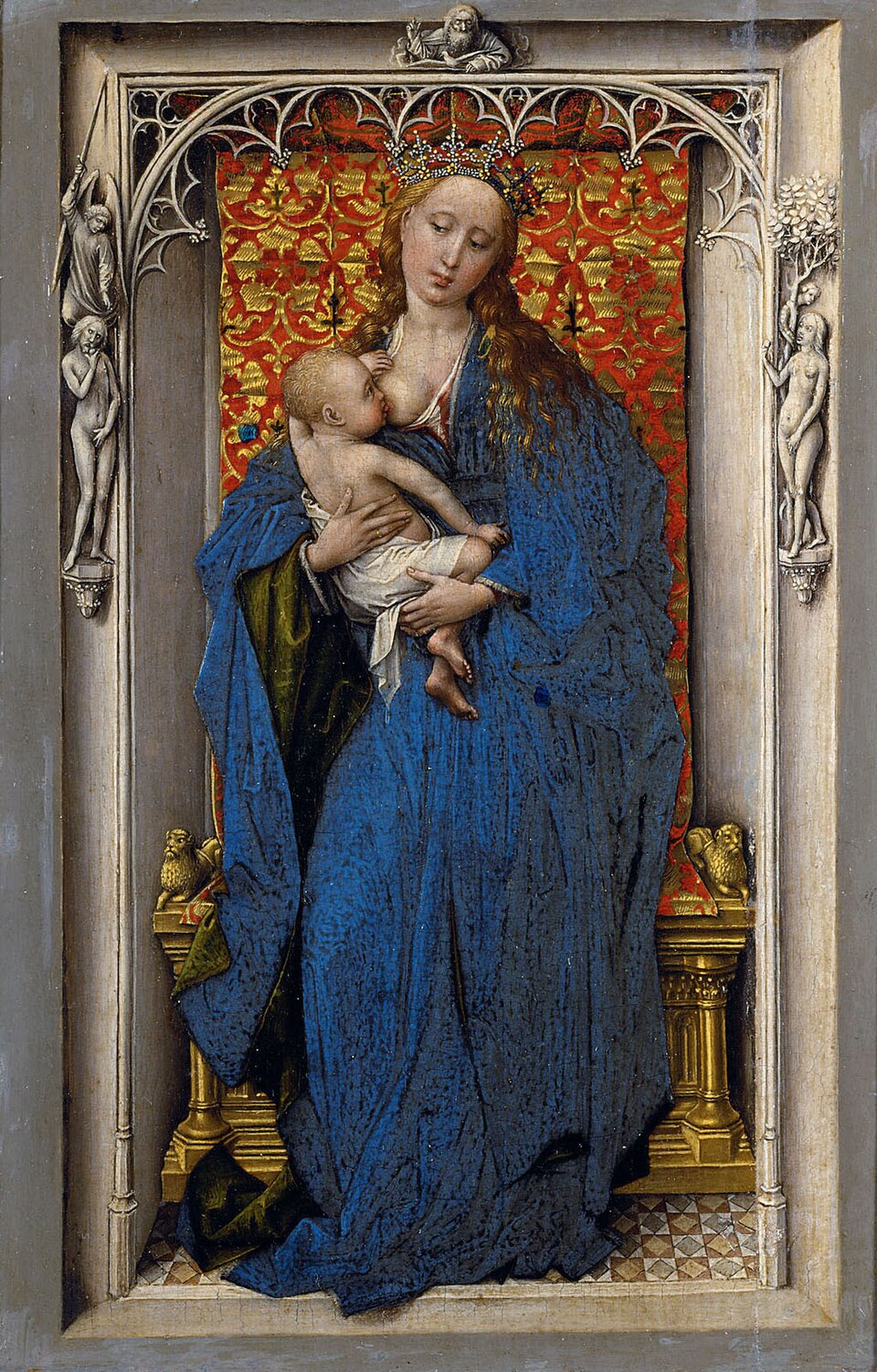
Smaller than a sheet of paper, this panel holds a crowned mother nursing her child inside a carved niche, with God, Adam and Eve in stone grey around her. It may be the work of a young Rogier who had just seen the Ghent Altarpiece.
The story behind the painting
The Madonna Standing, also called Madonna al latte, is a tiny painting by the Flemish artist Rogier van der Weyden dated about 1430 to 1432; Wikidata gives 1430 and a size of only 12.1 by 18.9 cm. It is the left panel of a diptych that has been in the Kunsthistorisches Museum in Vienna since 1772. The right panel shows Saint Catherine. The museum also attributes it to van der Weyden, but it is weaker in quality and generally thought to be by a workshop member. With the Virgin and Child Enthroned, this panel is usually cited as one of Rogier's earliest known works.
What to look for
Mary stands with the Child in a painted niche, between the rich brocade of a throne behind and a delicate curtain of tracery in front. Erwin Panofsky saw this flattening of space into a kind of relief as already unmistakably Rogier's. She wears a crown as Queen of Heaven, and her robe is blue. The Child, nursing at her breast, wears only a white linen cloth. Around the niche, figures in grisaille, painted to look like stone: God the Father at the top, leaning forward in blessing with a hand on the frame, the dove of the Holy Spirit, and Adam and Eve on either side, Eve eating the forbidden fruit beside a serpent with a human head.
Meaning and intent
This is a Madonna Lactans, the nursing Virgin. The blue robe may allude to Mary's devotion and fidelity to her son, and the linen cloth foreshadows the shroud used after the Deposition. Adam and Eve refer to the Fall and so to the Redemption that the Child brings. Lions on the armrests show that Mary stands before the Throne of Solomon, recalling the Seat of Wisdom tradition, as in Jan van Eyck's Lucca Madonna. By painting the surrounding figures as grey stone, Rogier separates the living, in flesh tones, from the divine and the past, frozen in time as imitation sculpture.
Legacy
The panel shows clear debts to Jan van Eyck's Ghent Altarpiece: a living figure in a niche, Adam and Eve split apart, and God leaning on the frame like the prophet Micah. Scholars disagree on the date. Panofsky thought Rogier painted it while still in Robert Campin's workshop. John Ward suggests he made it after leaving Campin and travelling to Ghent, where he likely saw the altarpiece, signed and dated 6 May 1432. Karl Birkmeyer notes that documents show Rogier left Campin only on 1 August 1432, and argues that he absorbed van Eyck's motifs into his own language, refined later in the Duran Madonna.
豆知識
- Dated about 1430-1432; one of Rogier's earliest known works.
- Left panel of a diptych in Vienna since 1772.
- Grisaille figures of God, Adam and Eve frame the nursing Virgin.
- Borrows motifs from van Eyck's Ghent Altarpiece of 1432.
画家について
ロヒール・ファン・デル・ウェイデン (1390s-1464)
宗教美術 · 聖母マリア · イエスの幼少時代 · 初期フランドル派 · 天使 · 美術史美術館
同じ画家の作品: ロヒール・ファン・デル・ウェイデン
 十字架降架 - Rogier van der Weyden (1440s)
 女性の肖像 - Rogier van der Weyden (1460)
 最後の審判 - Rogier van der Weyden (1443)
 聖母を描く聖ルカ - Rogier van der Weyden (1490)
 コルンバ祭壇画 - Rogier van der Weyden (1450s)
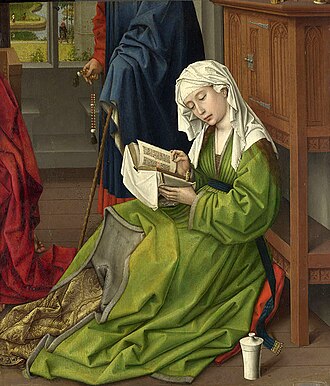 読書するマグダラのマリア - Rogier van der Weyden (1435)
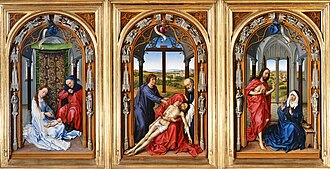 ミラフロレスの祭壇画 - Rogier van der Weyden (1443)
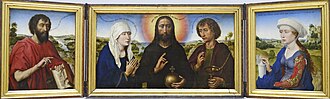 ブラック家の祭壇画 - Rogier van der Weyden (1452)
関連する画家の作品
 アルノルフィーニ夫妻像 - Jan van Eyck (1434)
 ヘントの祭壇画 - Jan van Eyck (1432)
 受胎告知 - Hans Memling (1480s)
 キリストの受難の場面 - Hans Memling (1470)
 快楽の園 - Hieronymus Bosch
 愚者の船 - Hieronymus Bosch (1500s)
 雪中の狩人 - Pieter Bruegel the Elder (1565)
 ネーデルラントの諺 - Pieter Bruegel the Elder (1551)