草上の昼食
Claude Monet · 1866
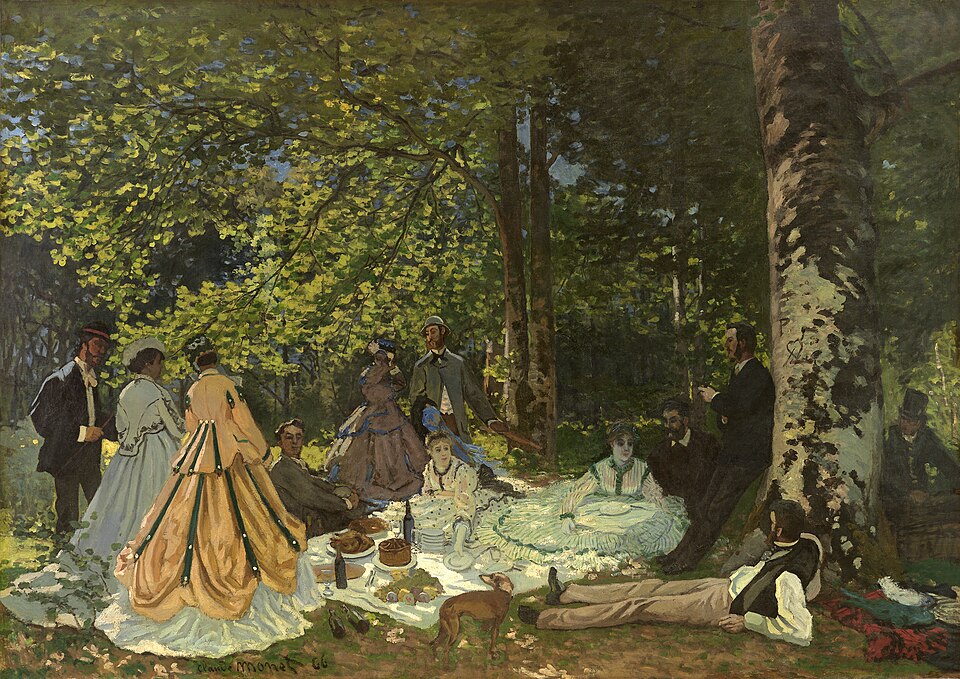
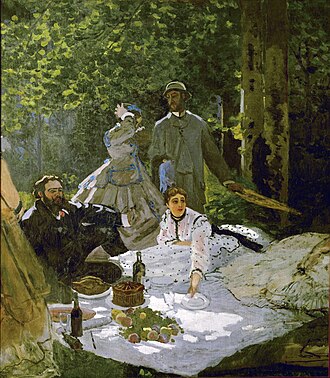
Twelve Parisians picnic under a tree, sunlight breaking through the leaves. Monet's giant answer to Manet was cut into pieces, but this smaller Moscow version still shows the whole picnic as he imagined it.
The story behind the painting
Monet worked on Le Déjeuner sur l'herbe in 1865 and 1866, in response to Édouard Manet's painting of the same title from 1863. He wanted to send it to the Salon of 1866, but he underestimated how long it would take to transfer his sketches to a life-size canvas, and it was unfinished in time. He later gave the large canvas to his landlord in place of rent. When he bought it back, it was badly damaged by damp, and he had to cut it up to save the good parts. Two large fragments are now in the Musée d'Orsay, while this smaller 1866 version is in the Pushkin Museum in Moscow.
What to look for
Twelve people dressed in the Parisian fashion of the day gather around a white cloth near a forest glade, with fruit, cake and wine. The mood comes from the play of light and shadow under the deciduous tree above them. Monet liked light-toned priming to make his pictures glow, and John House compared the lighting to the sparkling light effects of nature, unlike the studio light of Manet's picture. Look for the bright accents of the dress on the left, which André Dombrowski called an unnatural visual siren, and the bold brushwork with large patches of light. Monet painted Courbet here, and his friend Bazille appears four times.
Meaning and intent
Monet's aim differed from Manet's. Joel Isaacson notes that, according to Émile Zola, every painter's dream then was to put life-size figures in a landscape, and that Monet wanted a contemporary, objective picnic without the artificial touches of Manet's version. John House writes that he looked for freshness and immediacy through an informal grouping. Mary Gedo believes Monet did not mean homage but wanted to show his vision was superior. Isaacson also sees Manet's Music in the Tuileries behind the picture, and Gedo suggests Courbet's The Hunt Breakfast. Stephan Koja says the style was meant to make the scene feel entirely of the present.
Legacy
This version was long seen as a preparatory sketch, but the Pushkin Museum now says it is probably a later repetition of the finished work, given its careful detail and the artist's signature. It belonged for a time to the opera singer Jean-Baptiste Faure and may have been shown at Monet's 1900 exhibition at the Durand-Ruel Gallery. Sergei Shchukin bought it from the dealer Paul Cassirer between 1901 and 1908. The Soviet state seized his collection in May 1918; the painting went first to the State Museum of New Western Art and, from 1948, to the Pushkin Museum.
豆知識
- Painted by Claude Monet in 1866, after his large unfinished canvas of 1865-1866.
- A response to Manet's Le Déjeuner sur l'herbe of 1863.
- The large canvas was cut up; two fragments are in the Musée d'Orsay.
- In the Pushkin Museum in Moscow since 1948.
画家について
Claude Monet (1840-1926)
同じ画家の作品: Claude Monet
 印象・日の出 - Claude Monet (1872)
 睡蓮 - Claude Monet (1906)
 日傘をさす女 - Claude Monet (1875)
 サン=タドレスのテラス - Claude Monet (1867)
 庭の女たち - Claude Monet (1866)
 かささぎ - Claude Monet (1868)
 庭の女 - Claude Monet (1867)
 草上の昼食 - Claude Monet (1866)
関連する画家の作品
 戦艦テメレール号 - J. M. W. Turner (1839)
 雨、蒸気、速度 - グレート・ウェスタン鉄道 - J. M. W. Turner (1844)
 世界の起源 - Gustave Courbet (1866)
 オルナンの埋葬 - Gustave Courbet (2020)
 草上の昼食 - Édouard Manet (1863)
 オランピア - Édouard Manet (1863)
 ムーラン・ド・ラ・ギャレットの舞踏会 - Pierre-Auguste Renoir (1876)
 舟遊びの昼食 - Pierre-Auguste Renoir (1881)
 ゆりかご - Berthe Morisot (1872)
 Summer's Day - Berthe Morisot (1879)
 アブサントを飲む人 - Edgar Degas (1875)
 The Bellelli Family - Edgar Degas (1858)