Le pêcheur
Édouard Manet · 1862
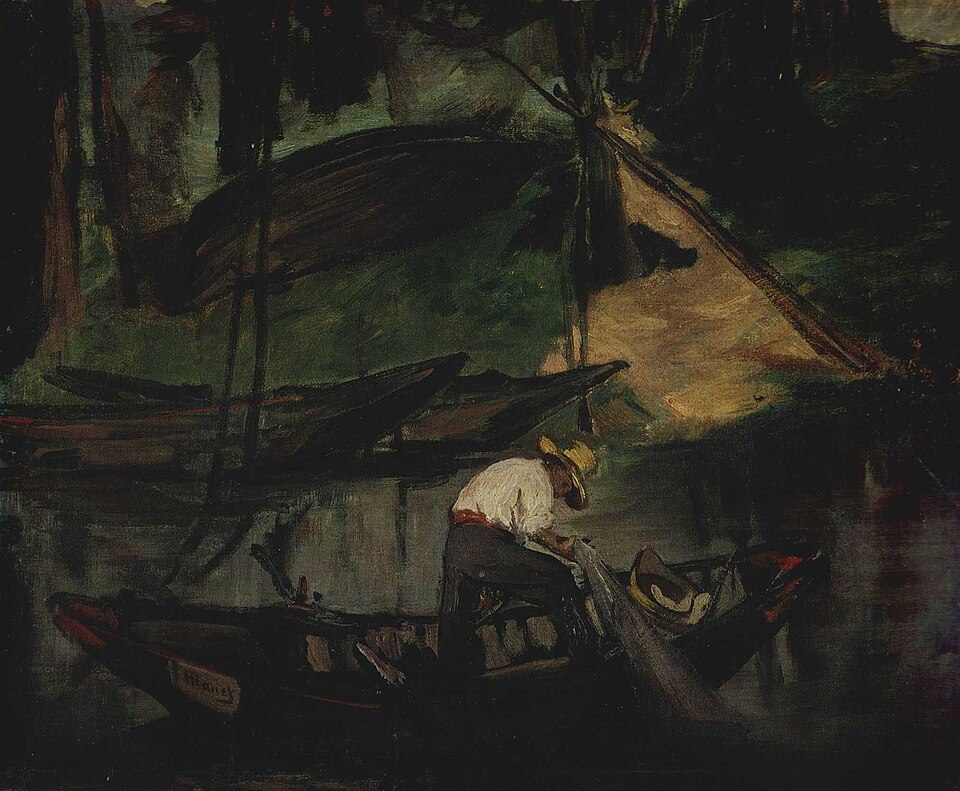
A fisherman leans out of his boat and hauls in a net on the Seine north of Paris. Manet signed the picture on the side of the boat, as if it were the boat's name.
The story behind the painting
Manet painted The Fisherman around 1862, in oil on canvas, 46 by 56 cm. The landscape behind the boat was probably taken from the Seine around the Île Saint-Ouen, north of Paris, an island later joined with others into today's Île Saint-Denis. Manet knew this stretch of river from childhood, because his family had owned land for generations in nearby Gennevilliers, and he had explored it on many outings. In the early 1860s he used the area as a backdrop for several pictures, including The Students of Salamanca and The Surprised Nymph. When he painted The Fisherman, the riverbank was still rural; later decades turned it into town.
What to look for
We look down from a slightly raised point onto a rowing boat that fills almost the whole width of the lower edge. The hull is dark brown with touches of red at bow and stern. On a grey patch on the left side, in black letters like a boat's name, stands the signature Manet. The fisherman, seen from the side, stands on his left leg, braces his right foot against the bow and bends forward to pull the net from the water with his right hand. A wooden tub for the catch waits in front of him, the oars rest behind. He wears long dark grey trousers, a red belt, a white shirt and a yellowish straw hat. The far bank is painted with rough strokes in green, ochre, dark brown and black, and the pale grey water mirrors it.
Meaning and intent
His whole appearance marks him as a working fisherman, not a city dweller fishing for pleasure. The strong contrasts of light and dark and the reduced range of colours are typical of Manet's manner in the early 1860s. Art historians link the picture closely to two other works. Rouart and Wildenstein saw it as preparatory work for Luncheon on the Grass, where a woman standing in the water takes a pose much like the bending fisherman. Others, including Sabine Fehlemann, see it as one of the studies for Fishing in the Metropolitan Museum of Art, where a man in grey trousers and a white shirt also pulls a net from a boat.
Legacy
A pencil drawing coloured with watercolour, also called Fishing and once owned by Camille Pissarro, shows the same bending man in his boat; Anne Coffin Hanson thought it might be a study for the painting, or made afterwards. The canvas was still in Manet's studio when he died in 1883 and was inventoried by Léon Leenhoff. It was auctioned in 1884 under the title Marine and passed through several Paris collections, then through Paul Cassirer's gallery in Berlin to Gottlieb Friedrich Reber. Through Justin Thannhauser it reached Eduard von der Heydt, who lent it to a Manet exhibition in Berlin in 1928 and gave it in 1962 to the Von der Heydt Museum in Wuppertal.
豆知識
- Painted around 1862, oil on canvas, 46 x 56 cm.
- Manet's signature is painted on the boat like a name.
- Linked by scholars to Luncheon on the Grass and to Fishing in New York.
- Given to the Von der Heydt Museum, Wuppertal, in 1962.
画家について
Édouard Manet (1832-1883)
同じ画家の作品: Édouard Manet
 草上の昼食 - Édouard Manet (1863)
 オランピア - Édouard Manet (1863)
 フォリー・ベルジェールのバー - Édouard Manet (1882)
 バルコニー - Édouard Manet (1868)
 テュイルリー公園の音楽会 - Édouard Manet (1862)
 笛を吹く少年 - Édouard Manet (1866)
 鉄道 - Édouard Manet (1873)
 ナナ - Édouard Manet (1877)
関連する画家の作品
 印象・日の出 - Claude Monet (1872)
 睡蓮 - Claude Monet (1906)
 ムーラン・ド・ラ・ギャレットの舞踏会 - Pierre-Auguste Renoir (1876)
 舟遊びの昼食 - Pierre-Auguste Renoir (1881)
 ゆりかご - Berthe Morisot (1872)
 Summer's Day - Berthe Morisot (1879)
 アブサントを飲む人 - Edgar Degas (1875)
 The Bellelli Family - Edgar Degas (1858)
 The Canal du Loing at Moret - Alfred Sisley (1892)
 The Watering Pond at Marly with Hoarfrost - Alfred Sisley (1876)
 パリの通り、雨 - Gustave Caillebotte (1877)
 床削り - Gustave Caillebotte (1875)