カプシーヌ大通り
Claude Monet · 1873
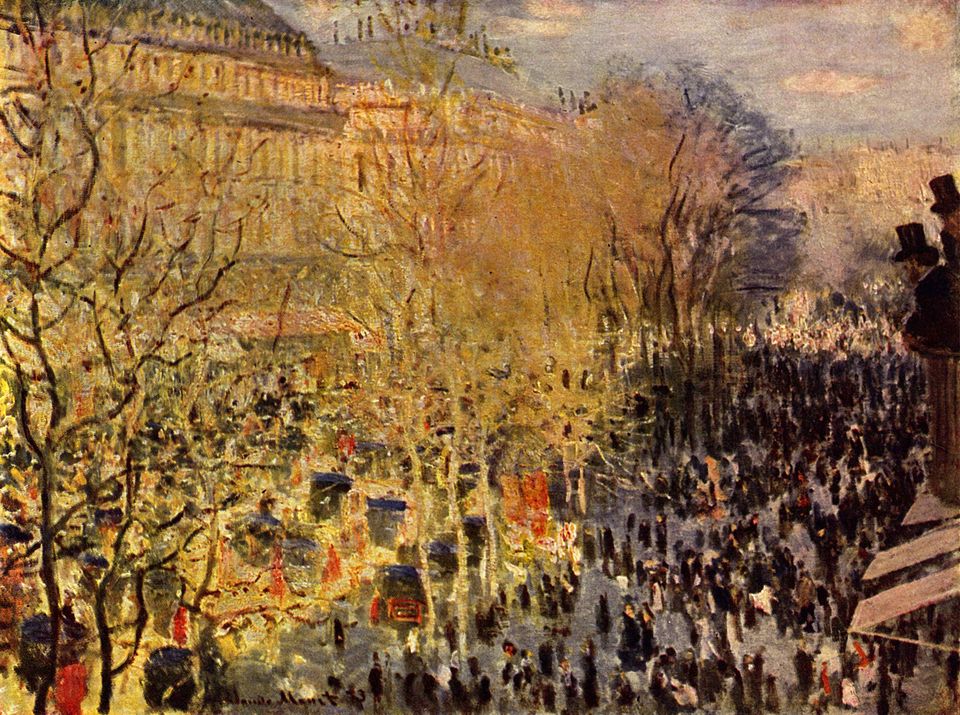
From a balcony high above Paris, Monet looked down on a boulevard full of carriages and passers-by and turned them into quick dark flecks. A critic mocked those little black marks; they became part of the birth of Impressionism.
The story behind the painting
Monet painted this view in 1873 from the balcony of the photographer Nadar's studio at 35 boulevard des Capucines, on the corner of rue Daunou, the same rooms that a few months later would host what became known as the first Impressionist exhibition. Manet later said Nadar was as good as good bread. That same year Monet painted two views of the boulevard. One, number 292 in Daniel Wildenstein's catalogue, was shown at the first Impressionist exhibition; the other, number 293, is now in the Nelson-Atkins Museum of Art in Kansas City. This version, about 60 by 80 cm, is in the Pushkin Museum in Moscow.
What to look for
Monet had the luck of looking down on the life of the boulevard from above. The people below are not drawn one by one: he renders them as thin graphic notes, small dark touches that read as a crowd moving along the pavement. Look at how the whole street seems to shimmer with motion, carriages and walkers blending into one flow. The critic Ernest Chesneau, though he confused Manet and Monet, praised exactly this: the prodigious animation of the public street and the swarming of the crowd on the asphalt. Seen up close the marks dissolve; step back and the boulevard comes alive.
Meaning and intent
Louis Leroy of Le Charivari mocked the painting in a fictional dialogue after the 1874 exhibition, asking what all the little black marks at the bottom meant, and being told they were people walking. He called them flecks made like imitation marble and claimed they could give one a stroke. Yet Monet had defenders too. Ernest d'Hervilly in Le Rappel urged support for this bold venture, and Léon de Lora in Le Gaulois praised a brilliant sketch of the Boulevard des Capucines. Marianne Alphant notes that Monet disliked crowds and street painting, which may explain why he chose to paint the city from above.
Legacy
Monet kept returning to balconies. In 1876 he painted the Tuileries gardens from the fifth floor of 198 rue de Rivoli, at the home of Victor Chocquet, and in 1878 he painted La Rue Montorgueil and La Rue Mosnier with Flags from balconies lent by strangers he had asked for permission. This canvas was bought from Monet in 1874, through Manet, by the baritone Jean-Baptiste Faure, and was shown at Durand-Ruel in 1883 and at Georges Petit in 1889. In 1907 the Russian collector Ivan Morozov, a lover of the Impressionists, acquired it. His collection was nationalised in 1918, and the painting is today in the Pushkin Museum.
豆知識
- Painted in 1873 from Nadar's studio balcony.
- One of two 1873 views of the boulevard; the other is in Kansas City.
- About 60 x 80 cm.
- Owned by Ivan Morozov from 1907; now in the Pushkin Museum, Moscow.
画家について
Claude Monet (1840-1926)
印象派 · プーシキン美術館 · 都市風景 · 集団 · 2階以上の都市建築 · 街路樹 · 影
同じ画家の作品: Claude Monet
 印象・日の出 - Claude Monet (1872)
 睡蓮 - Claude Monet (1906)
 日傘をさす女 - Claude Monet (1875)
 サン=タドレスのテラス - Claude Monet (1867)
 庭の女たち - Claude Monet (1866)
 かささぎ - Claude Monet (1868)
 庭の女 - Claude Monet (1867)
 草上の昼食 - Claude Monet (1866)
関連する画家の作品
 戦艦テメレール号 - J. M. W. Turner (1839)
 雨、蒸気、速度 - グレート・ウェスタン鉄道 - J. M. W. Turner (1844)
 世界の起源 - Gustave Courbet (1866)
 オルナンの埋葬 - Gustave Courbet (2020)
 草上の昼食 - Édouard Manet (1863)
 オランピア - Édouard Manet (1863)
 ムーラン・ド・ラ・ギャレットの舞踏会 - Pierre-Auguste Renoir (1876)
 舟遊びの昼食 - Pierre-Auguste Renoir (1881)
 アブサントを飲む人 - Edgar Degas (1875)
 The Bellelli Family - Edgar Degas (1858)
 星月夜 - Vincent van Gogh (1889)
.jpg) 夜のカフェテラス - Vincent van Gogh (1888)
夜のカフェテラス - Vincent van Gogh (1888)