La Voyante
ギュスターヴ・クールベ · 1855
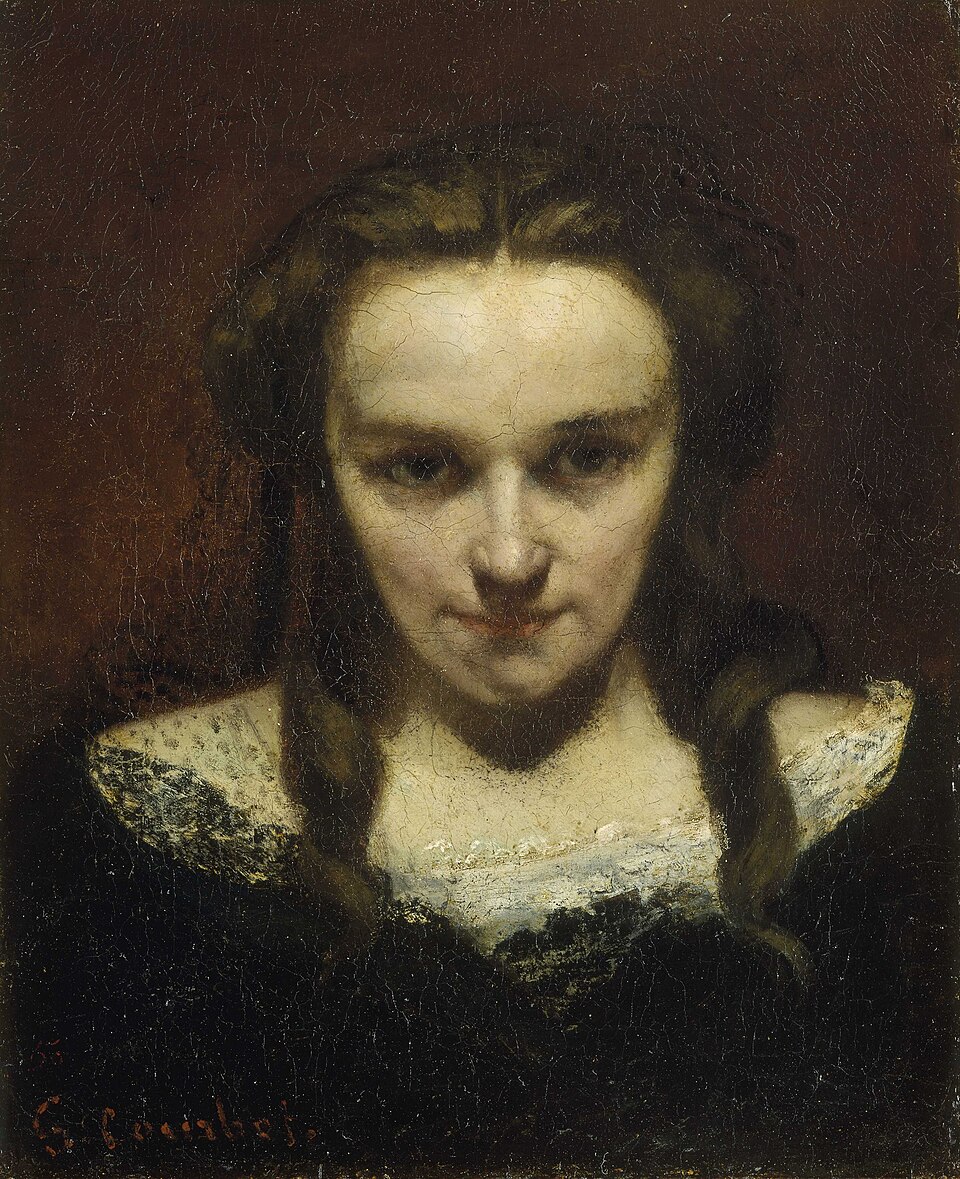
A young woman's face rises out of the dark, tilted slightly down, her eyes seeming to meet ours and then to look straight through us. Courbet called her The Seer, or The Sleepwalker, and never quite settled the question.
The story behind the painting
Courbet signed and dated this small oil on canvas, about 47 by 39 cm, but the date itself is a puzzle. Robert Fernier in 1977 and Pierre Courthion in 1986 read a 65 painted in red; a closer look with a magnifying glass suggests 55, and Wikidata gives 1855. Courbet was also known to backdate some of his pictures. Fernier thought the work might have been inspired by Bellini's opera La sonnambula, staged at the Theatre Italien in Paris in 1862 with Adelina Patti as Amina. The canvas was a reused one, a habit common for Courbet.
What to look for
This is a bust-length portrait of a young woman whose identity is still debated; she may be Juliette Courbet, the artist's youngest sister. Her head faces us, leaning a little downward, and her features emerge in strong light and shadow from a dark ground. At first her gaze seems raised and fixed on the viewer. Stay with it a moment and it turns empty, as if she were looking toward some place beyond the room. That deliberate blank stare is the heart of the picture.
Meaning and intent
The two titles tell us Courbet did not want an innocent portrait. He offered instead a young woman in contact with the beyond, gifted with some magnetic power, lost in thoughts no one can enter. Is she having a vision, or is she in the grip of sleepwalking? The painting refuses to choose. Coming from the great champion of realism, this quiet, uncanny face shows how a plain likeness could still open onto mystery, simply through the direction of a gaze.
Legacy
Courbet mentioned La Voyante or La Somnambule several times in his letters. In 1866 it received a gold medal in Amsterdam. In a letter of 18 February 1867 to his patron Alfred Bruyas he planned to send it to the Universal Exhibition in Paris as a pendant to an older picture, and in 1873 he wrote of it twice from Switzerland to his Paris dealer Alphonse Legrand. A lost sketch of the same subject adds to the confusion over dates. Juliette Courbet sold it in 1881 to the father of Elisee Cusenier, who bequeathed it in 1934 to the Musee des Beaux-Arts et d'Archeologie in Besancon.
豆知識
- Dated 1855 or 1865: the painted date is read both ways.
- The model may be Juliette Courbet, the artist's youngest sister.
- Won a gold medal in Amsterdam in 1866.
- Bequeathed to the Besancon museum in 1934.
画家について
ギュスターヴ・クールベ (1819-1877)
同じ画家の作品: ギュスターヴ・クールベ
 世界の起源 - Gustave Courbet (1866)
 オルナンの埋葬 - Gustave Courbet (2020)
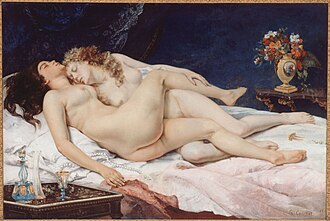 眠り - Gustave Courbet (1866)
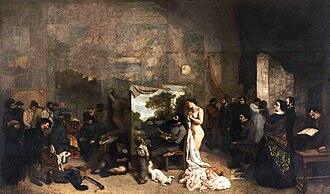 画家のアトリエ - Gustave Courbet (1855)
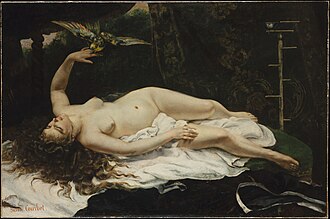 女とオウム - Gustave Courbet (1866)
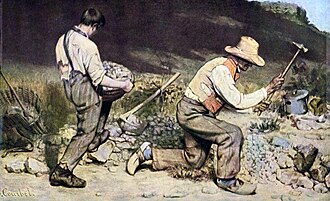 石割人夫 - Gustave Courbet (1850)
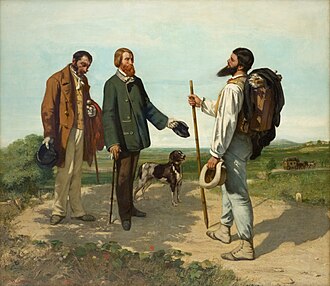 出会い または こんにちはクールベさん - Gustave Courbet (1854)
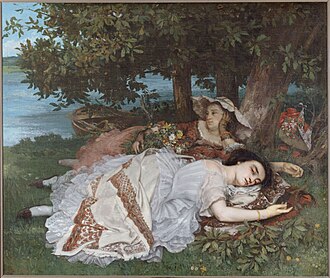 セーヌ川辺のお嬢さんたち - Gustave Courbet (1857)
 印象・日の出
 睡蓮
 草上の昼食
 オランピア
 風が強まる
 濃霧警報
 星月夜
 夜のカフェテラス