レオカディア
Francisco Goya · 1819
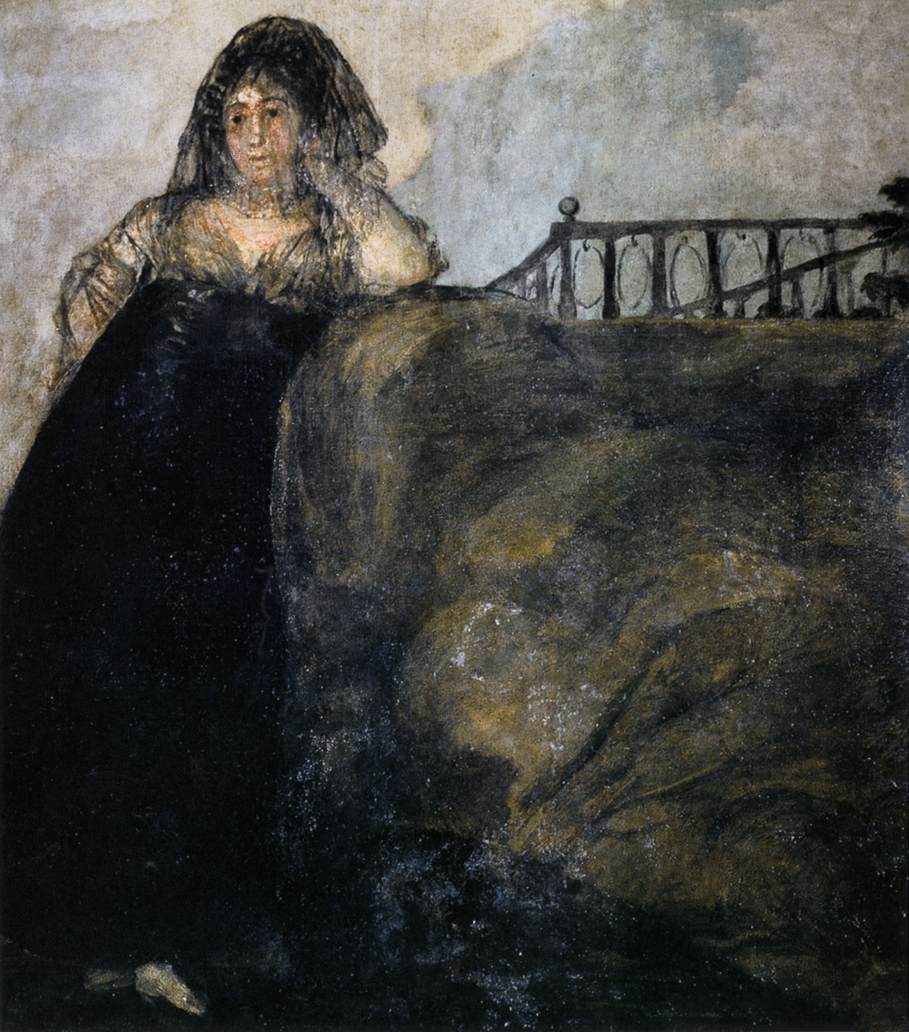
A woman in black leans on a mound topped with iron railings and looks out at us with sorrowful eyes. Goya painted her on the wall of his own house, probably Leocadia Weiss, the woman who cared for him in his last years.
The story behind the painting
Leocadia is one of the fourteen Black Paintings that Goya made in his seventies on the walls of the Quinta del Sordo, his villa outside Madrid, at a time of political, physical and psychological turmoil after he left his post as court painter. Wikipedia places the series between 1819 and 1823 and calls this one of the last to be finished; Wikidata gives 1819. Goya never titled or wrote about these murals. According to the inventory made around 1828 to 1830 by his friend Antonio Brugada, Leocadia hung on the ground floor, which Lawrence Gowing saw as divided into a male side, with Saturn Devouring His Son, and a female side, with Judith and Holofernes, Witches' Sabbath and Leocadia.
What to look for
The funereal mood comes from the grey shading, the black veil and maja dress, and her sad or nostalgic expression. She stands before an open blue sky, leaning slightly against a rock or mound crowned with small wrought iron rails, which some critics read as a burial mound. X-rays suggest the mound was first painted as an open fireplace and that the veil was added later. Her head rests on her forearm as she looks thoughtfully toward us. A yellow light falls on her face, arm and chest, and the sky gives off an ochre noon light that recalls one of Goya's last works, The Milkmaid of Bordeaux.
Meaning and intent
Unlike the other Black Paintings, this one holds a sense of peace and reconciliation. Juan José Junquera suggested it may personify Melancholy, or, given the bond between painter and model, the symbol of the fire of love and of the home and the presentiment of coming death. Robert Havard saw in her confident stare and maja dress a reference to an earlier charge of adultery against her. The identity itself is not certain: Junquera called it more romantic than a certainty, though the face strongly resembles an 1805 Goya portrait generally accepted as her. Some imagine her as his widow mourning at his tomb; others think their affection was platonic.
Legacy
Leocadia Weiss, born Zorrilla in 1788, was 35 years younger than Goya and a distant relative. Separated since 1811 from her husband, a jeweller who had accused her of illicit conduct, she and her daughter Rosario lived with Goya and cared for him, and followed him into exile in France until his death in 1828. He sent her a thousand kisses in a letter, yet his will left her nothing. After Goya's death all the Black Paintings were transferred from the walls to canvas, and today Leocadia hangs with the rest of the series in the Museo del Prado in Madrid.
豆知識
- One of Goya's 14 Black Paintings, painted on the walls of his villa.
- Probably shows Leocadia Weiss, his companion in his last years.
- X-rays show the mound may first have been a fireplace.
- Transferred to canvas, now in the Museo del Prado.
画家について
Francisco Goya (1746-1828)
同じ画家の作品: Francisco Goya
 1808年5月3日 - Francisco Goya (1814)
 裸のマハ - Francisco Goya (1800)
 我が子を食らうサトゥルヌス - Francisco Goya (1819)
 カルロス4世の家族 - Francisco Goya (1800)
 着衣のマハ - Francisco Goya (1800)
 1808年5月2日、エジプト人親衛隊との戦闘 - Francisco Goya (1814)
 犬 - Francisco Goya (1819)
 魔女の夜宴 - Francisco Goya (1820s)
関連する画家の作品
 雲海の上の旅人 - Caspar David Friedrich (c. 1818)
 楡の木のある僧院 - Caspar David Friedrich (1800s)
 民衆を導く自由の女神 - Eugène Delacroix (1830)
 サルダナパールの死 - Eugène Delacroix (1827)
 戦艦テメレール号 - J. M. W. Turner (1839)
 雨、蒸気、速度 - グレート・ウェスタン鉄道 - J. M. W. Turner (1844)
 青衣の少年 - Thomas Gainsborough (1770)
 アンドリューズ夫妻 - Thomas Gainsborough (1748)