Josefa Bayeu
Francisco Goya · 1810s
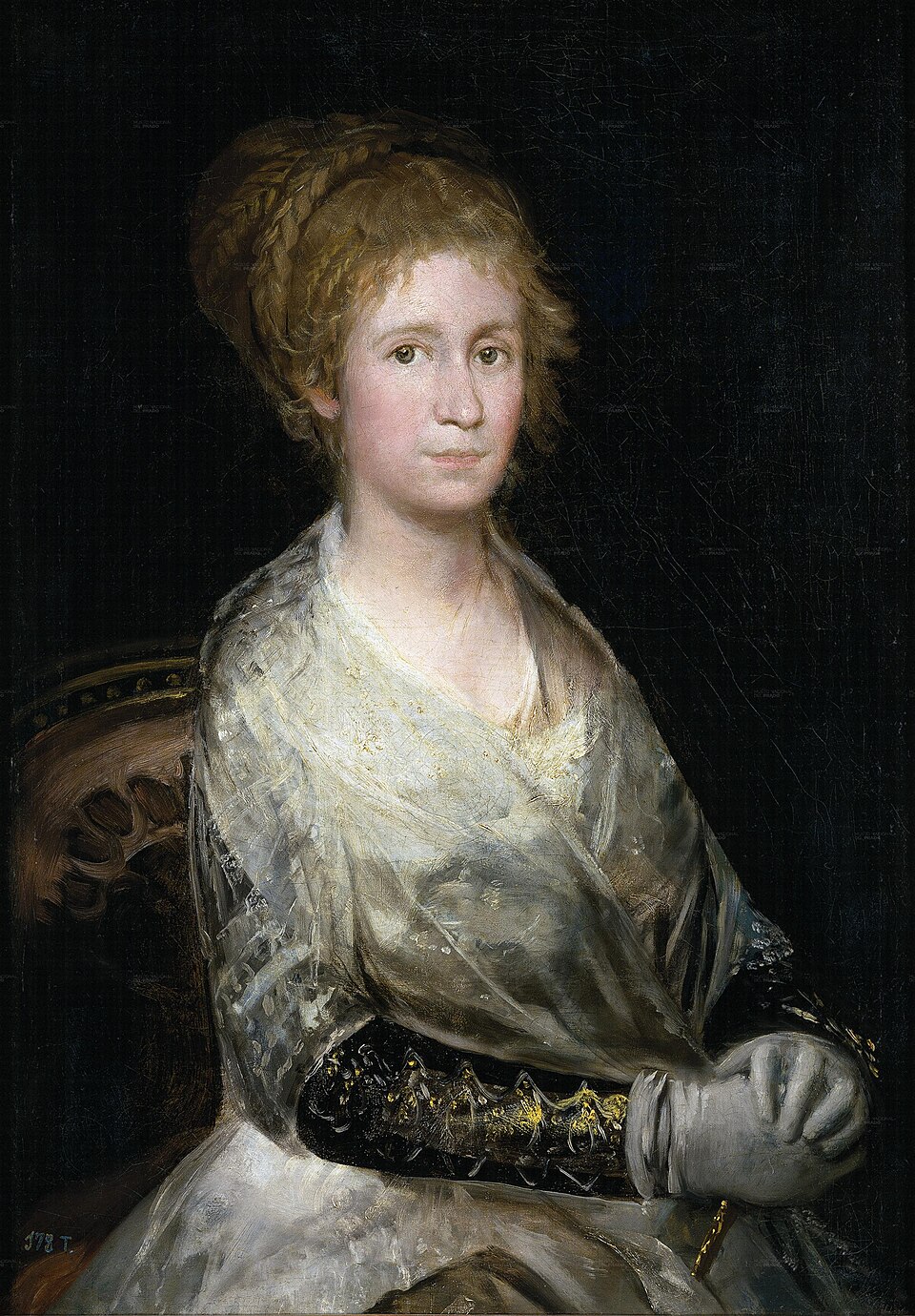
A young woman in black silk and white gloves, with a smile so hard to read that people call this Goya's Mona Lisa. For a century and a half she was called his wife. She probably is not.
The story behind the painting
Nothing is documented about how this portrait was made. In 1866 it was bought from Goya's heirs for the Museo de la Trinidad as Portrait of the Painter's Wife, Doña Josefa Bayeu, and it kept that title after the museum merged with the Prado in 1872. A half-length portrait of his wife appears in Antonio Brugada's 1828 inventory of Goya's works, but with no description, so no one can confirm it is this one. The traditional date was 1798. Doubts began in the 1920s, and Prado historians now date it most likely between 1814 and 1816.
What to look for
The woman sits against Goya's typical dark, even background, with only an ornate chair back on the left. Her face is painted with great precision: smooth light skin, a blush on the cheeks, large calm eyes, narrow pressed lips, a serious expression. Her dress is the opposite, with gold trim on black silk sleeves and a transparent shawl laid down in quick, almost impressionistic strokes. Her white-gloved hands hold a golden handle, perhaps of an umbrella or a cane. Count Viñaza thought it was a fan, but the force of her grip seems to rule that out.
Meaning and intent
Josefa Bayeu, Goya's wife from 1773 until her death in 1812, would have been over fifty in 1798, while this sitter is no older than thirty. The only confirmed image of Josefa, a charcoal profile from 1805, shows a tired, stooped woman whose face does not match. The hairstyle, simple braids with short strands framing the face, belongs to the Restoration years after 1814, as does the reuse of an old canvas when canvases were scarce after the war. Prado historians think the sitter is most likely Leocadia Zorrilla de Weiss, Goya's companion after his wife's death, who would have been 26 to 28.
Legacy
Her direct, confident posture suggests trust between painter and model, and the picture was probably a private work rather than a commission. X-rays revealed another woman underneath: the actress Juana García Ugalde, painted in the late 1790s holding her lines. She died poor, probably unable to pay, and Goya reused the canvas. Drawings by Leocadia's daughter Rosario, whom Goya taught to paint, show a similar figure, which supports the Leocadia theory. A copy exists in a private collection in Madrid. The painting stays in the Prado under its old name, a portrait whose sitter is still uncertain.
豆知識
- Long catalogued as the portrait of Goya's wife, Josefa Bayeu.
- Prado historians now date it to about 1814-1816.
- The sitter is most likely Leocadia Zorrilla de Weiss.
- X-rays show a portrait of an actress painted underneath.
画家について
Francisco Goya (1746-1828)
同じ画家の作品: Francisco Goya
 1808年5月3日 - Francisco Goya (1814)
 裸のマハ - Francisco Goya (1800)
 我が子を食らうサトゥルヌス - Francisco Goya (1819)
 カルロス4世の家族 - Francisco Goya (1800)
 着衣のマハ - Francisco Goya (1800)
 1808年5月2日、エジプト人親衛隊との戦闘 - Francisco Goya (1814)
 犬 - Francisco Goya (1819)
 魔女の夜宴 - Francisco Goya (1820s)
関連する画家の作品
 雲海の上の旅人 - Caspar David Friedrich (c. 1818)
 楡の木のある僧院 - Caspar David Friedrich (1800s)
 民衆を導く自由の女神 - Eugène Delacroix (1830)
 サルダナパールの死 - Eugène Delacroix (1827)
 戦艦テメレール号 - J. M. W. Turner (1839)
 雨、蒸気、速度 - グレート・ウェスタン鉄道 - J. M. W. Turner (1844)
 青衣の少年 - Thomas Gainsborough (1770)
 アンドリューズ夫妻 - Thomas Gainsborough (1748)