Etude d'arbres
Édouard Manet · 1859
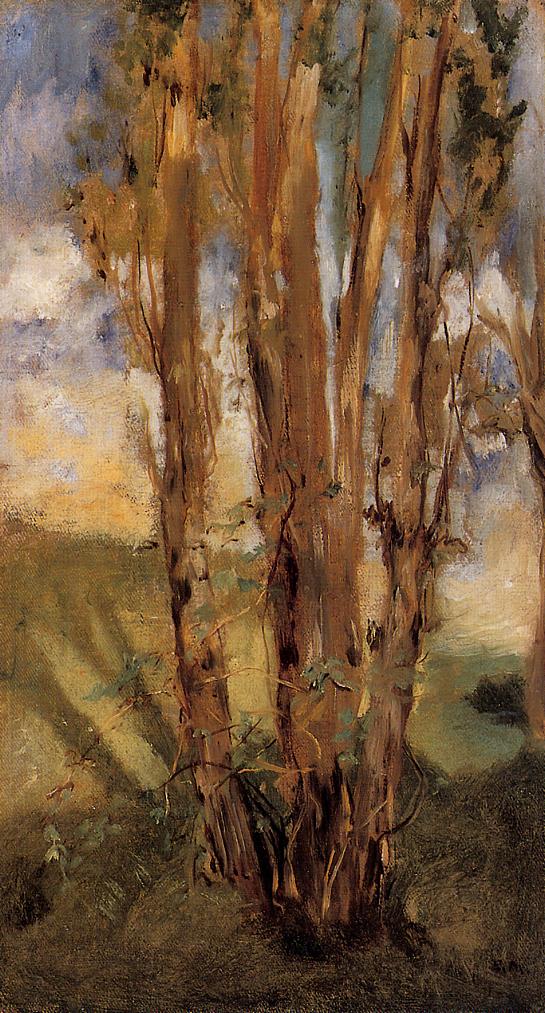
A cluster of brown trunks rises out of the picture, their long shadows falling across a green hill beside a blue green river. This small study by the young Manet spent a century in private hands and was once found hidden in a cellar in Parma.
The story behind the painting
Étude d'arbres belongs to Manet's early work, and no one knows exactly when it was painted. Manet's godson Léon Leenhoff said it was a study for Le Déjeuner sur l'herbe of 1863, which would date it to around 1863. Manet's biographer Adolphe Tabarant instead placed it in 1859, without giving a reason, and other art historians followed him. Before Le Déjeuner, Manet had already used the Seine landscape near the Île Saint-Ouen, close to his family's land at Gennevilliers, in several pictures painted between 1859 and 1863, so an early date is quite possible. A related study, Tronc d'arbres, is also dated 1859.
What to look for
The upright canvas, about 54 by 30 cm, is a sketchy landscape. In the middle stands a group of trees whose species cannot be identified; several brown trunks rise from the ground and are cut off by the top edge. Thin branches carry a few dark green leaves above, and lighter green leaves grow at the foot of the trunks, where thin strokes of green ochre may suggest grass. Behind them a gently rising hill catches the long shadows of the trees, so a low sun must be shining from the right. On the right a blue green river reaches the horizon, under a sky of blue, grey, lilac, white, yellow and brown. It is signed E.M. at lower right.
Meaning and intent
The study was probably made from nature around Paris and served as preparation for other paintings. Like Le Déjeuner sur l'herbe, it shows trees and a river landscape in the background, and the background of Le Déjeuner has been identified as the wooded Île Saint-Ouen, a former island in the Seine. If Tabarant's date is right, the study may have served one or several earlier pictures, such as La Pêche, La Nymphe surprise or The Students of Salamanca. Either way, it lets us watch Manet looking closely at light, shadow and foliage, the raw material from which his famous figure scenes were later built.
Legacy
The painting stayed with Manet until his death in 1883 and was sold with his estate at the Hôtel Drouot in February 1884 to a Monsieur de la Narde of Paris. It then passed to Belgium, to the Devillez collection in Brussels and the Leten collection in Ghent. Leten lent it in 1953 to an exhibition at the Museum voor Schone Kunsten in Ghent, so far its only museum showing. After a sale in New York in 1996 its owner was not made public. In 2009 Italian tax police found it in a cellar in Parma, hidden by the businessman Calisto Tanzi during the Parmalat scandal, and in 2019 it was auctioned in Florence to an unknown bidder.
豆知識
- An early Manet study, dated 1859 or around 1863.
- Possibly a study for Le Déjeuner sur l'herbe.
- Found in 2009 in a cellar in Parma during the Parmalat affair.
- Shown in a museum only once, in Ghent in 1953.
画家について
Édouard Manet (1832-1883)
同じ画家の作品: Édouard Manet
 草上の昼食 - Édouard Manet (1863)
 オランピア - Édouard Manet (1863)
 フォリー・ベルジェールのバー - Édouard Manet (1882)
 バルコニー - Édouard Manet (1868)
 テュイルリー公園の音楽会 - Édouard Manet (1862)
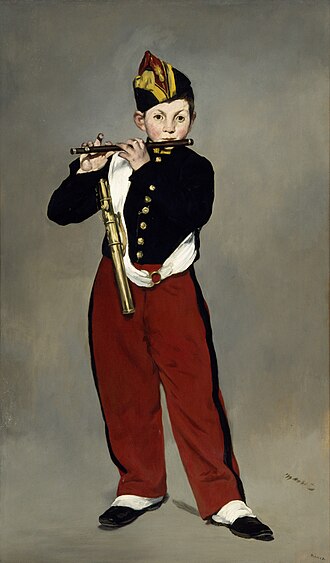 笛を吹く少年 - Édouard Manet (1866)
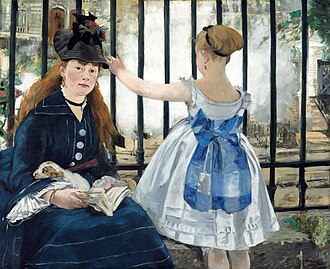 鉄道 - Édouard Manet (1873)
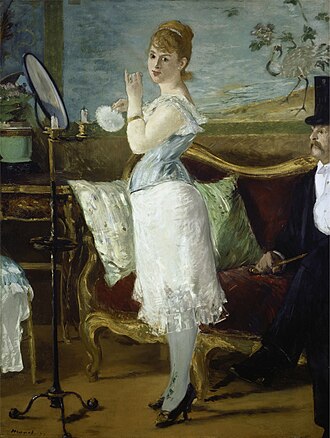 ナナ - Édouard Manet (1877)
関連する画家の作品
 印象・日の出 - Claude Monet (1872)
 睡蓮 - Claude Monet (1906)
 ムーラン・ド・ラ・ギャレットの舞踏会 - Pierre-Auguste Renoir (1876)
 舟遊びの昼食 - Pierre-Auguste Renoir (1881)
 ゆりかご - Berthe Morisot (1872)
 Summer's Day - Berthe Morisot (1879)
 アブサントを飲む人 - Edgar Degas (1875)
 The Bellelli Family - Edgar Degas (1858)
 The Canal du Loing at Moret - Alfred Sisley (1892)
 The Watering Pond at Marly with Hoarfrost - Alfred Sisley (1876)
 パリの通り、雨 - Gustave Caillebotte (1877)
 床削り - Gustave Caillebotte (1875)