ティオ・パケーテ
Francisco Goya · 1820
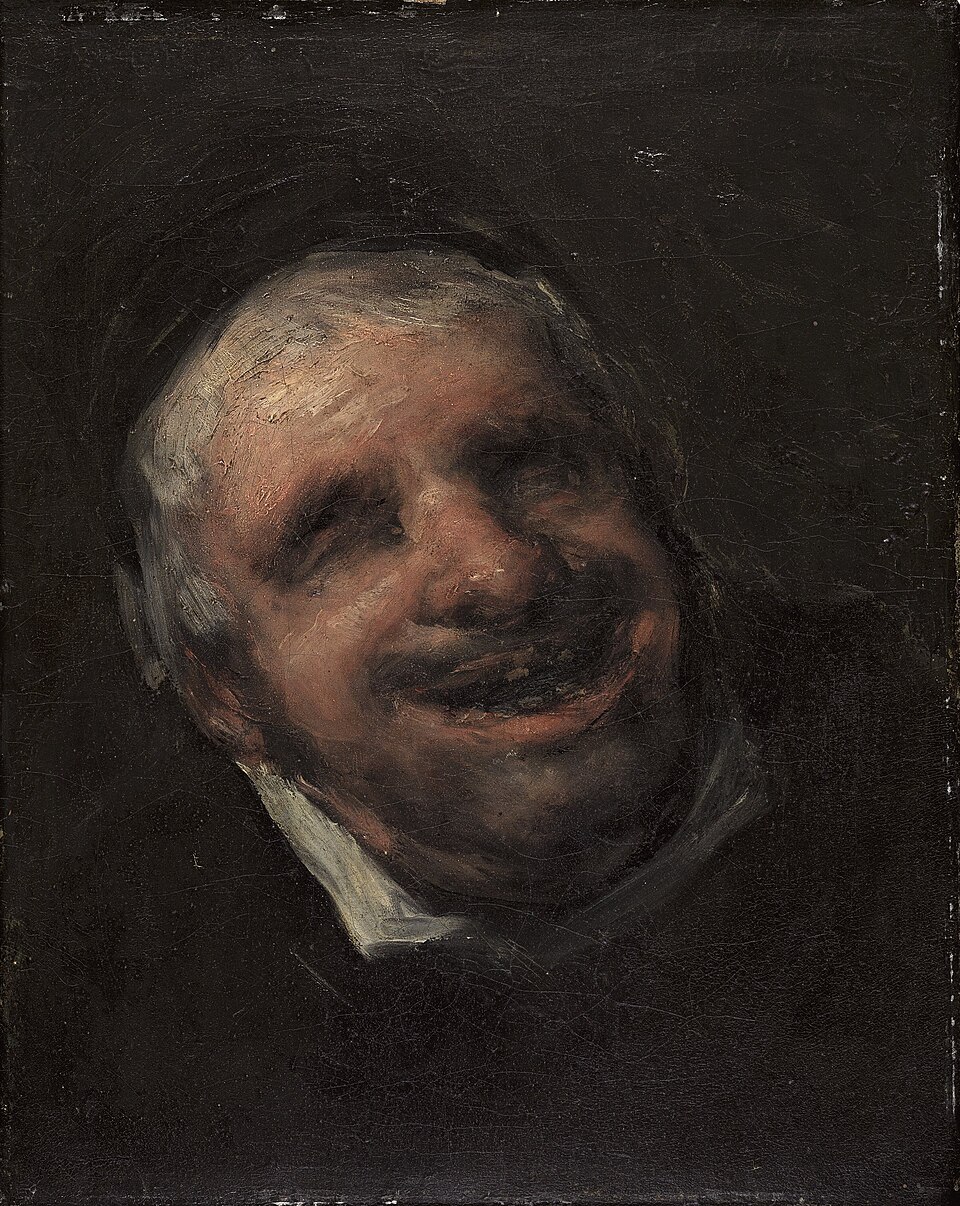
A blind beggar laughs out of the dark, his round face filling almost the whole small canvas. Goya painted a man every Madrileño knew, and gave him neither pity nor mockery, only presence.
The story behind the painting
Tío Paquete was a real figure of early 19th-century Madrid, an old blind beggar who sat on the steps of the church of San Felipe el Real, where he begged, sang and played the guitar. Goya, drawn to the grotesque side of everyday life, was inspired by him and set down his features in a portrait. Wikipedia dates it to about 1819 to 1820, the same period as the Black Paintings, while Wikidata gives 1820.
What to look for
The face emerges from a dark background and takes up nearly the entire canvas, which measures about 39 by 31 cm. The eyes are sunken and closed, the nose broad, the mouth open and almost toothless, yet laughing widely. The colours are dark and the paint is laid on thickly in impasto, much as in the Black Paintings, and the picture is especially close to Man Mocked by Two Women from that series.
Meaning and intent
Goya shows the man's blindness with strict realism while avoiding caricature. The portrait holds together the drama of losing one's sight and the comic temperament of the beggar. Its strong, almost Expressionist force seems to anticipate that movement by about a hundred years. Goya was fascinated by the grotesque in ordinary life, yet here the laugh feels warm rather than cruel. The beggar is not a curiosity but a person with his own humour, known to a whole city.
Legacy
Written sources record an inscription on the back, El Célebre Ciego Fijo, which disappeared when the canvas was lined and framed after 1887. The painting belonged to Goya's grandson Mariano, then to the Count of Doña Marina and the Marqués de Heredia. Since 1935 it has been part of the Thyssen-Bornemisza collection, today shown at the museum in Madrid. The small panel, about 39 by 31 cm, has stayed in one collection for nearly a century.
豆知識
- Portrait of a blind beggar known in Madrid, who sang and played guitar at San Felipe el Real.
- Dated about 1819-1820, the period of the Black Paintings.
- Thick impasto and dark colours.
- In the Thyssen-Bornemisza collection since 1935.
画家について
Francisco Goya (1746-1828)
同じ画家の作品: Francisco Goya
 1808年5月3日 - Francisco Goya (1814)
 裸のマハ - Francisco Goya (1800)
 我が子を食らうサトゥルヌス - Francisco Goya (1819)
 カルロス4世の家族 - Francisco Goya (1800)
 着衣のマハ - Francisco Goya (1800)
 1808年5月2日、エジプト人親衛隊との戦闘 - Francisco Goya (1814)
 犬 - Francisco Goya (1819)
 魔女の夜宴 - Francisco Goya (1820s)
関連する画家の作品
 雲海の上の旅人 - Caspar David Friedrich (c. 1818)
 楡の木のある僧院 - Caspar David Friedrich (1800s)
 民衆を導く自由の女神 - Eugène Delacroix (1830)
 サルダナパールの死 - Eugène Delacroix (1827)
 戦艦テメレール号 - J. M. W. Turner (1839)
 雨、蒸気、速度 - グレート・ウェスタン鉄道 - J. M. W. Turner (1844)
 青衣の少年 - Thomas Gainsborough (1770)
 アンドリューズ夫妻 - Thomas Gainsborough (1748)