アンドレス・デル・ペラルの肖像
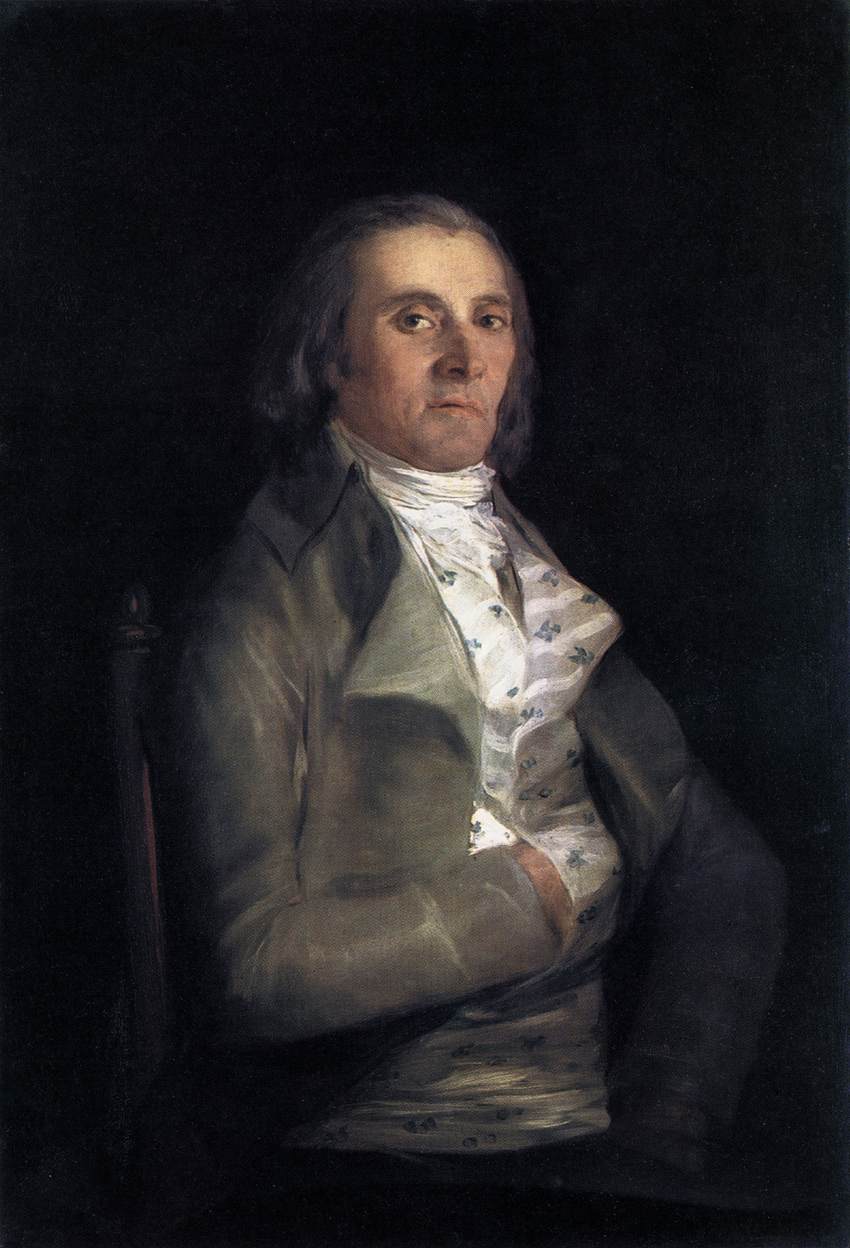
A grave face, a mouth pulled slightly to one side, a silver-grey coat painted in quick strokes. Goya portrayed his friend Andrés del Peral, a painter and gilder, while he himself was recovering from the illness that left him deaf.
The story behind the painting
Andrés del Peral worked at the royal residences between 1774 and 1778 as a painter and gilder, decorating horse-drawn carriages. He built an important art collection, which he sold to King Charles IV in 1808, and many works from it are now in the Prado. He was Goya's friend and owned several of his paintings. When Goya made this portrait he was working on the frescoes of San Antonio de la Florida in Madrid and still living with the after-effects of a grave illness of 1792, above all deafness, and was slowly returning to commissioned portraits. He showed it at the Royal Academy of San Fernando in 1798.
What to look for
Del Peral is seen half-length, seated against a dark, neutral background. At the left runs the vertical line of the back of his wicker chair. His expression is serious, and the mouth turned slightly to one side may be a trace of an earlier stroke. He wears a silver-grey frock coat, a white waistcoat embroidered with blue flowers and a white cravat. One hand is tucked under the waistcoat and the other rests on his hip. The panel is poplar wood, so the surface stays smooth despite fast brushwork. The coat is sketched in broad, loose strokes, while the face is built with fine, precise touches and warm pink, light brown and red tones.
Meaning and intent
The source notes that hands, being hard to paint, weighed heavily in what a portrait cost, which is why many of Goya's sitters hide their hands behind their backs, or, as here, tuck them away. The contrast is deliberate: economy and unfinished speed in the clothes, close attention to light and warmth in the face. Everything leads the eye to the man himself, a craftsman and collector Goya knew well, painted with seriousness rather than flattery at a time when the painter was finding his way back to portraiture after illness.
Legacy
On 17 August 1798 the Diario de Madrid published a very flattering opinion of the portrait after its showing at the Academy. The painting stayed with the sitter's family until his granddaughter sold it, probably at the end of the 19th century, to the Marquis of la Vega-Inclán. It then passed to the collection of the painter Gaston Linden in Paris. In 1902 it was bought by the collector Sir George Donaldson, who first deposited it at the National Gallery in London and then gave it to the museum, where it remains. Wikidata records no date for the work.
豆知識
- Portrait of Goya's friend, the painter and gilder Andrés del Peral.
- Shown at the Royal Academy of San Fernando in 1798.
- Painted on poplar panel, about 95 by 66 cm.
- Given to the National Gallery, London, by Sir George Donaldson.
画家について
Francisco Goya (1746-1828)
同じ画家の作品: Francisco Goya
 1808年5月3日 - Francisco Goya (1814)
 裸のマハ - Francisco Goya (1800)
 我が子を食らうサトゥルヌス - Francisco Goya (1819)
 カルロス4世の家族 - Francisco Goya (1800)
 着衣のマハ - Francisco Goya (1800)
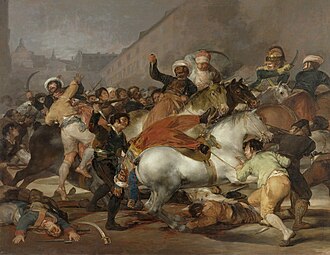 1808年5月2日、エジプト人親衛隊との戦闘 - Francisco Goya (1814)
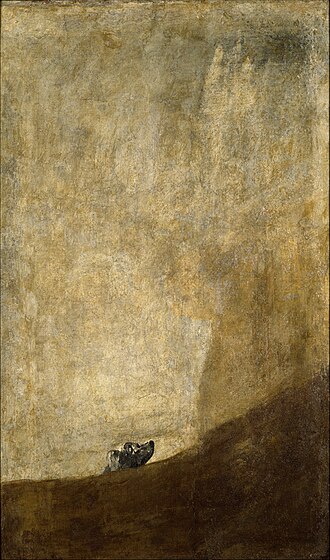 犬 - Francisco Goya (1819)
 魔女の夜宴 - Francisco Goya (1820s)
関連する画家の作品
 雲海の上の旅人 - Caspar David Friedrich (c. 1818)
 楡の木のある僧院 - Caspar David Friedrich (1800s)
 民衆を導く自由の女神 - Eugène Delacroix (1830)
 サルダナパールの死 - Eugène Delacroix (1827)
 戦艦テメレール号 - J. M. W. Turner (1839)
 雨、蒸気、速度 - グレート・ウェスタン鉄道 - J. M. W. Turner (1844)
 青衣の少年 - Thomas Gainsborough (1770)
 アンドリューズ夫妻 - Thomas Gainsborough (1748)