Disrobing of Jesus
エル・グレコ · 1580s
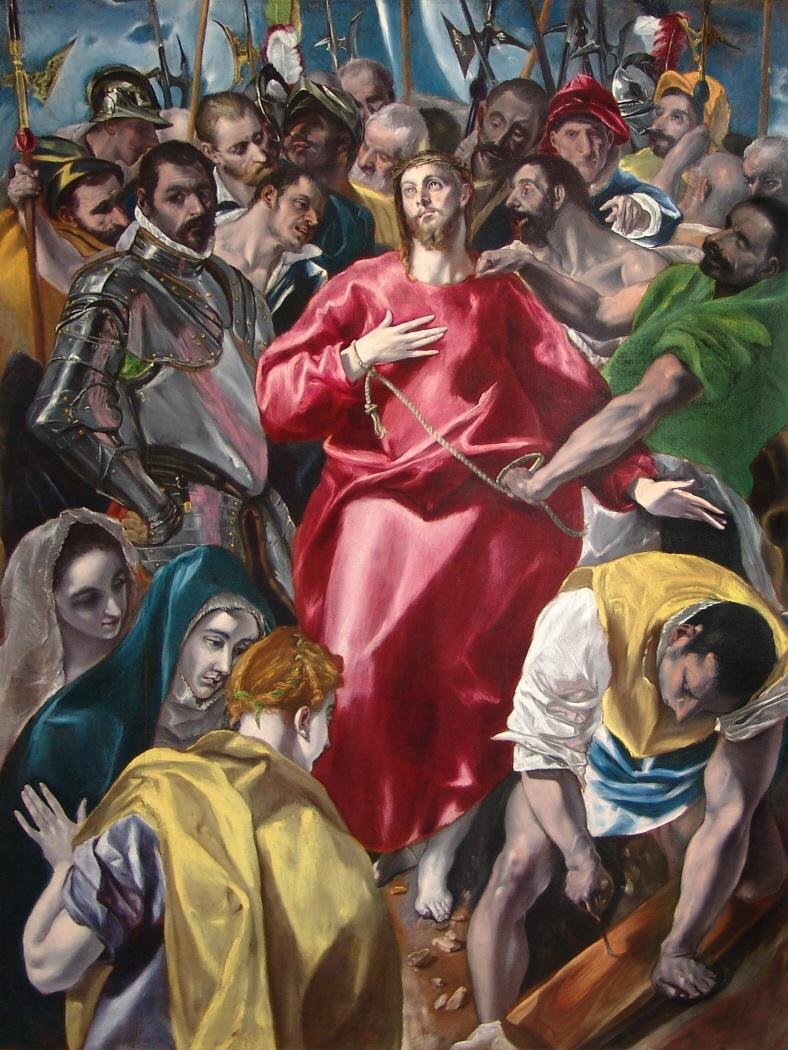
Christ about to be stripped of his robe, a small crown of thorns on his head without a single drop of blood. This Toledo canvas may be El Greco's own hand or his workshop's, and scholars still disagree.
The story behind the painting
El Greco's great Disrobing of Christ hangs in the sacristy of Toledo Cathedral. This version, now in the Museum of Santa Cruz in Toledo, was painted during his first Toledo period, dated around 1580 to 1585, oil on canvas, 186 by 126 cm. It was made for the Church of Santa Leocadia in Toledo and later kept in the parish museum of San Vicente. Its authorship is disputed. Cossío, Mayer and Camón Aznar considered it an authentic El Greco. For Harold Wethey, who listed it as X-82 in his catalogue, it is surely a workshop piece. Tiziana Frati catalogued it as 24-f.
What to look for
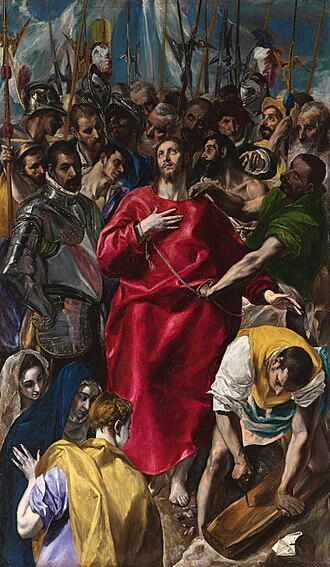
Compare it with the cathedral original. At upper right appears the head of an old man turned away from us, a figure already present in the version in Munich. The group of the Three Marys is larger, also as in the Munich canvas. Two changes appear in neither earlier picture. Here Christ wears the crown of thorns, small and without any drop of blood, which the source links to El Greco's little taste for gory excess. And the upper band of pikes and halberds is noticeably smaller. Wethey found Christ's face altered and the emotional force weaker than in the cathedral masterpiece, but he admitted that the colour remains splendid.
Meaning and intent
Why does this version matter so much? The differences it introduces, the crown of thorns and the reduced crowd of weapons, are repeated in the nine later versions of the Disrobing made by El Greco and his workshop. The source offers a reason. The prototype in the cathedral sacristy was not open to everyone, while this canvas, originally in the Church of Santa Leocadia, could be seen by anyone in Toledo who was interested. It was therefore far more likely to become the model for the later variants. In that sense, a picture whose authorship is doubted may have shaped how the image spread.
Legacy
The painting's history is short on the page but clear: from the Church of Santa Leocadia to the parish museum of San Vicente in Toledo, and today in the Museum of Santa Cruz in the same city, which also holds the cathedral original. Wikidata dates it to the 1580s. Whether it is judged an autograph work, as Cossío, Mayer and Camón Aznar held, or a workshop painting, as Wethey believed, it stands at the head of a family of nine later Disrobings, and its colour still earns praise even from its most sceptical critic.
豆知識
- Painted around 1580 to 1585, oil on canvas, 186 by 126 cm.
- Authorship disputed: El Greco for some, his workshop for Wethey.
- Adds a small, bloodless crown of thorns absent from the cathedral original.
- Its changes recur in nine later versions of the subject.
画家について
エル・グレコ (1541-1614)
宗教美術 · イエス・キリスト · サンタ・クルス美術館 · 茨の冠
同じ画家の作品: エル・グレコ
 オルガス伯の埋葬 - El Greco (1586)
 トレドの風景 - El Greco (1596)
 聖衣剥奪 - El Greco (1570s)
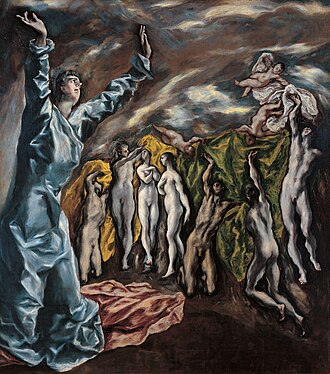 黙示録第5の封印 - El Greco (1610)
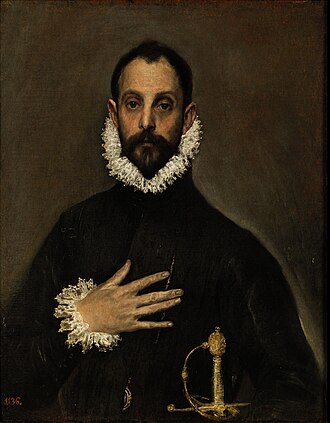 胸に手を置く騎士 - El Greco (1580)
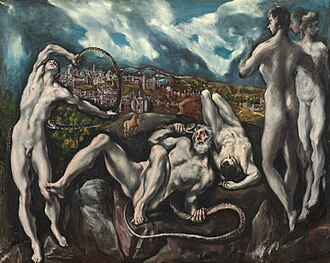 ラオコーン - El Greco (1610s)
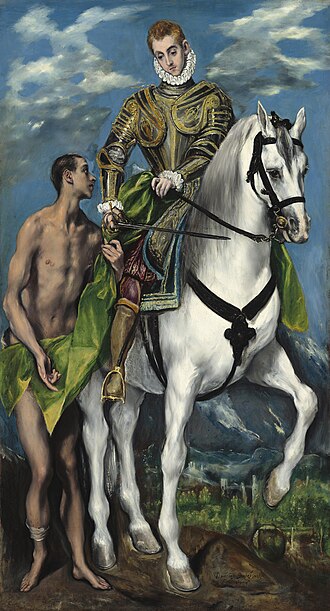 聖マルティヌスと乞食 - El Greco (1597)
 羊飼いの礼拝 - El Greco (1612)
関連する画家の作品
 カナの婚礼 - Paolo Veronese (1560s)
 レヴィ家の饗宴 - Paolo Veronese (1573)
 最後の晩餐 - Jacopo Tintoretto (1563)
 奴隷を解放する聖マルコ - Jacopo Tintoretto (1540s)
 ウルビーノのヴィーナス - Titian (1538)
 聖母被昇天 - Titian (1510s)
 エマオの晩餐 - Caravaggio (1601)
 聖マタイの召命 - Caravaggio (1609)
 大使たち - Hans Holbein the Younger (1533)
 墓の中のキリストの屍 - Hans Holbein the Younger (1520s)