キリストの十字架降下
フラ・アンジェリコ · 1432
%2C%20ante%201432%2C%2001.jpg)
Gently, carefully, friends lower Christ's body from the cross, while behind them Tuscan hills roll away into the distance. Giorgio Vasari said it looked painted by a saint or an angel.
The story behind the painting
The Deposition of Christ, also called the Santa Trinita Altarpiece, began as a commission to another painter. The wealthy Florentine banker and humanist Palla Strozzi, a rival of Cosimo de' Medici, ordered it from Lorenzo Monaco for the Strozzi Chapel in the church of Santa Trinita, in the same dimensions as the Adoration of the Magi he had commissioned from Gentile da Fabriano. Monaco reportedly finished the pinnacles and predella but died suddenly in 1425, and Fra Angelico was asked to complete it. The source dates his work to 1432 to 1434, though the dating is debated; Wikidata gives 1432. Strozzi was exiled from Florence in 1434. The altarpiece is now in the Museum of San Marco, Florence.
What to look for
Monaco had divided the main panel with columns into three scenes; Angelico removed them to paint one continuous scene, 275 by 285 centimetres. At the centre, Joseph of Arimathea and Nicodemus lower Christ, helped by three men, two on ladders. Christ's blood flows into a rock base, a medieval sign of redemption. Mary, in lapis lazuli blue, prays; Mary Magdalene kisses Christ's feet. Women on the left prepare the shroud. Men on the right in Florentine dress discuss the instruments of the Passion; the one in a red chaperon holding the crown of thorns and nails is believed to be Palla Strozzi. The ground is covered with tiny plants.
Meaning and intent
The scene joins grief with contemplation. The standing figures, the vertical lines of the background and Christ's place at the top of a pyramid of bodies all draw the eye to him. Behind, a fortified city with towers on the left and a Tuscan landscape on the right suggest both Jerusalem and Florence. The small plants may allude to spring as a symbol of rebirth. The source describes the light as theological rather than decorative, wrapping the scene in clarity. The portrait-like faces, including figures believed to be Michelozzo and Alessio Strozzi, bring the sacred event into the world of Angelico's own city.
Legacy
Fra Angelico was among the first Italian Renaissance painters to set figures in a receding landscape rather than lining them up across the foreground like actors on a stage. Some elements echo Gentile da Fabriano's Adoration, such as the layering of figures and the fortified city, yet Angelico's work is wider and more contemplative. Monaco's pinnacles, with scenes after the Resurrection, and his predella remain in a Gothic manner, so one altarpiece shows two generations of painting side by side. A restoration from 2023 to 2025 recovered the transparency and luminosity of its colours, especially in the landscape, the first since the late nineteenth century.
豆知識
- Begun by Lorenzo Monaco, who died in 1425; completed by Fra Angelico
- Commissioned by Palla Strozzi for Santa Trinita, Florence
- Source dates Angelico's work to 1432-1434; Wikidata gives 1432
- Restored 2023-2025; now in the Museum of San Marco
画家について
フラ・アンジェリコ (1400-1455)
宗教美術 · 男性 · Early Renaissance · イエス・キリスト · 天使
同じ画家の作品: フラ・アンジェリコ
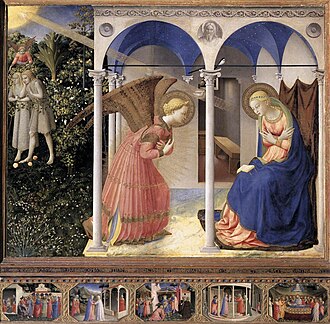 受胎告知 - Fra Angelico (1425)
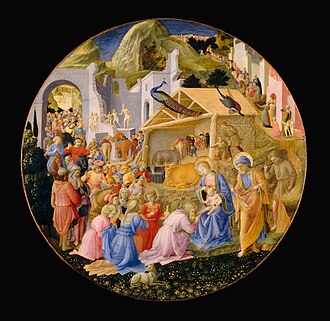 東方三博士の礼拝 - Fra Angelico (1430)
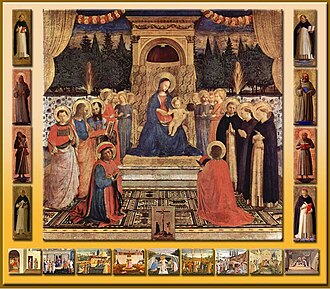 San Marco Altarpiece - Fra Angelico
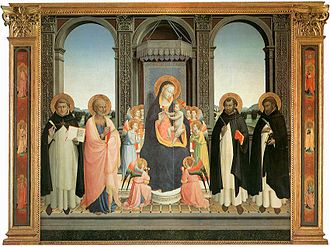 フィエーゾレの祭壇画 - Fra Angelico (1422)
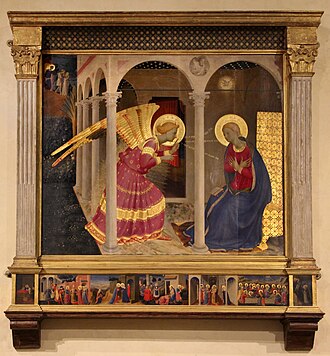 コルトーナの受胎告知 - Fra Angelico (1430s)
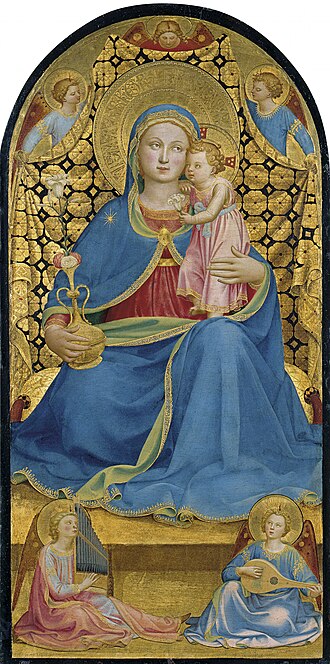 謙譲の聖母 - Fra Angelico (1433)
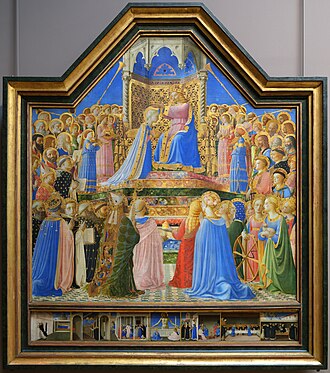 聖母戴冠 - Fra Angelico
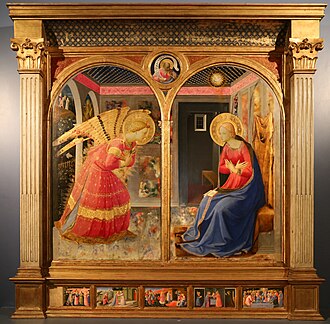 Annunciation of San Giovanni Valdarno - Fra Angelico (1430)
 モナ・リザ
モナ・リザ 白貂を抱く貴婦人
 聖家族
聖家族 聖アンソニーの苦悩