キリストの磔刑の二連祭壇画
ロヒール・ファン・デル・ウェイデン · 1460
%20-%20The%20Crucifixion%2C%20with%20the%20Virgin%20and%20Saint%20John%20the%20Evangelist%20Mourning%20-%20Google%20Art%20Project.jpg)
Two panels, a stone wall, two red cloths, and silence. Late in life Rogier van der Weyden stripped the Crucifixion down to almost nothing, and the effect is overwhelming.
The story behind the painting
Rogier van der Weyden completed this diptych around 1460, late in his life. Nothing is known of its history before the mid 19th century. Its extreme starkness led Penny Howell Jolly to propose it was made for a Carthusian monastery, an order of absolute silence and harsh fasting. The link is personal: the painter's son Cornelis entered the Carthusian monastery of Herrines about 1449, and Rogier gave money and paintings to the order and left it a bequest in his will.
What to look for
The figures are almost two-thirds life size. On the right, Christ hangs heavily, his body a Y against the T of the cross and the rectangle of a brilliant red cloth of honour. Blood runs from hands, feet, brow and side. His loincloth flutters, marking the moment of death, and a skull and bone at the foot of the cross refer to Adam. On the left John supports the swooning Virgin, both in pale robes before another red cloth, its creases fresh as if just unfolded. A high stone wall pushes them forward under a dark sky, as in Matthew: darkness over all the land.
Meaning and intent
The Virgin's and Christ's faces mirror each other, as do their places at the centre of the red cloths, so her suffering echoes his. The usual deep blue of Mary's robe and red of John's are bleached nearly white, the colour of Carthusian habits. The scholar Tamytha Cameron Smith notes its overwhelming stillness and suggests it may have been his last work. In the spirit of Ludolph of Saxony, a monk could project himself into the scene as the ever loyal John.
Legacy
No one knows whether the panels were a self-contained diptych, part of a triptych or one panel cut in two. Conservator Mark S. Tucker found dowel holes suggesting they were two parts of a four-panel work, perhaps the shutters of a carved altarpiece. In 1941 a restorer replaced the dark sky with gold, believing it a later addition; in 1990 Tucker showed the blue was original, and he restored it in 1992 and 1993. The Philadelphia Museum of Art calls it the greatest Old Master painting in the museum.
豆知識
- Completed around 1460.
- Figures almost two-thirds life size.
- Possibly made for a Carthusian monastery.
- The sky was gilded in 1941 and restored to dark blue in 1992 and 1993.
画家について
ロヒール・ファン・デル・ウェイデン (1390s-1464)
宗教美術 · イエス・キリスト · 初期フランドル派 · フィラデルフィア美術館 · 福音記者ヨハネ
同じ画家の作品: ロヒール・ファン・デル・ウェイデン
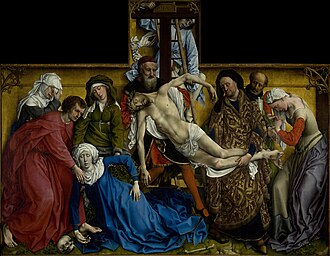 十字架降架 - Rogier van der Weyden (1440s)
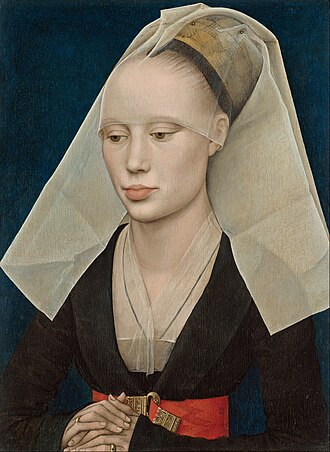 女性の肖像 - Rogier van der Weyden (1460)
.jpg) 最後の審判 - Rogier van der Weyden (1443)
最後の審判 - Rogier van der Weyden (1443)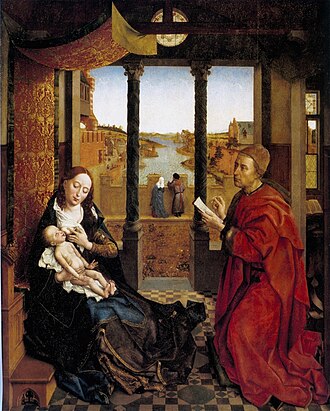 聖母を描く聖ルカ - Rogier van der Weyden (1490)
 コルンバ祭壇画 - Rogier van der Weyden (1450s)
 読書するマグダラのマリア - Rogier van der Weyden (1435)
 ブラック家の祭壇画 - Rogier van der Weyden (1452)
%20-%20Prado%20P02722.jpg) ドゥランの聖母 - Rogier van der Weyden (1430s)
ドゥランの聖母 - Rogier van der Weyden (1430s)
 快楽の園
快楽の園 愚者の船
愚者の船 アルノルフィーニ夫妻像
 ヘントの祭壇画
%20-%20Google%20Art%20Project.jpg) 雪中の狩人
雪中の狩人 ネーデルラントの諺