Christ blessing
ジョット・ディ・ボンドーネ · 1301
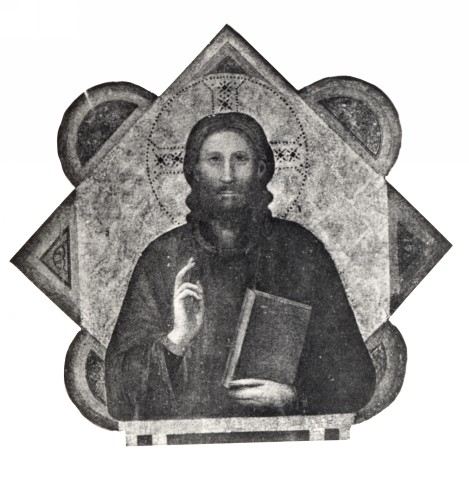
A small golden panel, long separated from the great cross it once crowned, shows Christ raising his hand in blessing. Its true home was only recognised in 1957.
The story behind the painting
This tempera panel on a gold ground, known in French as Le Rédempteur and in Italian as Il Redentore, is attributed to Giotto di Bondone and dated around 1301. It measures roughly 81 by 86 centimetres according to Wikidata. Its story is one of rediscovery. In 1911 it was published as a work by Giotto by Brockwell and Fry, who placed it in the master's Paduan period. Then, in 1957, the art historian Federico Zeri, studying it in the Jekyll collection, identified it as the lost top panel, the cimasa, of the painted Crucifix of Rimini. Wikidata lists no museum for the work; the source states that it is held in a private collection in London.
What to look for
Christ appears inside a quatrefoil, a frame with four lobes. He wears a halo marked with a red cross. His right hand is raised in blessing, while his left hand holds the Book. The figure is painted in tempera against a gold background, the traditional precious setting for sacred images of the time. Picture the panel as it once was, set high above the body of the crucified Christ at the top of a large painted cross, so that worshippers looking up would see first the suffering Christ and, above him, Christ in glory. The quatrefoil shape matches the one crowning Giotto's Crucifix of Padua, which, unlike the Rimini cross, has survived intact.
Meaning and intent
The blessing Christ above the crucifixion offers a meaningful pairing: death below, and above it the living Redeemer, the title by which this panel is known. Even separated from its cross, the image keeps that sense of calm authority. The gesture of blessing, the open promise of the Book and the cross inscribed in the halo all speak of salvation rather than suffering. Seeing it alone today, we meet the closing note of a larger visual sentence. Its rediscovery reminds us how many medieval works survive only as fragments, scattered pieces whose original meaning returns when scholars fit them back into their lost wholes.
Legacy
Attribution has not always been simple. After its 1911 publication as Giotto's, Suida attributed the panel to the Master of the Stefaneschi Triptych, and Toesca followed him. Today, the source reports, Zeri's identification with the Rimini Crucifix is unanimously accepted, on arguments drawn from technique and style. Its dating follows that of the Rimini cross, which recent studies place before Giotto's arrival in Padua, where he painted the frescoes of the Scrovegni Chapel. The source text is brief, but it shows how a single small panel can help reconstruct a lost monument and a stage in the career of a painter whom Wikidata places at the origins of the Proto-Renaissance.
豆知識
- Tempera on gold ground on panel, about 1301
- Identified by Federico Zeri in 1957 as the top panel of the Rimini Crucifix
- Earlier attributed by Suida to the Master of the Stefaneschi Triptych
- Wikidata lists no museum; the source places it in a private collection in London
画家について
ジョット・ディ・ボンドーネ (1267-1337)
同じ画家の作品: ジョット・ディ・ボンドーネ
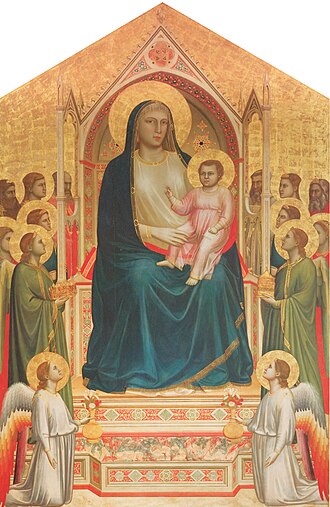 オンニサンティの聖母 - Giotto (1300s)
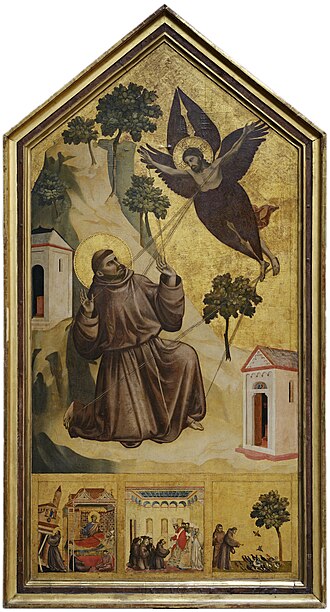 聖痕を受けるフランチェスコ - Giotto (1290s)
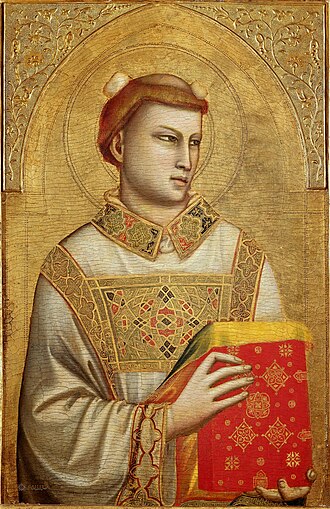 聖ステファノ - Giotto (1320)
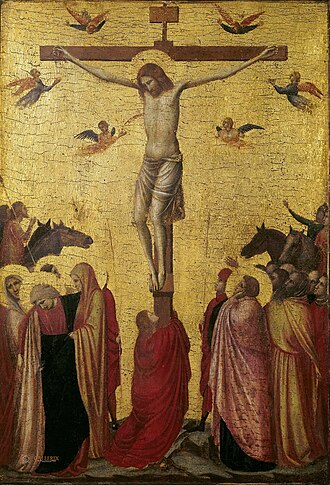 磔刑 - Giotto (1315)
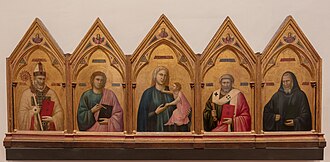 バディア多翼祭壇画 - Giotto (1300s)
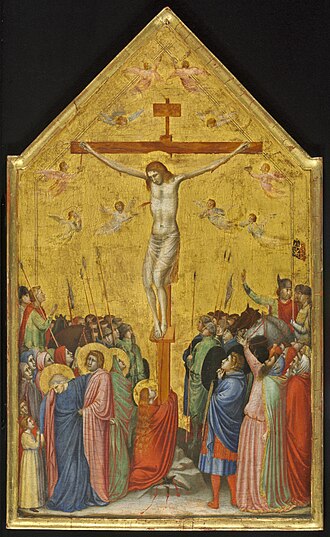 磔刑 - Giotto (1310s)
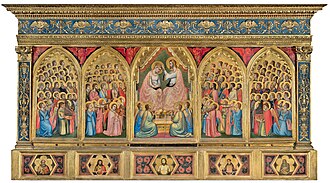 Coronation of Mary with Angels and Saints - Giotto (1328)
 Scenes from the New Testament: Lamentation - Giotto (1291)