博士たちの間のキリスト
パオロ・ヴェロネーゼ · 1560
%20grande.jpg)
A young Christ speaks in a grand Palladian hall while twenty-five richly dressed figures listen, argue and turn. Far behind, almost lost in the crowd, Mary and Joseph are still searching for their son.
The story behind the painting
The painting tells the gospel episode of the boy Jesus found teaching among the scholars in the Temple. Its date is disputed. The year 1548 appears on a book held by a figure seated on the stairs in the foreground, but in 1976 Diana Gisolfi Pechukas argued that 1565 is the earliest possible date. One argument for a later date is the architecture, in the style of Andrea Palladio, which could not predate 1556, when such designs appeared in an edition of Vitruvius's De architectura. Wikidata gives yet another date, 1560. The canvas measures about 236 by 430 cm.
What to look for
This is a typical Veronese: a wide composition with many figures set in monumental architecture, as in his Feast in the House of Levi or The Wedding at Cana. Twenty-five people in different poses and perspectives, dressed in rich clothes, show his skill in arranging a great variety of colours, and their gestures reveal his study of classical statues. Look among the bearded sages for one who listens to Christ wearing the black robe of a knight of the Order of the Holy Sepulchre and holding a pilgrim's staff. In the background, Joseph and Mary, with ordinary people around them, search for their son.
Meaning and intent
Veronese follows the main concerns of Venetian painting, above all the treatment of light and the harmony of colour. The child at the centre of so much learning and splendour turns the scene into a meeting of youth and wisdom, with the crowd of elders drawn toward him. The sage in the robe of the Order of the Holy Sepulchre may be the head of the assembly, and his pilgrim's staff could mean that the painting was commissioned to recall a pilgrimage to Jerusalem. The parents, small and far away, remind us of the worry behind the episode.
Legacy
In 1648 the painting was recorded in the Casa Contarini in Padua. By 1686 it was in the Royal Alcázar of Madrid, perhaps brought from Italy by Diego Velázquez after his second journey there, between 1649 and 1651. It was later moved to the Buen Retiro Palace, and today it hangs in the Museo del Prado. Its long debate over dating, between the inscribed 1548 and a date after 1556 or even 1565, keeps scholars looking closely at its architecture and figures, and makes it a good example of how a painting's own details can be read as evidence.
豆知識
- The book in the foreground bears the date 1548, but a later date is argued.
- Twenty-five figures in a Palladian architectural setting.
- Possibly brought to Spain by Velázquez between 1649 and 1651.
- Now in the Museo del Prado in Madrid.
画家について
パオロ・ヴェロネーゼ (1528-1588)
同じ画家の作品: パオロ・ヴェロネーゼ
 カナの婚礼 - Paolo Veronese (1560s)
.jpg) レヴィ家の饗宴 - Paolo Veronese (1573)
レヴィ家の饗宴 - Paolo Veronese (1573).jpg) ヴィーナスとアドニス - Paolo Veronese (1580)
ヴィーナスとアドニス - Paolo Veronese (1580) 美徳と悪徳の間の選択 - Paolo Veronese (1565)
 キューピッドによって結ばれるマルスとヴィーナス - Paolo Veronese (1570s)
 アレクサンドロス大王の前に出たダレイオスの家族 - Paolo Veronese (1565)
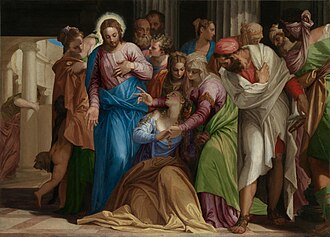 マグダラのマリアの改宗 - Paolo Veronese (1548)
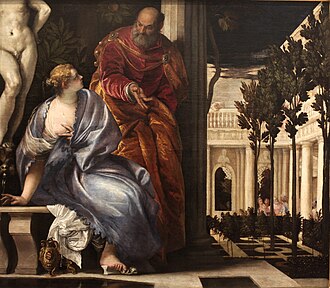 バテシバの水浴 - Paolo Veronese (1575)
関連する画家の作品
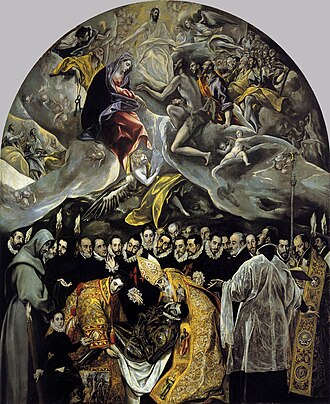 オルガス伯の埋葬 - El Greco (1586)
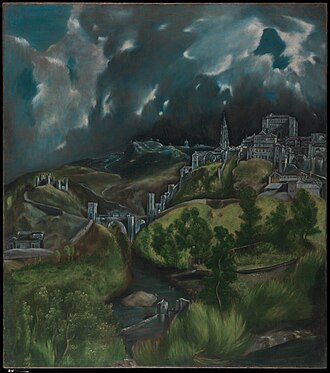 トレドの風景 - El Greco (1596)
 最後の晩餐 - Jacopo Tintoretto (1563)
 奴隷を解放する聖マルコ - Jacopo Tintoretto (1540s)
.jpg) ウルビーノのヴィーナス - Titian (1538)
ウルビーノのヴィーナス - Titian (1538) 聖母被昇天 - Titian (1510s)
 エマオの晩餐 - Caravaggio (1601)
 聖マタイの召命 - Caravaggio (1609)
 大使たち - Hans Holbein the Younger (1533)
 墓の中のキリストの屍 - Hans Holbein the Younger (1520s)