Belle-Île Rocks
Claude Monet · 1886
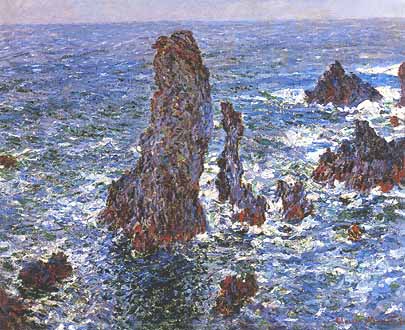
Black rocks rise from a churning Atlantic, the water swirling around them like flame. Monet painted the same rocks of Port-Coton six times in the autumn of 1886, chasing every change of light and sea.
The story behind the painting
In 1886 Post-Impressionists such as Seurat and Pissarro were challenging the Impressionists with new techniques. Monet left gentle scenery behind and went to the dramatic island of Belle-Ile-en-Mer to prove himself as a leading modern painter. He arrived at Le Palais on 12 September 1886 and went straight to the wild Atlantic coast, including Port-Coton. He meant to stay a fortnight but kept delaying, and left only on 25 November, painting outdoors in often poor weather.
What to look for
This canvas, about 65 by 81 cm, belongs to the series The Pyramides at Port-Coton, Rough Sea: six paintings of the same rock formations from the same angle and in a very similar format. Across the series, the sky and light change from clear midday to mist, partial cloud and warm late afternoon, and the sea from calm to stormy. The rocks appear only as isolated fragments among the water, painted in a fluid, almost flame-like way.
Meaning and intent
Monet wrote to his wife Alice that one needed no sun for lugubrious effects, and called the coast sinister, diabolical and magnificent. Limiting himself to so few motifs, according to Paul Tucker, forced him to be even more exact about the sea's movement, the light dancing on water and the shadows of the black rocks. David Clarke sees the series as part of Monet's exploration of water's ability to suggest personal emotional states. It was his most extensive serial practice before the Haystacks.
Legacy
The series was first shown in spring 1887 at George Petit's gallery in Paris, within a group of ten Belle-Ile paintings, and again in 1889 at the Monet-Rodin exhibition. Gustave Geffroy praised his colour relationships, and for the first time in Monet's career most critics were positive; one called him the most significant landscape painter of modern times. The six canvases are now dispersed, and this one is in the Pushkin Museum of Fine Arts in Moscow.
豆知識
- One of six paintings of the rocks at Port-Coton, made in 1886.
- Monet stayed on Belle-Ile from 12 September to 25 November 1886.
- First shown at George Petit's gallery in 1887.
- This version is in the Pushkin Museum, Moscow.
画家について
Claude Monet (1840-1926)
印象派 · 空 · 海洋アート · プーシキン美術館 · 海 · 岩石
同じ画家の作品: Claude Monet
 印象・日の出 - Claude Monet (1872)
 睡蓮 - Claude Monet (1906)
 日傘をさす女 - Claude Monet (1875)
 サン=タドレスのテラス - Claude Monet (1867)
 庭の女たち - Claude Monet (1866)
 かささぎ - Claude Monet (1868)
 庭の女 - Claude Monet (1867)
 草上の昼食 - Claude Monet (1866)
関連する画家の作品
 戦艦テメレール号 - J. M. W. Turner (1839)
 雨、蒸気、速度 - グレート・ウェスタン鉄道 - J. M. W. Turner (1844)
 世界の起源 - Gustave Courbet (1866)
 オルナンの埋葬 - Gustave Courbet (2020)
 草上の昼食 - Édouard Manet (1863)
 オランピア - Édouard Manet (1863)
 ムーラン・ド・ラ・ギャレットの舞踏会 - Pierre-Auguste Renoir (1876)
 舟遊びの昼食 - Pierre-Auguste Renoir (1881)
 アブサントを飲む人 - Edgar Degas (1875)
 The Bellelli Family - Edgar Degas (1858)
 星月夜 - Vincent van Gogh (1889)
.jpg) 夜のカフェテラス - Vincent van Gogh (1888)
夜のカフェテラス - Vincent van Gogh (1888)