アスモデア
Francisco Goya · 1819
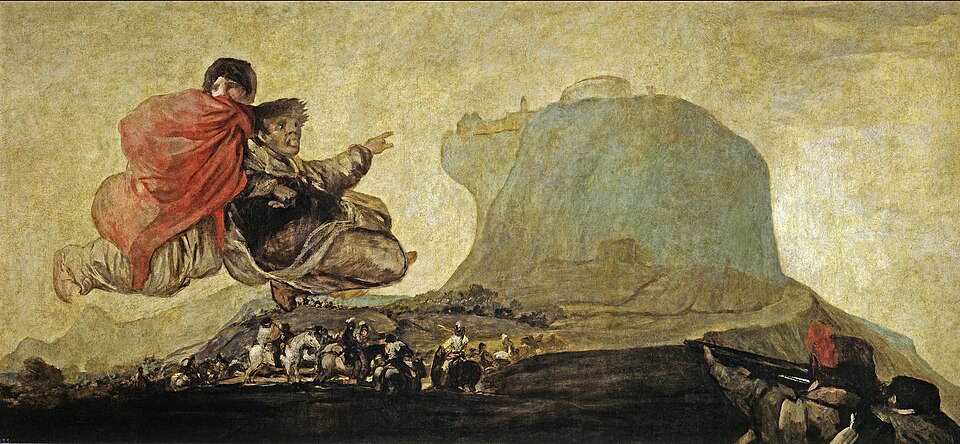
Two figures float above a wide landscape, frightened, looking in opposite directions, while soldiers below take aim. Goya painted this vision on a wall of his house and never named it or explained it.
The story behind the painting
Asmodea, also called Fantastic Vision, is one of the fourteen Black Paintings, Goya's last major series, which he painted in mental and physical despair directly on the walls of his house, the Quinta del Sordo, outside Madrid. Wikipedia dates it to between 1820 and 1823, while Wikidata gives 1819. No record survives of the series' meaning, and the paintings were probably never meant to be seen beyond Goya's small circle. Goya named none of them; the title Asmodea was given later by his friend, the painter Antonio Brugada.
What to look for
A man and a woman hover in the air above a broad landscape dominated by a large table mountain, with a town on its top. The woman wears a white dress under a rose-red robe and covers the lower half of her face; the man's face is deeply disturbed. They look in opposite directions as he points to the town. In the foreground a row of French soldiers, like those in The Third of May 1808, aims at people passing below with horses and wagons, perhaps refugees of the war with France. The canvas measures about 127 by 263 cm.
Meaning and intent
The title is probably a feminine form of the demon Asmodeus from the Book of Tobias. Lopez Vazquez and later Moffitt connected it instead with the myth of Prometheus, carried by Athena to the Caucasus. The critic Evan Connell noted that the mountain resembles Gibraltar, a refuge for Spanish liberals after the Peninsular War. Like Atropos, this is one of the few Black Paintings whose meaning can be partly deduced from classical sources. The male figure's robe seems to bring him almost out of the canvas, distorting our sense of space.
Legacy
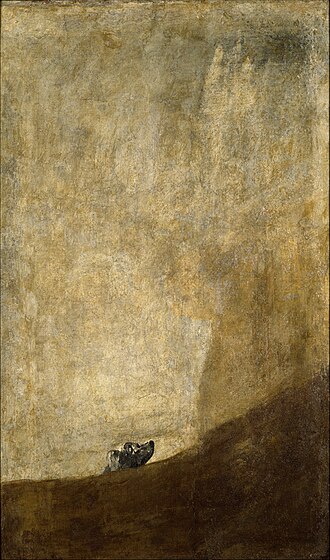
Richard Cottrell compared its livid sky with The Dog from the same series. The work was painted over an earlier version of the scene, on the side walls of the upper floor. Like the other Black Paintings it was later transferred to canvas, and it is now on permanent display at the Museo del Prado in Madrid. The writer Rolfh Kentish saw in it Goya's versatility in moving between crowds and pairs, darkness and light, everyday themes and imagination, and sometimes a strange mixture of the two.
豆知識
- One of Goya's fourteen Black Paintings.
- The title was given later by Antonio Brugada; Goya named none of them.
- Dated 1820-1823 by Wikipedia and 1819 by Wikidata.
- On permanent display at the Museo del Prado.
画家について
Francisco Goya (1746-1828)
同じ画家の作品: Francisco Goya
 1808年5月3日 - Francisco Goya (1814)
 裸のマハ - Francisco Goya (1800)
 我が子を食らうサトゥルヌス - Francisco Goya (1819)
 カルロス4世の家族 - Francisco Goya (1800)
 着衣のマハ - Francisco Goya (1800)
 1808年5月2日、エジプト人親衛隊との戦闘 - Francisco Goya (1814)
 犬 - Francisco Goya (1819)
 魔女の夜宴 - Francisco Goya (1820s)
関連する画家の作品
 雲海の上の旅人 - Caspar David Friedrich (c. 1818)
 楡の木のある僧院 - Caspar David Friedrich (1800s)
 民衆を導く自由の女神 - Eugène Delacroix (1830)
 サルダナパールの死 - Eugène Delacroix (1827)
 戦艦テメレール号 - J. M. W. Turner (1839)
 雨、蒸気、速度 - グレート・ウェスタン鉄道 - J. M. W. Turner (1844)
 青衣の少年 - Thomas Gainsborough (1770)
 アンドリューズ夫妻 - Thomas Gainsborough (1748)