受胎告知
ヤン・ファン・エイク · 1430s
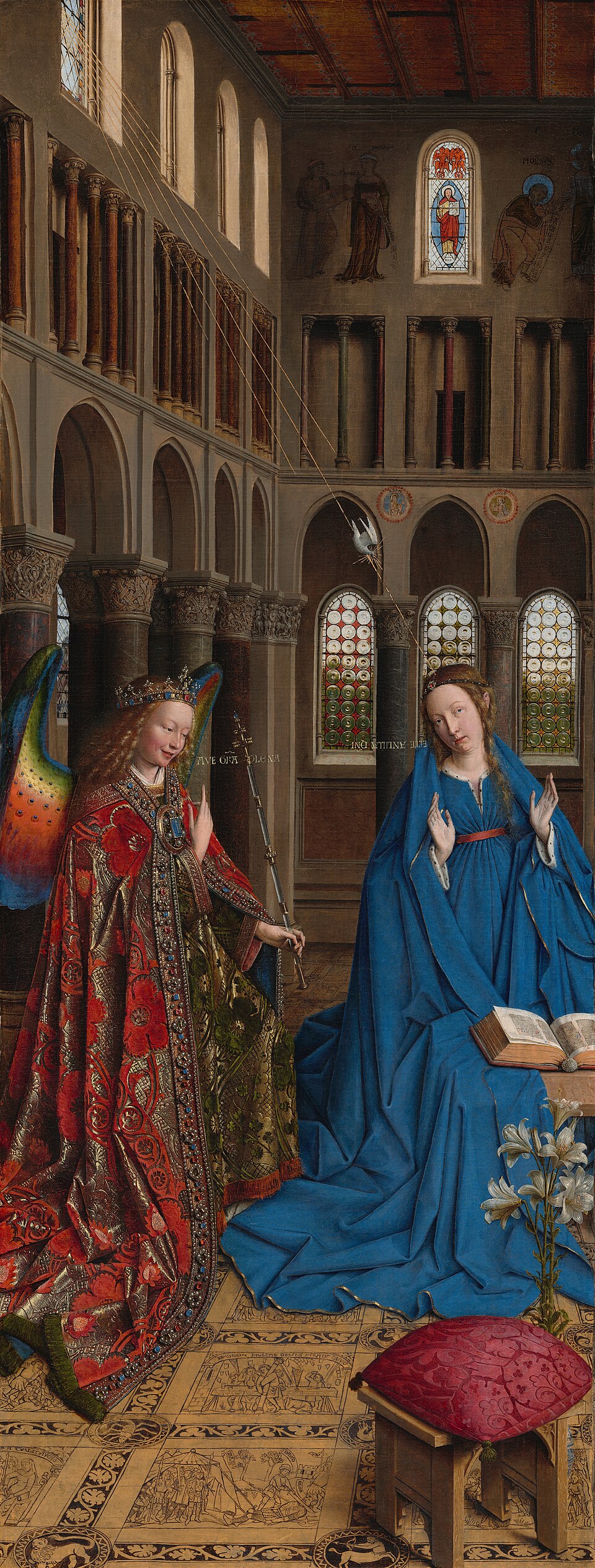
Gabriel in a glittering brocade cope greets Mary in a dim temple, and her answer is written upside down so that God can read it. Van Eyck packed this tall panel with hidden meanings, and a Tsar and Stalin's government both once owned it.
The story behind the painting
Jan van Eyck painted this Annunciation in oil around 1434 to 1436. It is thought to be the left inner wing of a triptych whose other wings have not been seen since before 1817; the centre was perhaps a Nativity or Adoration of the Magi. It may have been commissioned by Philip the Good, Duke of Burgundy, whose court painter van Eyck was. The Tsar of Russia bought it for the Hermitage, but Stalin's government sold it in 1930. It is now in the National Gallery of Art in Washington, transferred from panel to canvas.
What to look for
Gabriel greets Mary with AVE GRA PLENA, and she draws back answering ECCE ANCILLA DOMINI, written upside down because it is addressed to God. Seven rays of gold leaf, the only gold leaf in the picture, fall from a high window with the dove. Look at the floor tiles: David slays Goliath, Samson pulls down the temple. The architecture moves from dark Romanesque arches above to lit Gothic ones below, and the timber roof is in poor repair. Jehovah stands in the single stained glass window. Mary's posture is ambiguous: standing, kneeling or sitting.
Meaning and intent
The gloom of the old covenant gives way to the light of the new. Medieval viewers believed Mary studied in the Temple, and the big book suits that. The tiles prefigure Christ's triumph and Passion; lilies stand for purity, and the empty stool may be an empty throne. Gabriel's cope marks him like a celebrant at High Mass, and Mary's raised hands echo a priest's gesture, linking the painting to the Golden Mass. Mary may bear the features of Isabella of Portugal. Writers such as Hand call the figures over-large, though the sources say the building has no clear scale.
Legacy
The iconography is still debated by art historians; Erwin Panofsky developed much of the analysis, placing Gabriel over Aries and Mary over Virgo in the border tiles. A cleaning in 1998 and infrared reflectograms revealed van Eyck's underdrawing and many changes made during painting, consistent with works like the Arnolfini Portrait. His technique shines in Gabriel's brocade, painted wet-on-wet rather than gilded, and in a shadowy area behind the stool where he worked a glaze with his fingers. The play of light over so many textures remains astonishing.
豆知識
- Oil, about 1434-1436, probably the left wing of a lost triptych.
- Bought by the Tsar for the Hermitage, sold by Stalin's government in 1930.
- Mary's reply is painted upside down, addressed to God.
- Now in the National Gallery of Art, Washington.
画家について
ヤン・ファン・エイク (1390-1441)
宗教美術 · 女性 · 聖母マリア · ナショナル・ギャラリー・オブ・アート · 初期フランドル派 · エルミタージュ美術館 · 受胎告知 · ガブリエル
同じ画家の作品: ヤン・ファン・エイク
 アルノルフィーニ夫妻像 - Jan van Eyck (1434)
 ヘントの祭壇画 - Jan van Eyck (1432)
.webp) 宰相ロランの聖母 - Jan van Eyck
宰相ロランの聖母 - Jan van Eyck 教会の聖母子 - Jan van Eyck (1440)
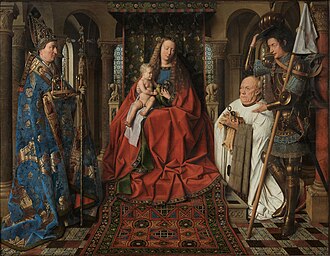 ファン・デル・パーレの聖母子 - Jan van Eyck (1436)
.png) ルッカの聖母 - Jan van Eyck (1437)
ルッカの聖母 - Jan van Eyck (1437)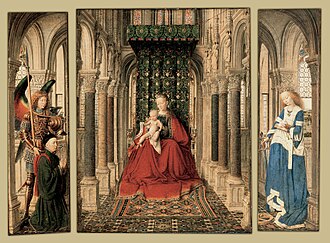 ドレスデンの祭壇画 - Jan van Eyck (1437)
%201433.jpg) 自画像 - Jan van Eyck (1433)
自画像 - Jan van Eyck (1433)
 快楽の園
快楽の園 愚者の船
愚者の船 十字架降架
十字架降架 女性の肖像
女性の肖像%20-%20Google%20Art%20Project.jpg) 雪中の狩人
雪中の狩人 ネーデルラントの諺