工業
Francisco Goya · 1804
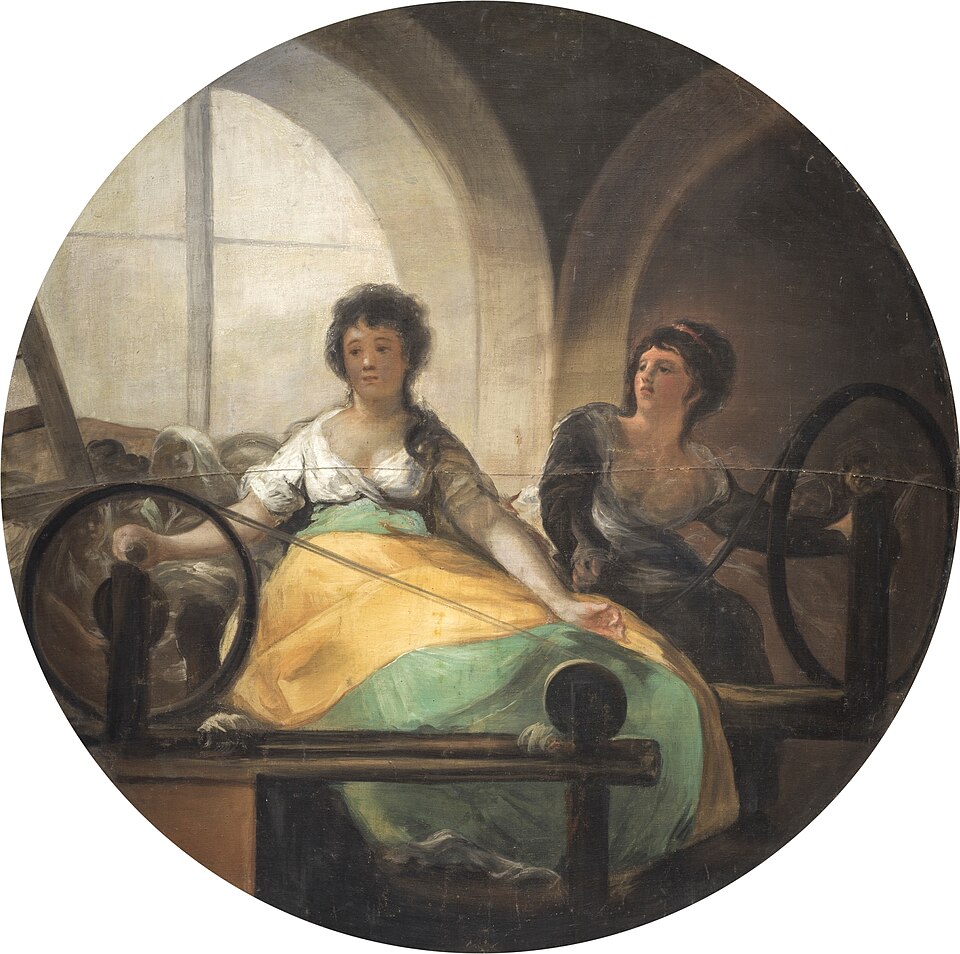
Two young women thread their spinning wheels in a half-dark room, while faces of old women hover in the shadows behind them. Goya painted this round picture for the most powerful man in Spain, and it says more about hopes than about factories.
The story behind the painting
Goya painted Allegory of Industry in tempera on canvas as a tondo, a round picture, around 1805; Wikipedia gives c. 1805 while Wikidata gives 1804. It was one of four allegories about scientific and economic progress, alongside Agriculture, Commerce and Science, the last of which has been lost. Together they decorated a waiting room in the residence of Manuel Godoy, Prime Minister of Spain under Charles IV. Visitors waiting to see him would have sat among these images of a prosperous, modern country.
What to look for
Two young women sit at their spinning wheels, threading them in a room that is mostly dark. A large window opens on the left and pours light over them, their white blouses and low necklines catching it. Their attitudes are melancholy and distracted rather than busy. Look into the gloom at the back: you can just make out uncertain faces of old women, sometimes linked to the Fates. It is not clear whether they are fellow workers or figures in a tapestry or canvas on the wall.
Meaning and intent
The theme served Godoy's wish to appear as an enlightened, reformist leader and guarantor of Spain's progress, in the spirit of the Sociedad Económica de los Amigos del País, which thrived at the time. Yet the picture is far from the Industrial Revolution then under way elsewhere in Europe. There is no crowd of spinners suggesting mass production, only simple machines, and the women look more like upper class ladies than factory workers. It shows the gap between what the wealthy imagined industry to be and what it really was.
Legacy
The painting departs from the model of the old regime, seen in Velázquez's Las Hilanderas, without becoming a picture of the industrial age, and that in-between quality is what makes it so revealing today. Of the four allegories made for Godoy's waiting room, the Allegory of Science is lost, which makes the surviving ones all the more precious as a set of ideas about progress. Since 1932 Allegory of Industry has been in the Museo del Prado in Madrid, where visitors can see this quiet, dreamy vision of work up close.
豆知識
- Tempera on canvas tondo, c. 1805 (Wikidata: 1804).
- One of four allegories for Manuel Godoy's waiting room.
- The companion Allegory of Science is lost.
- In the Museo del Prado since 1932.
画家について
Francisco Goya (1746-1828)
同じ画家の作品: Francisco Goya
 1808年5月3日 - Francisco Goya (1814)
 裸のマハ - Francisco Goya (1800)
 我が子を食らうサトゥルヌス - Francisco Goya (1819)
 カルロス4世の家族 - Francisco Goya (1800)
 着衣のマハ - Francisco Goya (1800)
 1808年5月2日、エジプト人親衛隊との戦闘 - Francisco Goya (1814)
 犬 - Francisco Goya (1819)
 魔女の夜宴 - Francisco Goya (1820s)
関連する画家の作品
 雲海の上の旅人 - Caspar David Friedrich (c. 1818)
 楡の木のある僧院 - Caspar David Friedrich (1800s)
 民衆を導く自由の女神 - Eugène Delacroix (1830)
 サルダナパールの死 - Eugène Delacroix (1827)
 戦艦テメレール号 - J. M. W. Turner (1839)
 雨、蒸気、速度 - グレート・ウェスタン鉄道 - J. M. W. Turner (1844)
 青衣の少年 - Thomas Gainsborough (1770)
 アンドリューズ夫妻 - Thomas Gainsborough (1748)