神の御名の礼拝
Francisco Goya · 1772
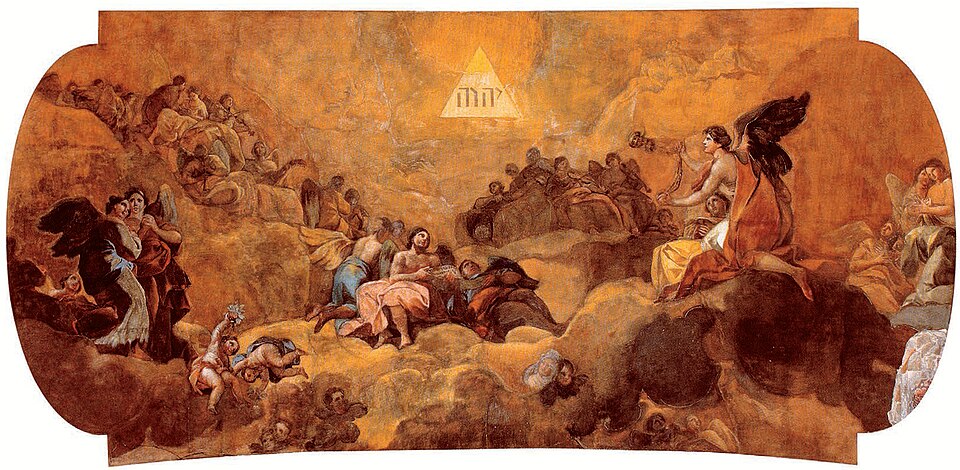
High above a small choir in Zaragoza, angels turn toward a glowing triangle bearing the name of God in Hebrew. It is Goya's first great fresco, painted in 1772 when he was just back from Italy.
The story behind the painting
In 1771 Goya returned from a journey to Italy, made to broaden his knowledge. Soon afterwards he received the commission to decorate the vault above the small choir, the Coreto of the Virgin, in the Basilica of Our Lady of the Pillar in Zaragoza, with a scene of the Adoration of the Name of God. The fresco, also called The Glory, is dated 1772. In carrying it out he showed a full command of fresco technique, yet he was paid less than other artists working on the basilica's ceilings, such as Antonio González Velázquez.
What to look for
This is a ceiling, so you look up into it. On both sides, groups of angels point the eye toward the centre, where the symbol of the Trinity and Godhead appears: an equilateral triangle inscribed with the Tetragrammaton, the four-letter name of God in Hebrew. Wikidata gives a size of 700 by 1500 cm. Because the groups sit at different heights, the overall effect is rather static, held by an X-shaped composition: Goya wanted lines of force to come in from the corners and cross in the middle.
Meaning and intent
The finished fresco follows the conventions of late Baroque Catholic religious painting. Its subject is pure worship: no story, only heavenly beings turning toward a name of light. The source notes that Goya's sketches and preparatory drawings, which survive, show more ambition than the vault does today. In them he planned strong contrasts of colour and light and much more movement. Here we meet a young painter learning to work at monumental scale, before the very different art he would later make.
Legacy
Part of the gap between drawings and ceiling may come from time and repair: the fresco has been restored no fewer than four times, in 1887, 1947, 1967 and 1991. It remains in place in the Basilica del Pilar, one of the grand churches of Zaragoza, near where Goya grew up. For visitors who know him for portraits and dark visions, this ceiling is a reminder that his career began with angels, clouds and the solemn task of filling a church vault.
豆知識
- Fresco painted in 1772 in the Basilica del Pilar, Zaragoza.
- Commissioned soon after Goya's return from Italy in 1771.
- Centred on a triangle with the Tetragrammaton in Hebrew.
- Restored in 1887, 1947, 1967 and 1991.
画家について
Francisco Goya (1746-1828)
同じ画家の作品: Francisco Goya
 1808年5月3日 - Francisco Goya (1814)
 裸のマハ - Francisco Goya (1800)
 我が子を食らうサトゥルヌス - Francisco Goya (1819)
 カルロス4世の家族 - Francisco Goya (1800)
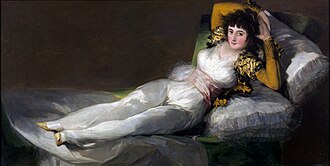 着衣のマハ - Francisco Goya (1800)
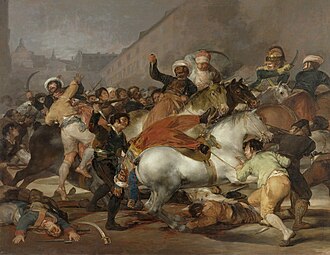 1808年5月2日、エジプト人親衛隊との戦闘 - Francisco Goya (1814)
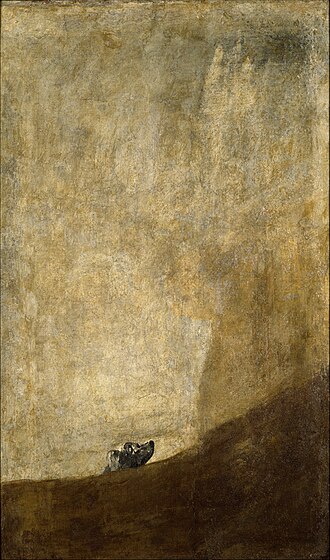 犬 - Francisco Goya (1819)
 魔女の夜宴 - Francisco Goya (1820s)
関連する画家の作品
 雲海の上の旅人 - Caspar David Friedrich (c. 1818)
 楡の木のある僧院 - Caspar David Friedrich (1800s)
 民衆を導く自由の女神 - Eugène Delacroix (1830)
 サルダナパールの死 - Eugène Delacroix (1827)
 戦艦テメレール号 - J. M. W. Turner (1839)
 雨、蒸気、速度 - グレート・ウェスタン鉄道 - J. M. W. Turner (1844)
 青衣の少年 - Thomas Gainsborough (1770)
 アンドリューズ夫妻 - Thomas Gainsborough (1748)