東方三博士の礼拝
パオロ・ヴェロネーゼ · 1573
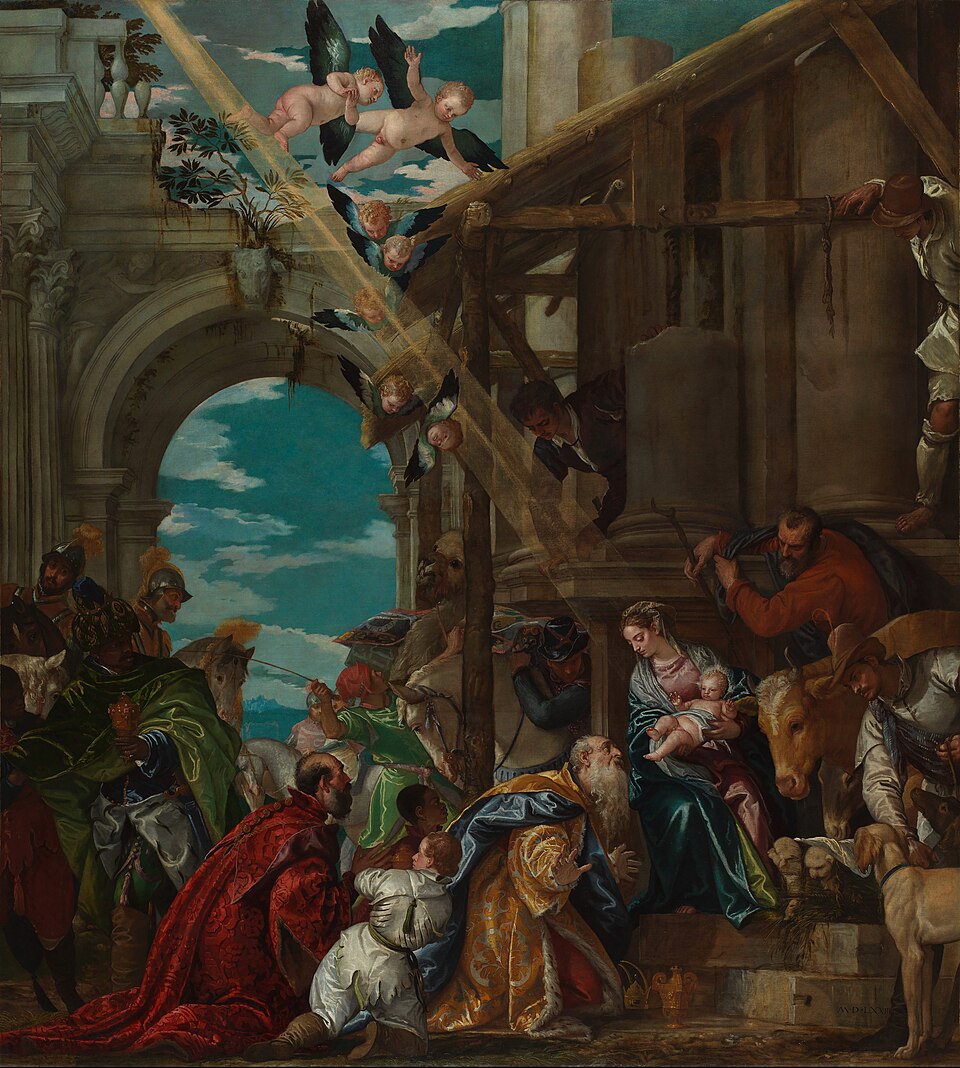
Three kings in robes fit for a Venetian stage bow before the Child among the ruins of a classical temple. Veronese's huge Adoration hung in a Venice church for almost three centuries before it came to London.
The story behind the painting
The painting was commissioned by the Scuola di San Giuseppe, a devotional confraternity of Saint Joseph that included women, for the parish church of San Silvestro in Venice. It was not an altarpiece but hung beside their altar on the left wall of the nave. The date 1573 is painted on the lowest stone step. In that same year Veronese also completed the enormous Feast in the House of Levi and a large Madonna del Rosario, which led Cecil Gould to suggest that much of this work was done by the studio.
What to look for
Follow the diagonal of the main figures up to Saint Joseph, placed on a ledge above the ox at its top. The three kings wear robes that echo the dress of the Venetian elite, but more extravagant and fanciful, perhaps drawn from theatre costumes, which Veronese also designed. The setting is a ruined classical temple, closer to stage scenery than real architecture. Look also for the animals: an ox and an ass, horses, two lambs, two dogs and a camel. The heads of the two older kings, Nicholas Penny writes, are among the finest Veronese ever painted.
Meaning and intent
The subject was chosen because the patrons were a confraternity of Saint Joseph, although he is not prominent. The ruined temple carries old meanings: a medieval legend in the Golden Legend said that the Basilica of Maxentius in Rome partly fell on the night of Christ's birth, and in earlier Netherlandish painting a ruined temple stood for the decayed Old Covenant. Some scholars see the hand of Jacopo Bassano or his workshop in the faces of the Virgin and Caspar and in the ox and ass. Veronese admired Bassano, a specialist in history paintings with animals.
Legacy
The picture was famous in Venice; in 1670 agents of Cosimo III de' Medici tried for two years to bribe every member of the confraternity to sell it, and failed. When San Silvestro was rebuilt from 1836, the painting was stored folded or rolled for nearly twenty years. The dealer Angelo Toffoli bought it in 1855 and sent it to Paris, but Sir Charles Eastlake, the new director of the National Gallery, bought it, probably unseen. It has hung in London since 1856, now in Room 9, and a 2012 to 2013 restoration suggested more of Veronese's own hand than once thought.
豆知識
- Dated 1573 on the lowest step.
- Commissioned by the confraternity of Saint Joseph for San Silvestro, Venice.
- Bought by the National Gallery in 1855.
- Restored in 2012-2013.
画家について
パオロ・ヴェロネーゼ (1528-1588)
宗教美術 · 聖母マリア · イエスの幼少時代 · ナショナル・ギャラリー · マニエリスム · 東方三博士の礼拝 · 東方の三博士 · 崇拝
同じ画家の作品: パオロ・ヴェロネーゼ
 カナの婚礼 - Paolo Veronese (1560s)
 レヴィ家の饗宴 - Paolo Veronese (1573)
 ヴィーナスとアドニス - Paolo Veronese (1580)
 美徳と悪徳の間の選択 - Paolo Veronese (1565)
 キューピッドによって結ばれるマルスとヴィーナス - Paolo Veronese (1570s)
 アレクサンドロス大王の前に出たダレイオスの家族 - Paolo Veronese (1565)
 マグダラのマリアの改宗 - Paolo Veronese (1548)
 バテシバの水浴 - Paolo Veronese (1575)
関連する画家の作品
 オルガス伯の埋葬 - El Greco (1586)
 トレドの風景 - El Greco (1596)
 最後の晩餐 - Jacopo Tintoretto (1563)
 奴隷を解放する聖マルコ - Jacopo Tintoretto (1540s)
 ウルビーノのヴィーナス - Titian (1538)
 聖母被昇天 - Titian (1510s)
 エマオの晩餐 - Caravaggio (1601)
 聖マタイの召命 - Caravaggio (1609)
 大使たち - Hans Holbein the Younger (1533)
 墓の中のキリストの屍 - Hans Holbein the Younger (1520s)