Conquête de passage
アンリ・ド・トゥールーズ=ロートレック · 1896
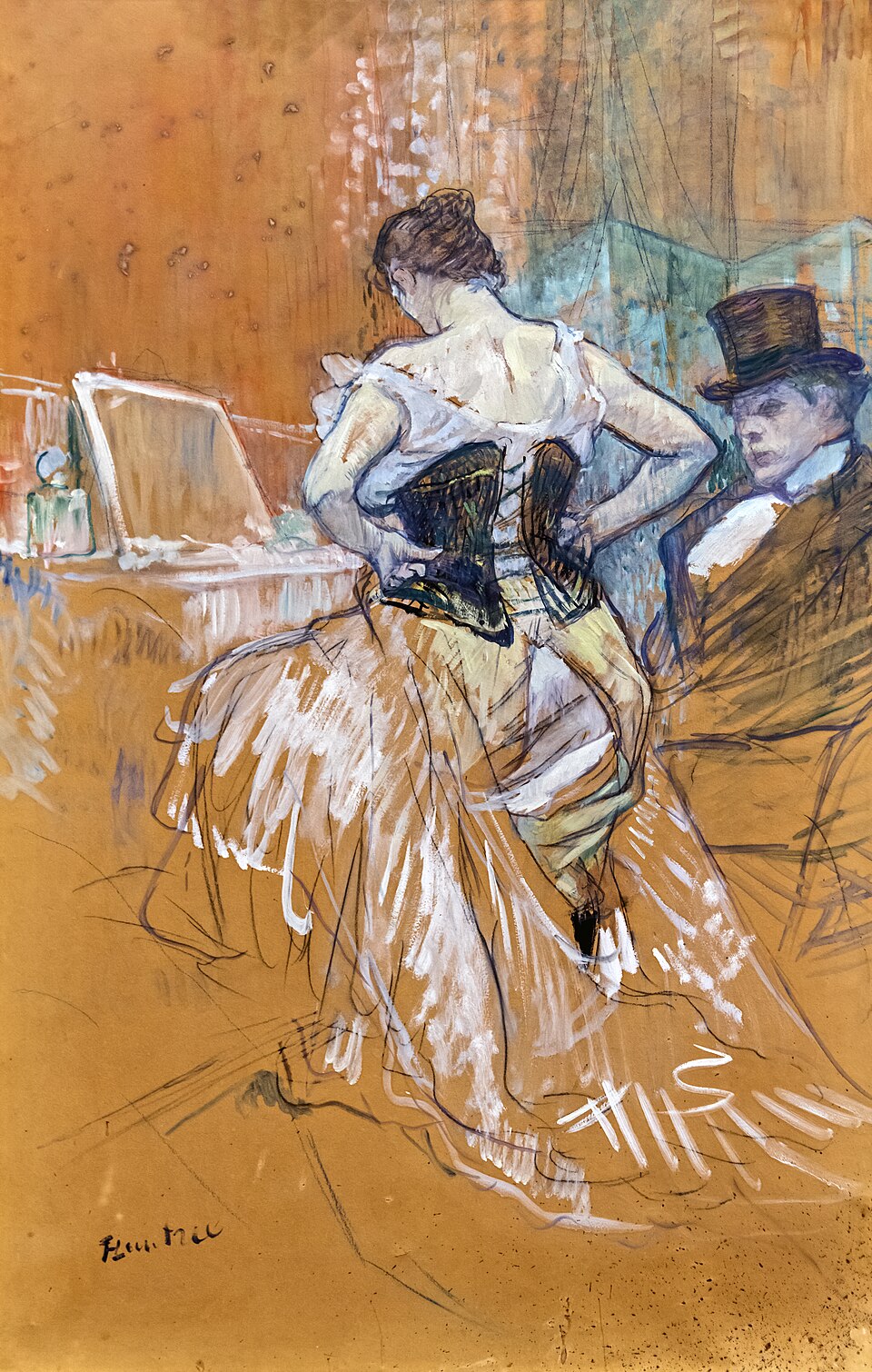
A woman, seen almost from behind, struggles with the laces of her black corset, while a man at the very edge of the picture watches her. This large painted study by Toulouse-Lautrec was the first step toward one of the prints of his famous album Elles.
The story behind the painting
Conquête de passage, also called Woman Putting on Her Corset, is a preparatory study from 1896 for a lithograph titled Femme en corset, conquête de passage. That print belongs to Elles, an album of colour lithographs on the private lives of courtesans, a world Lautrec knew well. He sometimes left his studio on the rue Tourlaque to stay for days or months in brothels on the rue Joubert, the rue d'Amboise or the rue des Moulins, living, painting and drawing there. When the dealer Paul Durand-Ruel asked to visit his studio, Lautrec received him in the salon of the rue des Moulins, surrounded by its residents.
What to look for
The woman, seen three quarters from behind, stands at her dressing table and fills the centre, pushing the man to the right edge, where he almost leaves the picture. Her torso is firmly modelled against the black corset, while her petticoat is only sketched in broad strokes of chalk and brush. Only the man's face is really detailed, which makes his gaze feel heavier. Lautrec laid out the lines in black chalk on a blue ground, then added white, yellow green, and a dark blue corset touched with yellow and green. Chalk lines at top right suggest he first thought of curtains over a bed, then chose a screen.
Meaning and intent
The man may be the English painter Charles Conder, Lautrec's friend; according to Joyant he was the model. Pencil corrections show that Lautrec first drew him smaller, then made him more massive. In the final print, unusually for Elles, the man remains, but reduced to a sketch in the background, an insistent and troubling presence. The source argues that Lautrec here refuses the viewer the implied male role and mocks the bourgeois client, while showing these women in their daily routine with a kindly, unsentimental attention. He was surely inspired by the prints of Utamaro, which showed courtesans at every hour of the day.
Legacy
This is the largest painted study of the Elles series. It was bequeathed by the artist's mother, Countess Alphonse de Toulouse-Lautrec, and has been in the Musée des Augustins in Toulouse since 1904, where it hangs in the Red Salon. Other, less finished studies on the same theme are in the Musée Toulouse-Lautrec in Albi and in a private collection. The album Elles appeared in 1896, published by Gustave Pellet, who saw in it a cruelty of marvellous exactness. The source counts eleven lithographs in one place and ten plates in another, a discrepancy it leaves unresolved.
豆知識
- A preparatory study from 1896 for a lithograph in the album Elles.
- The man may be the painter Charles Conder.
- The largest painted study of the Elles series.
- In the Musée des Augustins, Toulouse, since 1904.
画家について
アンリ・ド・トゥールーズ=ロートレック (1864-1901)
同じ画家の作品: アンリ・ド・トゥールーズ=ロートレック
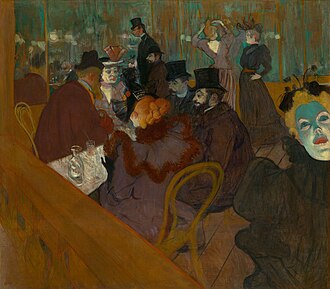 ムーラン・ルージュ - Henri de Toulouse-Lautrec (1892)
%20Rousse%20(La%20Toilette)%20-%201889%20-%20Henri%20de%20Toulouse-Lautrec%20-%20Mus%C3%A9e%20d'Orsay%2C%20Paris.jpg) La Toilette - Henri de Toulouse-Lautrec (1896)
La Toilette - Henri de Toulouse-Lautrec (1896)%2C%201887-1889%20color%20corrected.jpg) The Hangover - Henri de Toulouse-Lautrec (1889)
The Hangover - Henri de Toulouse-Lautrec (1889)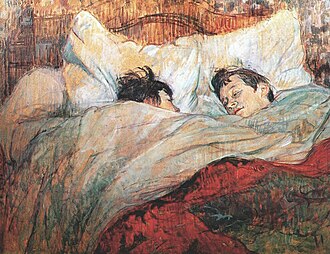 Le Lit - Henri de Toulouse-Lautrec (1890s)
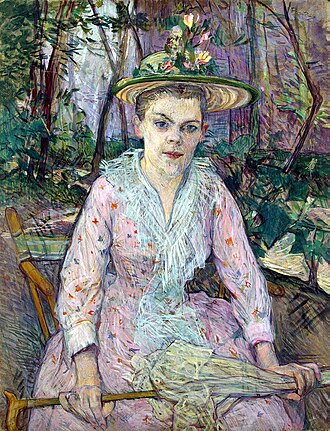 Woman with a parasol - Henri de Toulouse-Lautrec (1889)
 In a Private Dining Room - Henri de Toulouse-Lautrec (1899)
 Paul Viaud em almirante do século XVIII - Henri de Toulouse-Lautrec (1901)
 At Grenelle, Absinthe Drinker - Henri de Toulouse-Lautrec (1886)
関連する画家の作品
 星月夜 - Vincent van Gogh (1889)
.jpg) 夜のカフェテラス - Vincent van Gogh (1888)
夜のカフェテラス - Vincent van Gogh (1888) 我々はどこから来たのか 我々は何者か 我々はどこへ行くのか - Paul Gauguin (1897-1898)
%201889.jpg) 黄色いキリスト - Paul Gauguin (1889)
黄色いキリスト - Paul Gauguin (1889) ムーラン・ド・ラ・ギャレットの舞踏会 - Pierre-Auguste Renoir (1876)
 舟遊びの昼食 - Pierre-Auguste Renoir (1881)