Zerubbabel, Abiud and Eliakim
Michelangelo · 1508
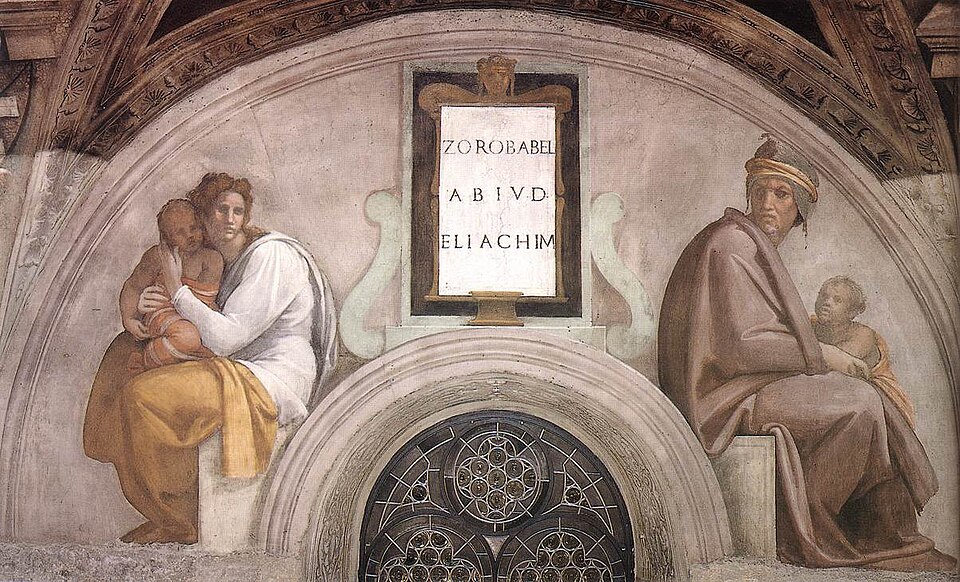
A mother hugs her child close in bright yellow and red; across from her, a man wrapped in violet barely notices the anxious boy at his knee. Michelangelo painted these Sistine ancestors in quick, powerful strokes, like sketches in colour.
The story behind the painting
The lunette of Zerubbabel, Abiud and Eliakim was frescoed by Michelangelo around 1508 to 1511 on the walls of the Sistine Chapel, as part of the ceiling decoration commissioned by Pope Julius II. Wikidata gives 1508 and a size of about 215 by 430 cm. The lunettes above the windows hold Michelangelo's series of the Ancestors of Christ, painted like the rest of the ceiling in two phases, starting from the far wall opposite the altar, so the latest generations in the story were painted first. By summer 1511 the first half of the chapel had to be finished, and the scaffolding was taken down and rebuilt in the other half. The second phase began in October 1511 and ended a year later, just in time for the unveiling on the eve of All Saints' Day 1512. This lunette was probably the fifth Michelangelo painted.
What to look for
The lunette has one group on each side of a tablet with the names in Roman capitals: ZOROBABEL, ABIVD, ELIACHIM. On the left a woman, seated and leaning in profile but turning her head toward us, clutches her child with a protective, motherly gesture. She wears a light dress, her legs covered by a yellow mantle; the child is wrapped in red cloth tied with white gauze that makes stripes. On the right a man is wrapped in a violet mantle under a large green cap with a yellow band, painted on dry plaster. The kneeling child beside him, blurrier to show he stands further back, seems to try to catch the man's attention with a slightly anxious look.
Meaning and intent
The lunettes follow the genealogy of Christ from the Gospel of Matthew; this one is the next-to-last lunette of the right wall, and one of the three named men, nobody knows which, is shown in the family group in the vaulted triangle above. With no precise clues or attributes, it is impossible to say who the figures are. Their arrangement seems driven by a search for symmetry: a woman on the left and a man on the right, each with a child. What remains is a quiet contrast of moods, the bright colour and warmth of the mother's side against the darker, more withdrawn group on the right.
Legacy
Seen up close, the figures look like powerful sketches, painted with rapid concision. The edge of one day's plaster runs along the line of the woman's back, showing that her outline, at least roughly, may already have been planned in a drawing. The lunettes were among the most blackened parts of the chapel's decoration, and their restoration in 1986 gave astonishing results, bringing back colours like the mother's yellow mantle and the child's red wrapping. Today they show how freely and quickly Michelangelo could work even on these less visible parts of his vast project.
Lo sapevi?
- Lunette fresco, about 1508 to 1511.
- Probably the fifth lunette Michelangelo painted.
- Names on the tablet: ZOROBABEL, ABIVD, ELIACHIM.
- Restored with striking results in 1986.
L'artista
Michelangelo (1475-1564)
religious art · High Renaissance · Vatican Museums
Altre opere di Michelangelo
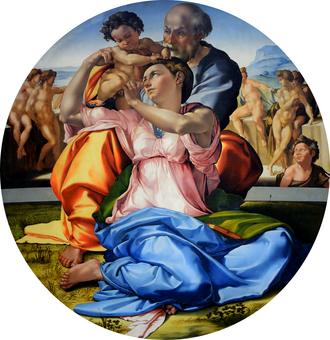 Doni Tondo - Michelangelo (1500s)
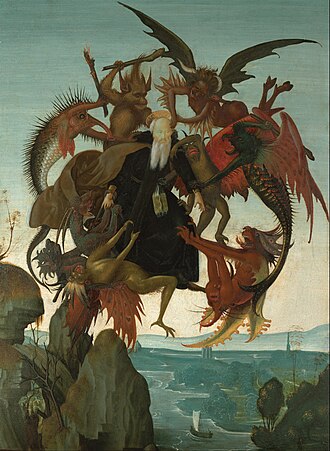 The Torment of Saint Anthony - Michelangelo (1487)
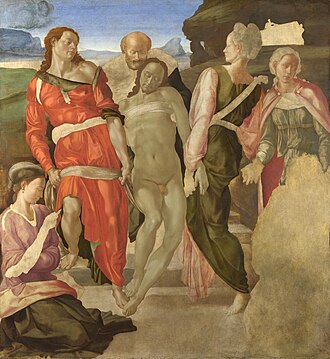 The Entombment - Michelangelo (1500s)
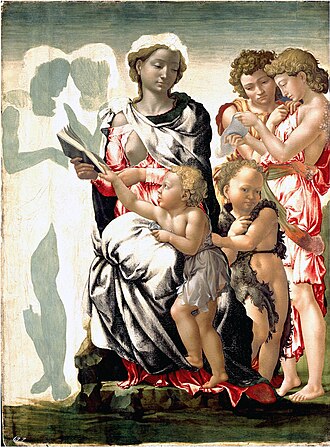 Manchester Madonna - Michelangelo (1494)
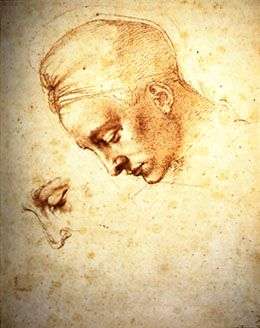 Leda and the Swan - Michelangelo (1530)
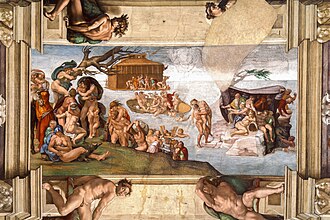 The Deluge - Michelangelo (1508)
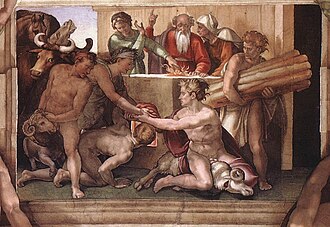 The Sacrifice of Noah - Michelangelo (1508)
 Separation of Light from Darkness - Michelangelo (1512)
Dipinti di artisti collegati
 Sistine Madonna - Raphael (1510s)
 La fornarina - Raphael
 Venus of Urbino - Titian (1538)
 Assumption of the Virgin - Titian (1510s)
 Mona Lisa - Leonardo da Vinci (1503-1519)
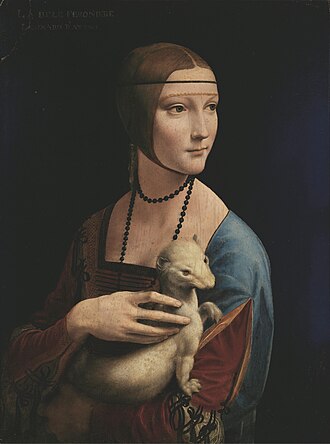 Lady with an Ermine - Leonardo da Vinci (1490)
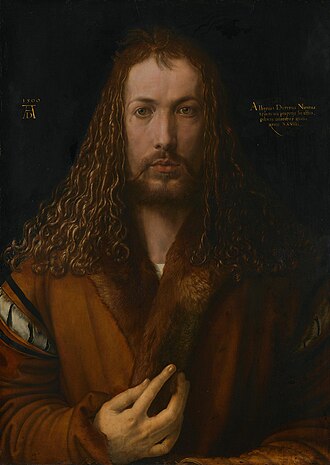 Self-Portrait with Fur-Trimmed Robe - Albrecht Dürer (1500)
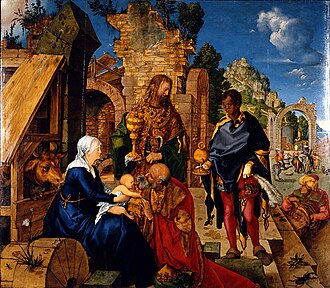 Adoration of the Magi - Albrecht Dürer (1504)
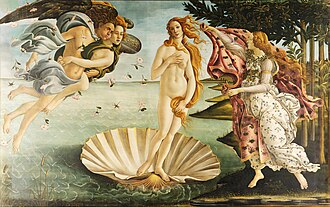 The Birth of Venus - Sandro Botticelli (c. 1485)
 Primavera - Sandro Botticelli (1480s)
 The Garden of Earthly Delights - Hieronymus Bosch
 Ship of Fools - Hieronymus Bosch (1500s)