Separation of Light from Darkness
Michelangelo · 1512
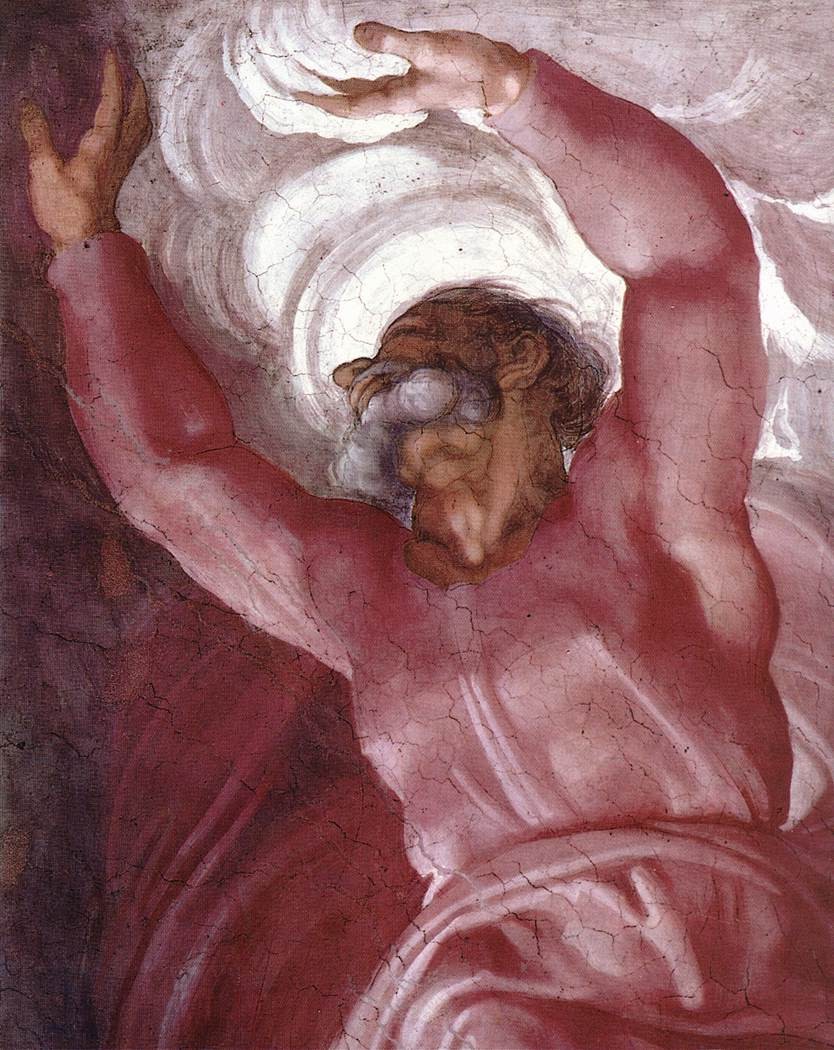
God twists upward with arms spread, tearing light from darkness on the very first day. It is the first scene of Genesis on the Sistine ceiling, yet the last one Michelangelo painted, reportedly in a single day.
The story behind the painting
This panel is, in the order of Genesis, the first of nine central scenes on Michelangelo's Sistine Chapel ceiling, based on the verses in which God says let there be light, and separates light from darkness. Yet it was the last of the nine to be painted, probably in summer 1512, the final year of the project. Michelangelo worked in two stages: from May 1508 to summer 1511 he painted the entrance half, ending with the Creation of Eve. After about six idle months he painted the altar half, starting with the Creation of Adam, between winter 1511 and October 1512. Wikidata gives about 180 by 260 cm.
What to look for
God rises at the centre in contrapposto, arms outstretched, painted in the difficult sotto in su technique, foreshortened so that he seems to lift above the viewer. Four ignudi, young male nudes, frame the scene with two bronze-like medallions: above, Abraham about to sacrifice Isaac; below, Elijah carried to heaven in a chariot of fire. One reading sees the ignudi as day and night: one stretches as if waking, one carries heavy oak garlands, one falls asleep. Look too at God's neck: its anatomy is unusually complex, and it seems lit from the right while the rest of the scene is lit from the bottom left.
Meaning and intent
For Giorgio Vasari, writing in 1550, the panel showed the perfection of Michelangelo's art and the greatness of God, alone with open arms in a display of love and creative energy. It is reported to have been painted in a single giornata, about eight hours of work, and in his lifetime it was seen as proof of his technical peak. Andrew Graham-Dixon reads the exaggerated chest as showing male strength but also the fecundity of the female principle. Pfeiffer and other scholars have suggested that the ignudi are angels and the bronze nudes below them fallen angels.
Legacy
In 2010 Ian Suk and Rafael Tamargo of Johns Hopkins proposed, in the journal Neurosurgery, that Michelangelo, who dissected cadavers from his late teens, hid an image of the brainstem in God's neck, the spinal cord in the chest and the optic nerves in the abdomen. They linked it with Frank Meshberger's 1990 suggestion of a brain hidden in the Creation of Adam, and Garabed Eknoyan's idea of a kidney in the Separation of Land and Water. Others have read the neck instead as a goiter. These remain proposals, but they show how this small panel still provokes new ways of looking.
Lo sapevi?
- First scene of Genesis on the Sistine ceiling, but the last panel painted.
- Probably completed in summer 1512.
- Reported to have been painted in a single working day.
- Some researchers see a hidden brainstem in God's neck.
L'artista
Michelangelo (1475-1564)
religious art · High Renaissance · Vatican Museums
Altre opere di Michelangelo
 Doni Tondo - Michelangelo (1500s)
 The Torment of Saint Anthony - Michelangelo (1487)
 The Entombment - Michelangelo (1500s)
 Leda and the Swan - Michelangelo (1530)
 The Deluge - Michelangelo (1508)
 The Sacrifice of Noah - Michelangelo (1508)
 The Creation of Eve - Michelangelo (1511)
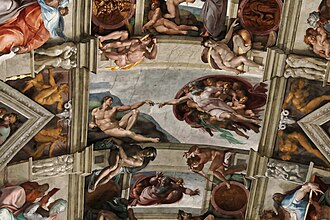 The Separation of the Earth and Waters - Michelangelo (1511)
Dipinti di artisti collegati
.jpg) Venus of Urbino - Titian (1538)
Venus of Urbino - Titian (1538) Assumption of the Virgin - Titian (1510s)
 Sistine Madonna - Raphael (1510s)
.jpg) La fornarina - Raphael
La fornarina - Raphael Mona Lisa - Leonardo da Vinci (1503-1519)
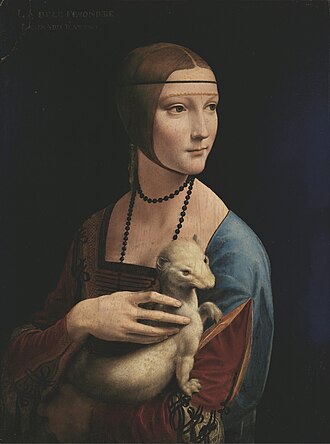 Lady with an Ermine - Leonardo da Vinci (1490)
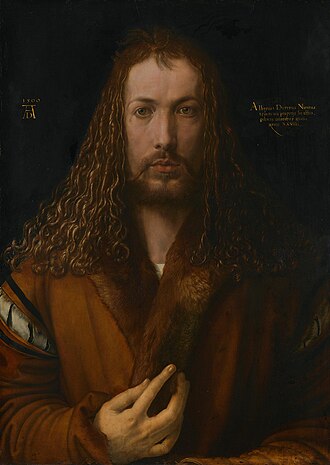 Self-Portrait with Fur-Trimmed Robe - Albrecht Dürer (1500)
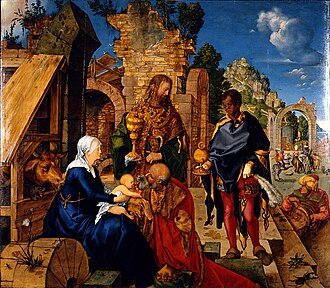 Adoration of the Magi - Albrecht Dürer (1504)
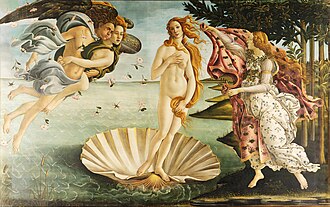 The Birth of Venus - Sandro Botticelli (c. 1485)
 Primavera - Sandro Botticelli (1480s)
 The Garden of Earthly Delights - Hieronymus Bosch
 Ship of Fools - Hieronymus Bosch (1500s)