The Sacrifice of Noah
Michelangelo · 1508
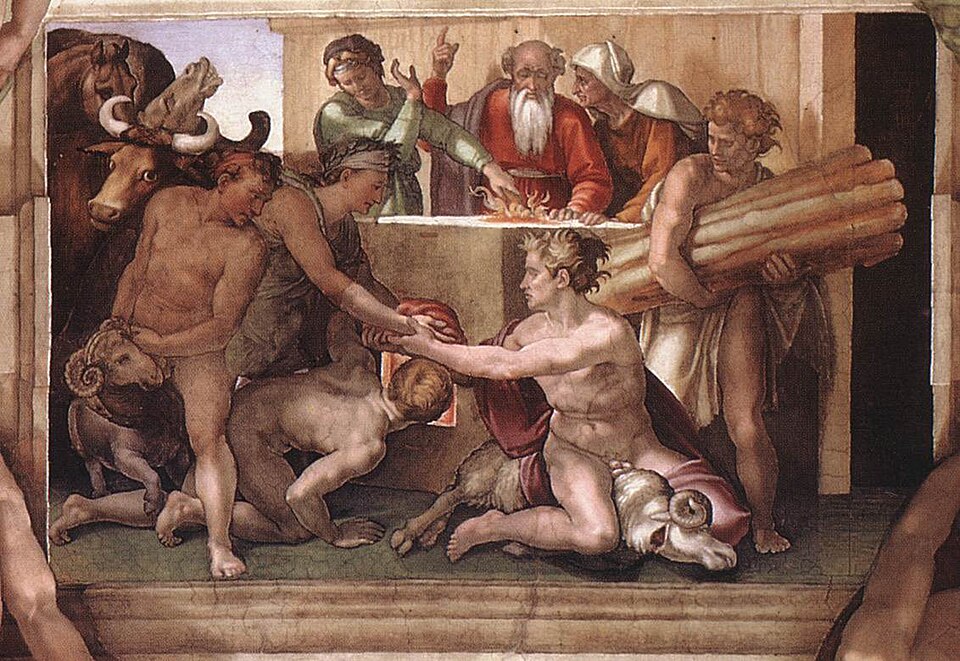
Saved from the Flood, Noah gives thanks at an altar while young men drag in rams, a bull and even a half-hidden elephant. Michelangelo painted this crowded, ordered scene early in his work on the Sistine ceiling.
The story behind the painting
The Sacrifice of Noah is a fresco of about 170 by 260 cm on the Sistine Chapel ceiling, commissioned by Pope Julius II and dated around 1508 to 1510; Wikidata gives 1508. Michelangelo painted the vault in two phases, because the scaffolding covered only half of the chapel and had to be taken down and rebuilt on the other side. This scene, based on Genesis 8, belongs to the first block, starting from the ceremonial entrance, and took twelve days of fresco. In 1568 part of the plaster came loose and Domenico Carnevali restored it. He seems to have followed the original closely, probably because he could see it before the damaged pieces fell.
What to look for
The composition is clear and orderly, borrowing a motif from ancient Roman reliefs of sacrifice. At the centre is the altar, and servants converge on it with animals: two rams, a bull, two horses, and an elephant barely visible in the background. Noah wears the same red tunic he wears in The Drunkenness of Noah. A young woman in green on the left lights the fire with a torch and shields her face with her hand, a figure inspired by a Roman sarcophagus with the story of Meleager. In the foreground a boy carries firewood, a naked youth sits on a freshly killed ram and takes entrails from another, and a third youth leans toward the opening of the altar, perhaps blowing on the fire. The darker figures on the left are Carnevali's restoration.
Meaning and intent
In the Bible, Noah makes his sacrifice after the Flood, to make peace with God, a key moment because his descendants lead to the people of Israel and to Christ. Yet on the ceiling this scene comes before the larger panel of the Flood. The source suggests Michelangelo inverted the order to reserve a major panel for the Flood. Because of this, some, including Ascanio Condivi, identified the scene as the sacrifice of Cain and Abel. The Genesis scenes show humanity before the law of Moses, and each can also be read backwards as a prefiguring of Holy Week, celebrated in the chapel with a procession to the altar.
Legacy
Michelangelo enriched a rather plain biblical account with vivid ritual details, perhaps taken from Leviticus. Older scholarship saw formal sources in versions of the subject by Paolo Uccello and Jacopo della Quercia, and Ernst Gombrich linked the woman at Noah's side to the figure of Althea on a Meleager sarcophagus now in the Villa Albani. The elderly woman in profile on the right, with stiffer outlines, may be the work of assistants. Around the panel sit two pairs of Ignudi, nude youths holding ribbons, and two bronze-coloured medallions showing the punishment of Heliodorus and the destruction of an idolatrous altar by the priest Mattathias.
Lo sapevi?
- Painted in twelve days of fresco.
- Restored by Domenico Carnevali after damage in 1568.
- Placed before the Flood, against the biblical order.
- Some, including Condivi, read it as the sacrifice of Cain and Abel.
L'artista
Michelangelo (1475-1564)
religious art · High Renaissance · Sistine Chapel
Altre opere di Michelangelo
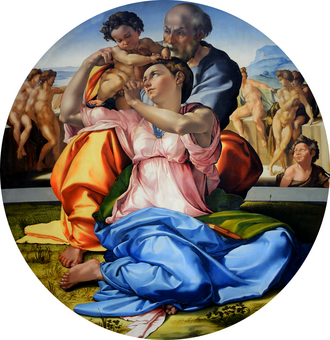 Doni Tondo - Michelangelo (1500s)
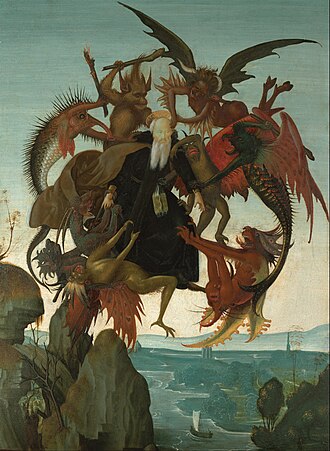 The Torment of Saint Anthony - Michelangelo (1487)
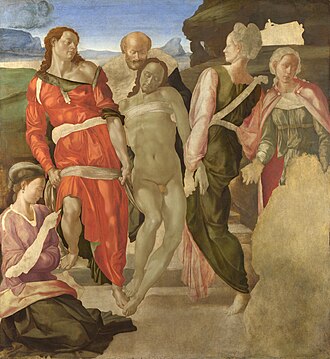 The Entombment - Michelangelo (1500s)
 Leda and the Swan - Michelangelo (1530)
 The Deluge - Michelangelo (1508)
 Separation of Light from Darkness - Michelangelo (1512)
 The Creation of Eve - Michelangelo (1511)
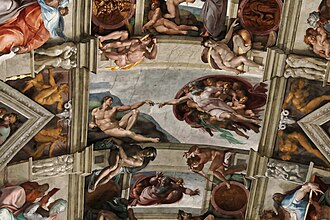 The Separation of the Earth and Waters - Michelangelo (1511)
Dipinti di artisti collegati
.jpg) Venus of Urbino - Titian (1538)
Venus of Urbino - Titian (1538) Assumption of the Virgin - Titian (1510s)
 Sistine Madonna - Raphael (1510s)
.jpg) La fornarina - Raphael
La fornarina - Raphael Mona Lisa - Leonardo da Vinci (1503-1519)
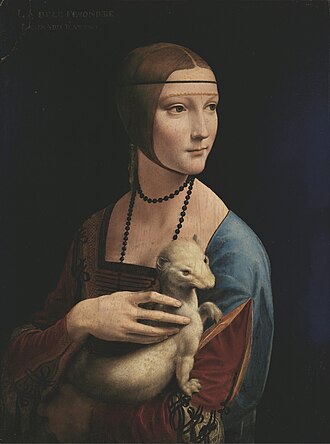 Lady with an Ermine - Leonardo da Vinci (1490)
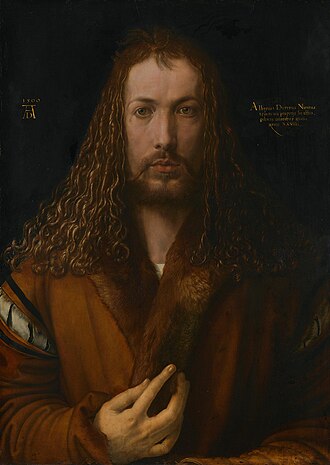 Self-Portrait with Fur-Trimmed Robe - Albrecht Dürer (1500)
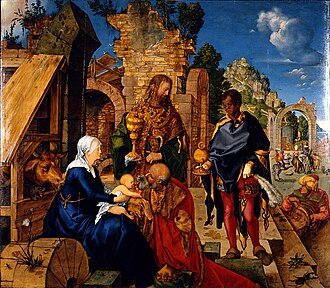 Adoration of the Magi - Albrecht Dürer (1504)
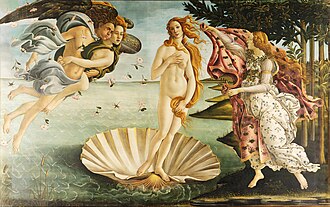 The Birth of Venus - Sandro Botticelli (c. 1485)
 Primavera - Sandro Botticelli (1480s)
 The Garden of Earthly Delights - Hieronymus Bosch
 Ship of Fools - Hieronymus Bosch (1500s)