Venus and Adonis
Peter Paul Rubens · 1638
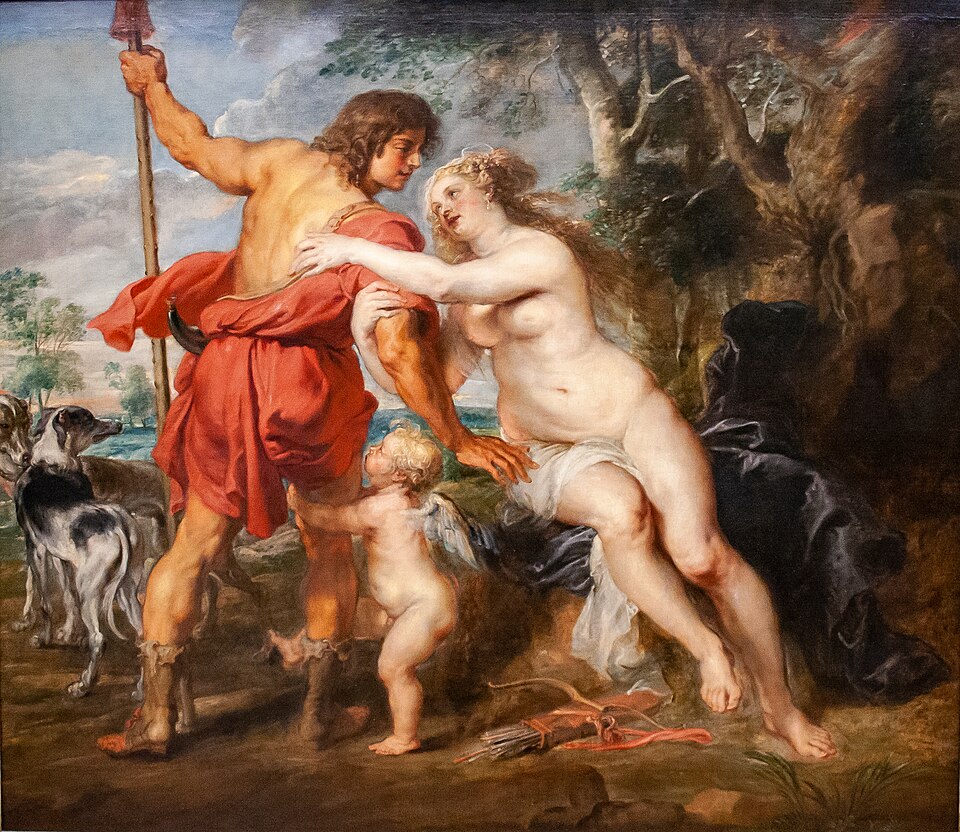
Venus clings to Adonis, Cupid grips his leg, and still the young hunter turns to go. Rubens painted the moment before a death that love could not prevent.
The story behind the painting
The myth is a love story with a fatal ending: Venus fell for Adonis after being pricked by one of Cupid's arrows, and she knows he is about to be killed while hunting. Rubens painted it as a large canvas, most likely to decorate a big country house. In Madrid in 1628 he had made a copy of a painting by Titian, and he used it as an influence here. The sources disagree on the date: the Wikipedia article places the painting in 1635, while Wikidata gives 1638.
What to look for
The canvas is almost 8 feet square, with added strips. Tall, tanned Adonis, in a bright red garment, turns back toward Venus, his left foot lifted as if about to step forward, his gaze blank and elsewhere. Rubens shows his curved spine, his muscles, the large spear, hunting boots and dogs. Venus, almost nude with a sheer white cloth, pulls him down, her face full of distress. Cupid clings to his right leg. Arrows lie on the ground, and two hounds wait in the background. The left side is light, the right side very dark.
Meaning and intent
Unlike Titian's version, this Adonis seems more taken by the hunt and the journey ahead than by Venus. Perhaps because it was meant for a country house, Rubens stressed Adonis as a hunter, strong and powerful. Venus and Cupid, with their bright, fair skin, glow almost like gods against his tanned body and the dark trees, and their likeness recalls that they are mother and son. The moody lighting, a dramatic tenebrism like that of Titian and Caravaggio, makes the figures seem to jump out of the frame. Love pleads; fate walks on.
Legacy
The first records place the painting in the collection of the Elector of Bavaria until 1706. Joseph I, Holy Roman Emperor, then presented it to John Churchill at Blenheim Palace, where it stayed until it was sold by the 8th Duke of Marlborough. Harry Payne Bingham lent it to the Metropolitan Museum of Art from 1920 and gave it in 1937. The museum then removed discoloured varnish and repaints, and the cleaning helped art historians narrow the date. Rubens later painted more versions of the scene, one with Venus's chariot.
Lo sapevi?
- Painted by Rubens in the 1630s; sources give 1635 or 1638.
- Probably made for a large country house.
- Once at Blenheim Palace.
- Given to the Metropolitan Museum of Art in 1937.
L'artista
Peter Paul Rubens (1577-1640)
mythological painting · Metropolitan Museum of Art · dog · Venus · Cupid · nude
Altre opere di Peter Paul Rubens
.jpg) The Elevation of the Cross - Peter Paul Rubens (1609)
The Elevation of the Cross - Peter Paul Rubens (1609) The Rape of the Daughters of Leucippus - Peter Paul Rubens (1618)
 Rubens and Isabella Brant in the honeysuckle bower - Peter Paul Rubens (1600s)
 Samson and Delilah - Peter Paul Rubens (1600s)
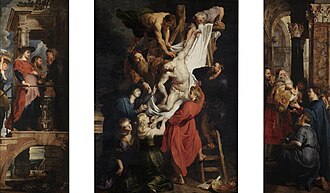 The Descent from the Cross - Peter Paul Rubens (1611)
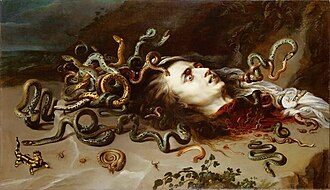 Head of Medusa - Peter Paul Rubens (1618)
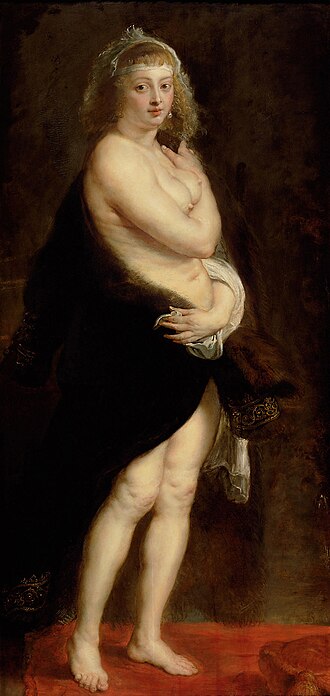 Helena Fourment in a Fur Robe - Peter Paul Rubens (1638)
.jpg) The Garden of Love - Peter Paul Rubens (1632)
The Garden of Love - Peter Paul Rubens (1632)
Dipinti di artisti collegati
 The Starry Night - Vincent van Gogh (1889)
.jpg) Café Terrace at Night - Vincent van Gogh (1888)
Café Terrace at Night - Vincent van Gogh (1888) Supper at Emmaus - Caravaggio (1601)
 La vocazione di San Matteo - Caravaggio (1609)
 Las Meninas - Diego Velázquez (1656)
 The Surrender of Brea - Diego Velázquez (1635)
%20-%20Google%20Art%20Project.jpg) Charles I in Three Positions - Anthony van Dyck (1635)
Charles I in Three Positions - Anthony van Dyck (1635)%20with%20M.%20de%20St%20Antoine%20-%20Google%20Art%20Project.jpg) Charles I (1600-1649) with M. de St Antoine - Anthony van Dyck (1636)
Charles I (1600-1649) with M. de St Antoine - Anthony van Dyck (1636)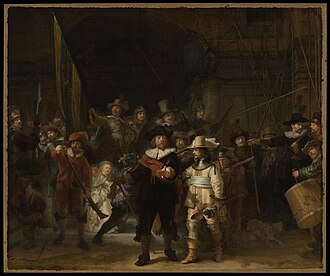 The Night Watch - Rembrandt van Rijn (1642)
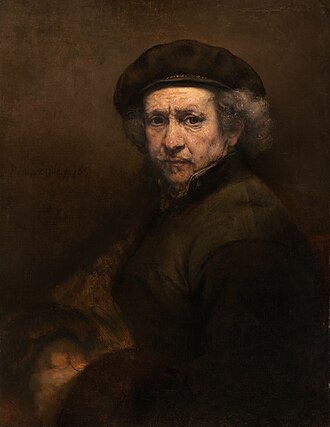 Self-Portrait - Rembrandt van Rijn (1659)
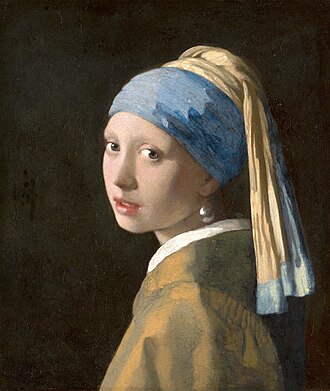 Girl with a Pearl Earring - Johannes Vermeer (1665)
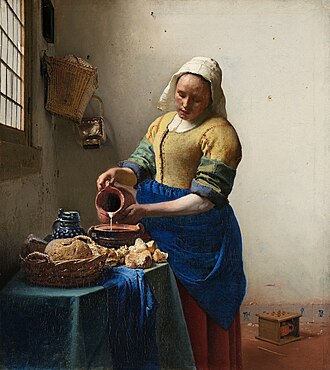 The Milkmaid - Johannes Vermeer (c. 1658)