The White Horse
Paul Gauguin · 1898
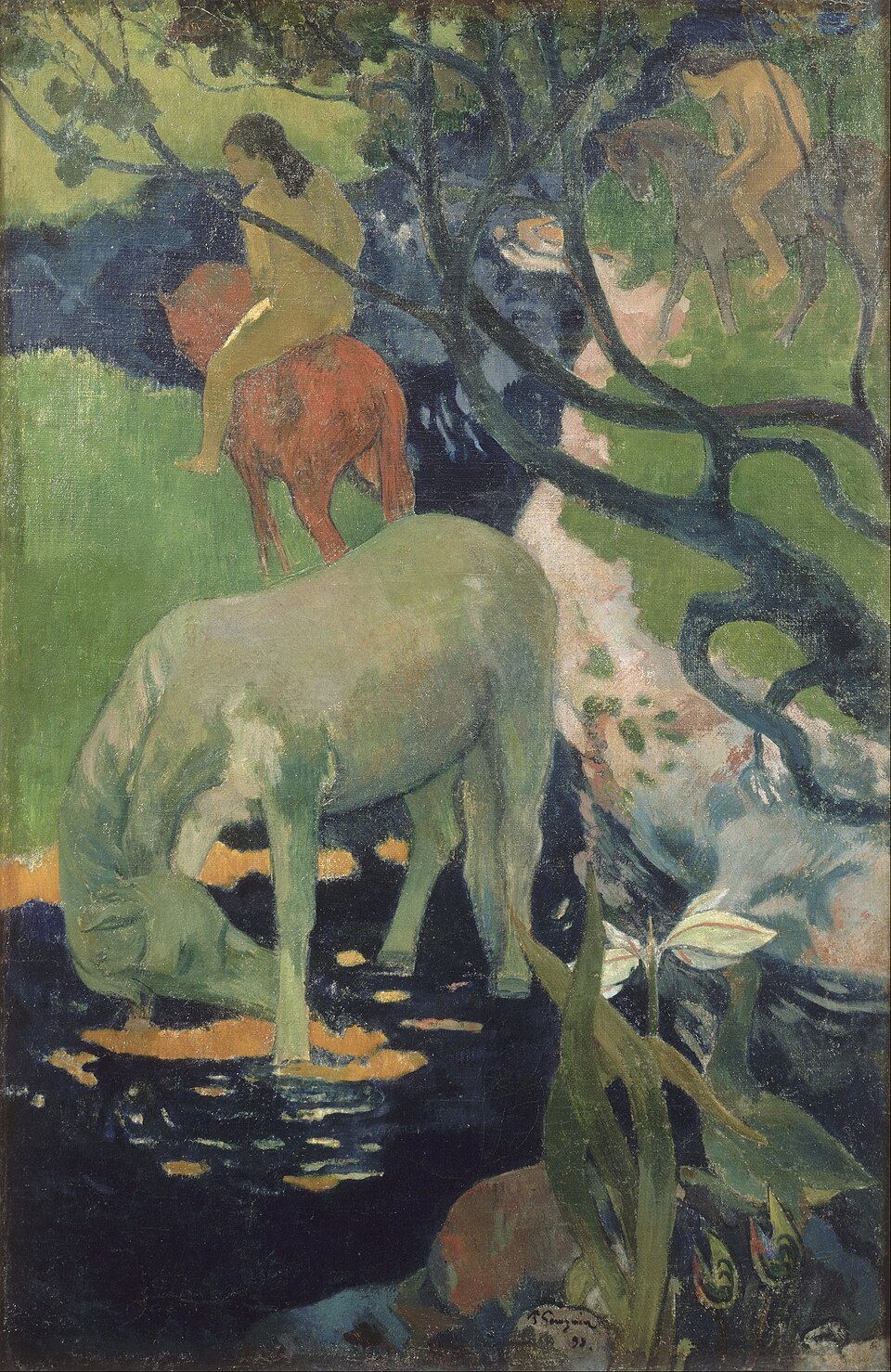
A white horse bends to drink in a shaded Tahitian stream, tinted green by the leaves above. The man who ordered it refused it for exactly that green, and today it hangs in the Musée d'Orsay.
The story behind the painting
Gauguin painted this canvas in 1898 in Tahiti, during his second stay on the island. It was a commission from Ambroise Millaud, a pharmacist in Tahiti, who refused the finished work because of its colours: he found the horse too green. The picture has carried several titles, White Horse in a River and Riders under the Trees among them, and The White Horse is the more recent name. After the refusal it passed into the collection of Gauguin's friend Daniel de Monfreid, where it stayed until 1927.
What to look for
A white horse drinks in the middle of a small river that crosses the whole picture, and the shade of the trees turns its coat green. Everything is seen from above, with no sky and no horizon, so the scene feels closed in. The foreground is filled with lilies and imaginary flowers, and the branches belong to a Hibiscus tiliaceus, known locally as bourao or purau. Behind the white horse, two more horses carry naked riders bareback, one moving away from us, the other crossing from right to left.
Meaning and intent
Gauguin loved walking in the Tahitian backcountry, yet this is not a scene he simply observed. It is an idealised, imagined vision. The white horse probably carries a symbolic meaning tied to Tahitian beliefs, in which white was associated with death and with the worship of the gods. The stacked planes and strong verticals give the picture little depth, and the colours are deeply decorative: luminous greens, deep blues, contrasting orange tones, pink and copper. The result is a feeling of great serenity.
Legacy
In 1927 the French national museums acquired the painting, even though part of the national museums committee opposed the purchase. It first joined the collections of the Musée du Luxembourg until 1932, then moved to the Louvre, and since 1986 it has been assigned to the Musée d'Orsay in Paris. The canvas, oil on canvas measuring 140 by 91.5 cm, is the same picture the pharmacist turned down, and its composition has been described as having become a true icon.
Lo sapevi?
- Painted in Tahiti in 1898, during Gauguin's second stay.
- Refused by the pharmacist who ordered it: the horse was too green.
- Acquired by the French national museums in 1927.
- At the Musée d'Orsay since 1986.
L'artista
Paul Gauguin (1848-1903)
Musée d'Orsay · nudity · tree · landscape · horse · flower · animal art · watercourse · Tahiti
Altre opere di Paul Gauguin
 Where Do We Come From? What Are We? Where Are We Going? - Paul Gauguin (1897-1898)
 Cristo giallo - Paul Gauguin (1889)
 When Will You Marry? - Paul Gauguin (1892)
 Donne di Tahiti - Paul Gauguin (1890)
 Vision After the Sermon - Paul Gauguin (1888)
Manaò tupapaú - Paul Gauguin (1892)
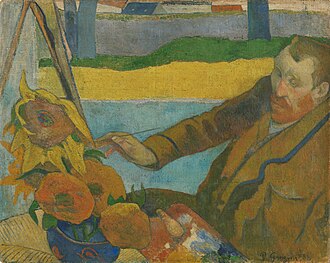 Vincent van Gogh Painting Sunflowers - Paul Gauguin (1888)
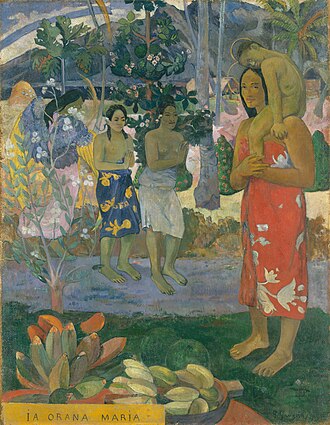 Ia Orana Maria - Paul Gauguin (1891)
Dipinti di artisti collegati
 The Starry Night - Vincent van Gogh (1889)
 Café Terrace at Night - Vincent van Gogh (1888)
 Walk on the mountain - Joaquín Sorolla (1909)
 Sad Inheritance - Joaquín Sorolla (1898)
 Les Grandes Baigneuses - Paul Cézanne (1900s)
 The Boy in the Red Vest - Paul Cézanne
 Dance at Le Moulin de la Galette - Pierre-Auguste Renoir (1876)
 Luncheon of the Boating Party - Pierre-Auguste Renoir (1881)
 At the Moulin Rouge - Henri de Toulouse-Lautrec (1892)
 La Toilette - Henri de Toulouse-Lautrec (1896)