Vision After the Sermon
Paul Gauguin · 1888
.jpg)
A group of Breton women in white headdresses, a blazing red field, and beyond a slanting tree trunk, Jacob wrestling with an angel. Gauguin paints not the Bible story itself, but the vision it stirs in the women's minds.
The story behind the painting
Gauguin had begun as a painter of landscapes made outdoors in the Impressionist manner. By 1888 he had grown dissatisfied with Impressionism, which did not answer his enthusiasm for archaic and primitive forms or his interest in the mystical. That year, at the artists' colony of Pont-Aven in Brittany, he met the young painter Émile Bernard, who was working in a simplified style influenced by Japanese prints. Following Bernard's example and pushing it further, Gauguin painted Vision after the Sermon in Pont-Aven in 1888. It marked his wish to interpret religious subjects in a highly personal way, and he came to be recognized as the leader of a new style called Synthetism.
What to look for
Red is likely the first thing you notice: a field of flat red that refuses to look like ordinary earth or grass. A brown tree trunk cuts diagonally through the center, dividing the Breton women on one side from their vision on the other. The curve of the trunk follows the head of the central figure, and its branches and leaves shoot toward the upper right, framing the angel and Jacob as they struggle. Along the left edge, people are clustered and diminished in size, deliberately skewing the perspective. The women wear white coiffes and black garments, one clasping her hands in prayer. Notice the strong outlines and how little shading softens these large areas of brown, black, white and red.
Meaning and intent
The story comes from Genesis 32:22-31, where Jacob wrestles an angel. Gauguin shows it indirectly, as a vision seen by the women after a sermon in church, joining Breton themes to a move toward abstraction. Here color is not description but feeling: the red, the source suggests, lends power to the struggle. Gauguin drew on Japanese woodblock prints by Hiroshige and Hokusai, which he owned. Bernard went further, naming Hokusai's sumo wrestlers in the Manga as the source of the struggling angel and Jacob. Yet the choice of subject and composition are described as Gauguin's own, a demonstration that painting could leave naturalism for a more symbolic language.
Legacy
Vision after the Sermon is admired for its bold handling of color, shape and line, and it stands as the work through which Gauguin became known as the leader of Synthetism, the style linked by Wikidata to the Pont-Aven School. It showed that a painter could move away from naturalism toward something more abstract, even symbolic. The canvas, measuring 72.2 by 91 cm, now hangs in the Scottish National Gallery in Edinburgh, part of the National Galleries of Scotland. Standing before it, visitors can still feel the jolt of that red field and the quiet intensity of the women who see what we cannot see with our own eyes.
Lo sapevi?
- Painted in Pont-Aven, Brittany, in 1888.
- Depicts Jacob wrestling the angel from Genesis 32:22-31, seen as a vision by Breton women.
- Influenced by Japanese prints by Hiroshige and Hokusai that Gauguin owned.
- Now in the Scottish National Gallery, Edinburgh.
L'artista
Paul Gauguin (1848-1903)
Altre opere di Paul Gauguin
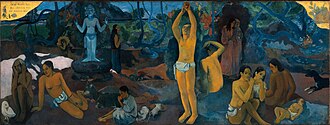 Where Do We Come From? What Are We? Where Are We Going? - Paul Gauguin (1897-1898)
%201889.jpg) Cristo giallo - Paul Gauguin (1889)
Cristo giallo - Paul Gauguin (1889)%201892%2C%20oil%20on%20canvas%2C%20101%20x%2077%20cm.jpg) When Will You Marry? - Paul Gauguin (1892)
When Will You Marry? - Paul Gauguin (1892)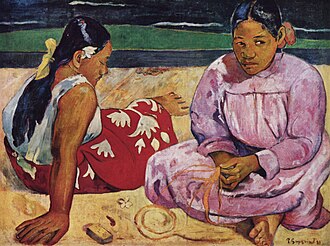 Donne di Tahiti - Paul Gauguin (1890)
Manaò tupapaú - Paul Gauguin (1892)
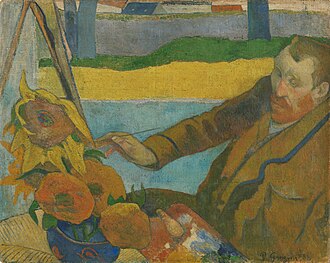 Vincent van Gogh Painting Sunflowers - Paul Gauguin (1888)
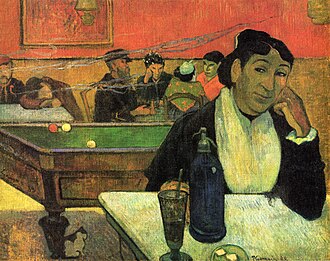 The Night Café in Arles - Paul Gauguin (1888)
%20-%201926.198%20-%20Art%20Institute%20of%20Chicago.jpg) Day of the God - Paul Gauguin (1894)
Day of the God - Paul Gauguin (1894)
Dipinti di artisti collegati
 The Starry Night - Vincent van Gogh (1889)
.jpg) Café Terrace at Night - Vincent van Gogh (1888)
Café Terrace at Night - Vincent van Gogh (1888) Dance at Le Moulin de la Galette - Pierre-Auguste Renoir (1876)
 Luncheon of the Boating Party - Pierre-Auguste Renoir (1881)