The wedding
Francisco Goya · 1792
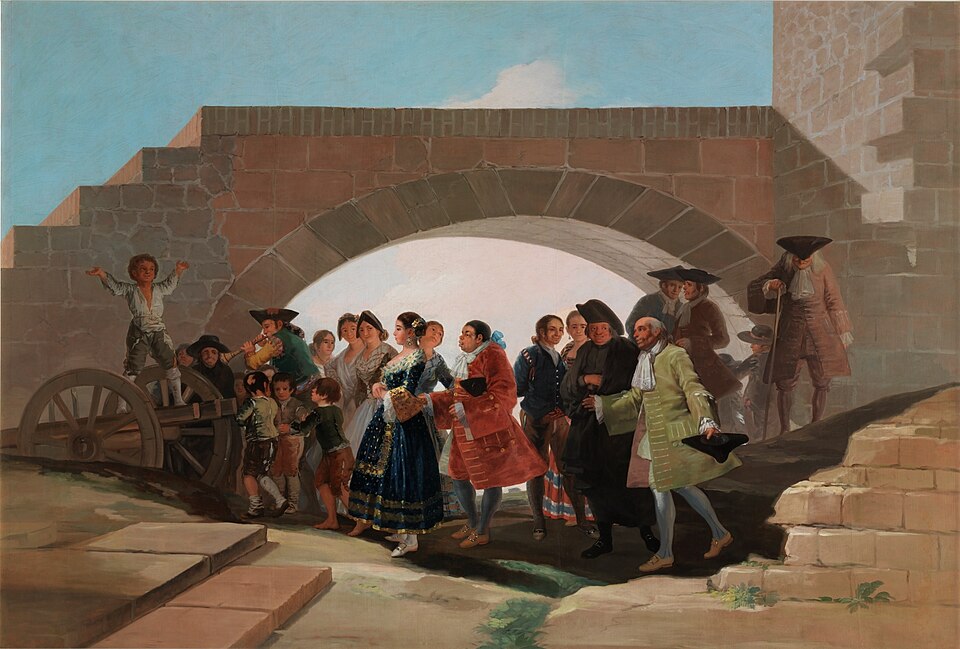
A wedding procession passes under a stone arch, cheerful and a little ridiculous. The young bride walks beside a groom much older than her, with heavy lips and a puffy face. Goya painted it in 1792 as a design for a royal tapestry, and he was not being kind.
The story behind the painting
The Wedding is one of Goya's tapestry cartoons, full-size models for tapestries. It belongs to the seventh and last series, intended for the study of Charles IV at the palace of El Escorial; the king, as Prince of Asturias, had already been the recipient of the six earlier series. The canvas was painted in the summer of 1792. The other cartoons in this series are The Stilts, The Seesaw, The Little Giants, Boys Climbing a Tree, The Straw Manikin and The Girls with Jugs. It is large, about 269 by 396 cm.
What to look for
The composition is a frieze of figures forming a joyful procession, walking to the left in profile under an arch that gives the scene a solid frame. It might be a bridge, but its presence and role are strange here. Look at the groom: chubby-cheeked, thick-lipped, very dark-skinned and much older than his bride. The ochres of the ground and the bridge piers are set against a sky of white clouds, which seems to serve mainly as a contrast to the stones and the reds of the main figures. A child raising his arms on a cart and an old man in a black tricorn hat face the viewer at either end.
Meaning and intent
In this last series Goya's themes take a satirical turn, probably through his contact with Enlightenment circles at court, even though royal commissions still asked mainly for picturesque scenes of Spanish life. The subject here is clearly the unequal marriage of convenience, also found in the plays of Leandro Fernández de Moratín at the same time. Much of the gaiety of the procession belongs to ridicule. The work has also been read as a path through life, from the child on the cart to the old man in the tricorn, the two figures that bracket the procession.
Legacy
This series marks the beginning of Goya's distortion of faces into caricature, which would prevail in Los Caprichos; the groom is an early example. Valeriano Museau, writing in 2005, sees in the painting a transition from Rococo to Goya's own particular Neoclassicism, more realistic and critical of society. Soon after painting it, Goya fell ill and turned toward Romanticism and the aesthetics of the sublime and terrible. Long thought lost, the canvas was found in 1869 in the basement of the Royal Palace in Madrid and given to the Prado in 1870, where the French article places it in room 93.
Lo sapevi?
- Painted in the summer of 1792 as a tapestry cartoon.
- Made for Charles IV's study at El Escorial.
- Satirises an unequal marriage of convenience.
- In the Prado since 1870.
L'artista
Francisco Goya (1746-1828)
Altre opere di Francisco Goya
 The Third of May 1808 - Francisco Goya (1814)
 La maja nuda - Francisco Goya (1800)
 Saturn Devouring His Son - Francisco Goya (1819)
 La famiglia di Carlo IV - Francisco Goya (1800)
 The Clothed Maja - Francisco Goya (1800)
 Il 2 maggio 1808 a Madrid - Francisco Goya (1814)
 Cane semiaffondato - Francisco Goya (1819)
 Il sabba delle streghe - Francisco Goya (1820s)
Dipinti di artisti collegati
 Wanderer above the Sea of Fog - Caspar David Friedrich (c. 1818)
 The Abbey in the Oakwood - Caspar David Friedrich (1800s)
 Liberty Leading the People - Eugène Delacroix (1830)
 Death of Sardanapalus - Eugène Delacroix (1827)
 The Fighting Temeraire - J. M. W. Turner (1839)
 Rain, Steam and Speed - The Great Western Railway - J. M. W. Turner (1844)
 The Blue Boy - Thomas Gainsborough (1770)
 Mr and Mrs Andrews - Thomas Gainsborough (1748)