Saturn Devouring His Son
Francisco Goya · 1819
.jpg)
Witness to a monstrous act, Francisco Goya's haunting painting forces us to confront the darkest aspects of human nature.
The story behind the painting
Francisco Goya created 'Saturn Devouring His Son' in 1819, one of 14 murals he painted directly on the walls of his home, Quinta del Sordo. At the time, Goya was living in near isolation, disillusioned with the political and social developments in Spain. He had suffered a severe illness that left him deaf in 1793, and his work became progressively darker and more pessimistic. This painting, like the others in the series, was not intended for public consumption and was only given a title after his death.
What to look for
In this painting, a grotesque figure with bulging eyes and an open mouth appears to be devouring a human form. The victim's head and part of their left arm have already been consumed, with only a severed limb remaining. The large figure's hand grips the victim's back, while his other hand holds the limb being eaten. The palette is dark and muted, with flashes of red blood and white flesh. The brushwork is expressive and textured, adding to the overall sense of chaos and horror.
Meaning and intent
The traditional interpretation of 'Saturn Devouring His Son' sees it as a depiction of the Greek myth of Cronus, or Saturn, eating his children to prevent them from overthrowing him. However, some art historians have questioned this title, suggesting that it may be misleading. The painting's meaning remains disputed, with possible interpretations including the conflict between youth and old age, time as the devourer of all things, and the wrath of God. Goya scholar Fred Licht has suggested that the painting could be an inversion of antisemitic artistic depictions of Jewish figures eating children.
Legacy
Today, 'Saturn Devouring His Son' is considered one of Goya's most important works and is housed at the Museo del Prado in Madrid. The painting has had a lasting impact on Western art, influencing many 19th- and 20th-century artists. It remains a powerful and disturbing work, continuing to fascinate art lovers with its haunting and thought-provoking imagery.
Lo sapevi?
- The painting measures 143.5 x 81.4 cm.
- It is one of 14 murals known as the 'Black Paintings'.
- Goya purchased Quinta del Sordo in 1819 and lived there until 1823.
- The painting was transferred from the wall to canvas in 1874.
Wikipedia · Wikipedia - Francisco Goya · Wikidata
L'artista
Francisco Goya (1746-1828)
Museo del Prado · mythological painting
Altre opere di Francisco Goya
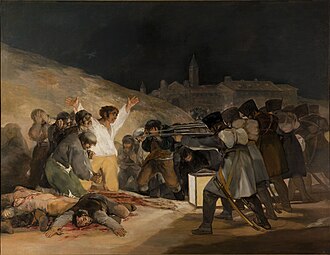 The Third of May 1808 - Francisco Goya (1814)
.jpg) La maja nuda - Francisco Goya (1800)
La maja nuda - Francisco Goya (1800)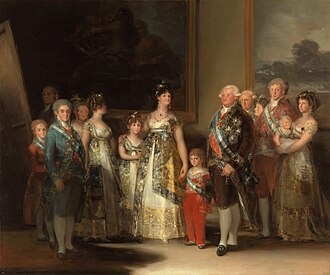 La famiglia di Carlo IV - Francisco Goya (1800)
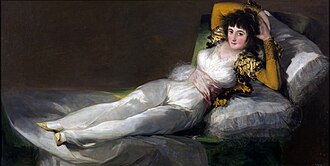 The Clothed Maja - Francisco Goya (1800)
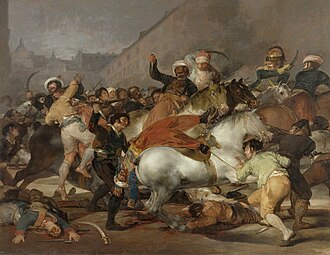 Il 2 maggio 1808 a Madrid - Francisco Goya (1814)
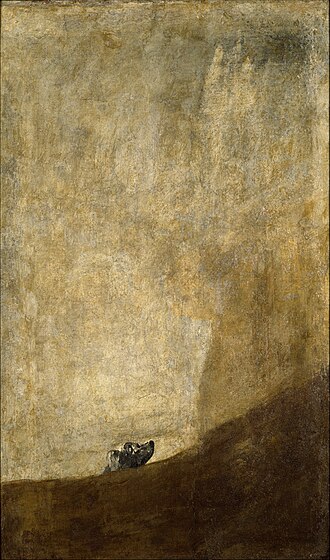 Cane semiaffondato - Francisco Goya (1819)
 Il sabba delle streghe - Francisco Goya (1820s)
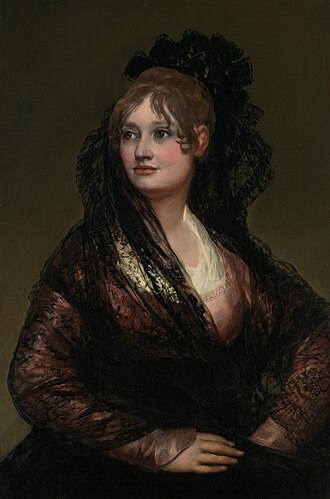 Portrait of Doña Isabel de Porcel - Francisco Goya (1800s)