the washerwomen
Francisco Goya · 1779
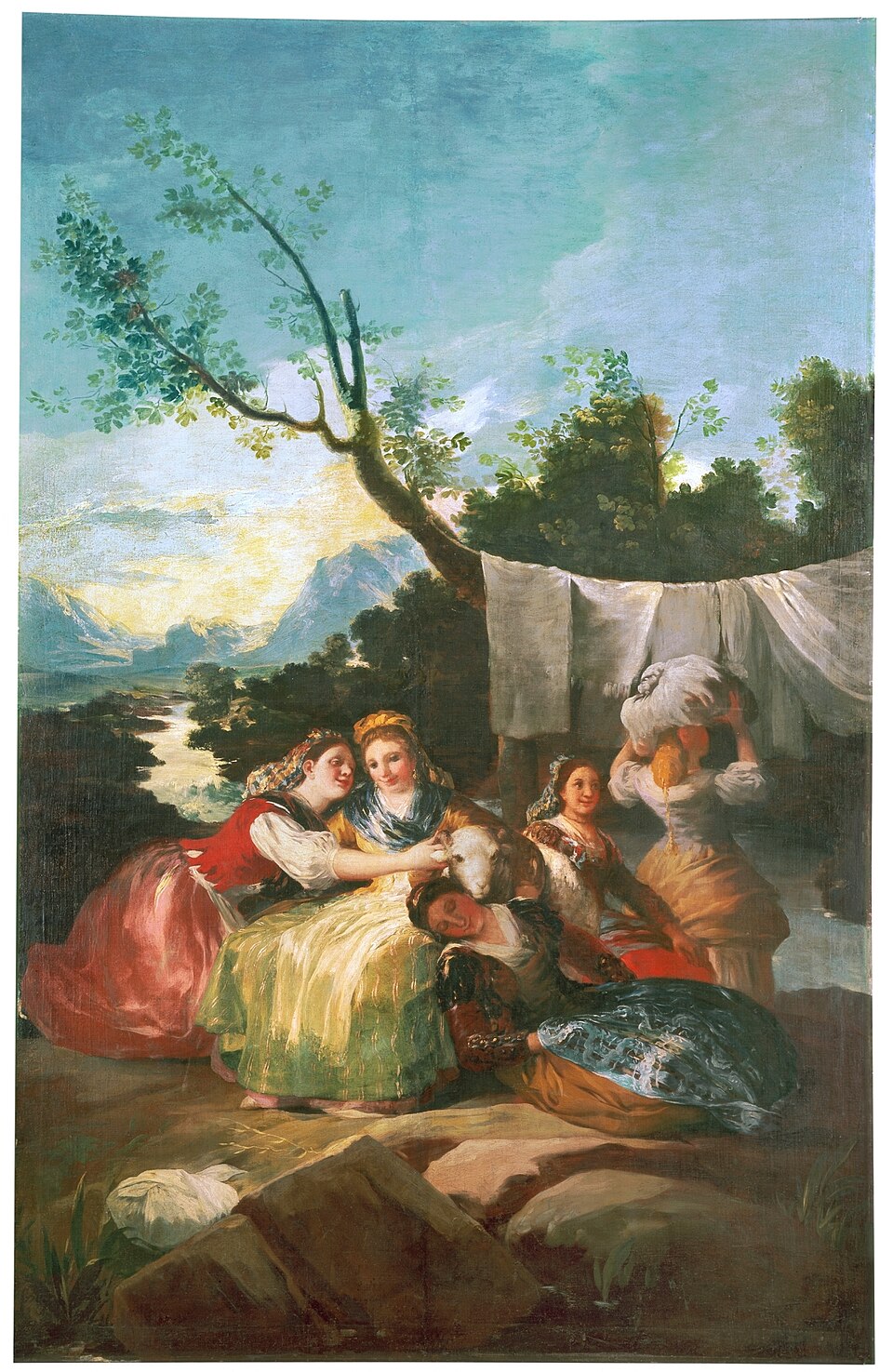
Washerwomen rest on the bank of the Manzanares after work. One has fallen asleep in a friend's lap, and the others creep up with a lamb to wake her. Goya painted the joke as a design for a royal tapestry.
The story behind the painting
The painting is one of Goya's cartoons, full-size designs for tapestries woven at the Royal Tapestry Factory in Madrid. It belongs to the fourth series, made for the antechamber of the Prince of Asturias, the future Charles IV, and his wife Maria Luisa of Parma, at the palace of El Pardo. The French article dates it 1780 and says it was delivered to the factory on 24 January 1780, while Wikidata gives 1779. Work took more than six months because the factory unexpectedly closed. Other cartoons in the series include The Swing, The Blind Guitarist and The Woodcutters.
What to look for
Goya described it himself in his report to the factory: washerwomen resting on the riverbank, one asleep on another's knees, and two of them holding a lamb close to her face to wake her. Behind them, two other figures are still at work. The setting is near Madrid, with the Manzanares and the Guadarrama mountains in the background. The sketchy sky changes tone and intensity, suggesting a fading sun, and the light and colours make it feel like sunset. The women's flushed faces fit the type of femininity that interested the Rococo. The canvas is large, about 257.5 by 166 cm.
Meaning and intent
This is a scene of rest, not of labour: a pause after work, a shared joke, a lamb used as a prank. The French article calls it one of the most naturalistic and beautiful landscapes of the region, and notes that Goya's tones recall those of the young Diego Velázquez, whose works the Aragonese artist had been able to study in the royal palaces. With its free handling and patches of bright, cheerful colour, the cartoon shows Goya as an assured colourist, and the article counts it among his most accomplished works.
Legacy
Like many of Goya's tapestry cartoons, it was long thought lost. In 1869 Gregorio Cruzada Villaamil found the canvas in the basement of the Royal Palace in Madrid, and in 1870, by orders of 19 January and 9 February, it was handed to the Prado. It first appeared in the museum's catalogue in 1876. Today it hangs in the Prado's room 91, according to the French article. Two cartoons of the same series, The Dog and The Fountain, are still lost, which makes the survival of this cheerful riverside scene all the more fortunate.
Lo sapevi?
- A tapestry cartoon for the palace of El Pardo.
- Dated 1780 by the French article, 1779 by Wikidata.
- Rediscovered in 1869 in a Royal Palace basement.
- In the Prado since 1870.
L'artista
Francisco Goya (1746-1828)
Altre opere di Francisco Goya
 The Third of May 1808 - Francisco Goya (1814)
 La maja nuda - Francisco Goya (1800)
 Saturn Devouring His Son - Francisco Goya (1819)
 La famiglia di Carlo IV - Francisco Goya (1800)
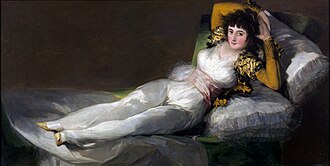 The Clothed Maja - Francisco Goya (1800)
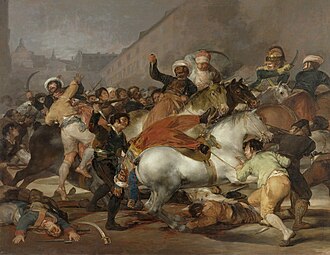 Il 2 maggio 1808 a Madrid - Francisco Goya (1814)
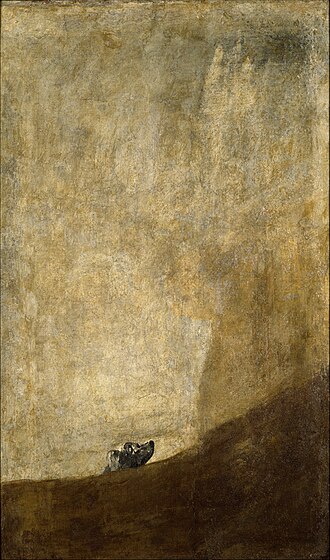 Cane semiaffondato - Francisco Goya (1819)
 Il sabba delle streghe - Francisco Goya (1820s)
Dipinti di artisti collegati
 Wanderer above the Sea of Fog - Caspar David Friedrich (c. 1818)
 The Abbey in the Oakwood - Caspar David Friedrich (1800s)
 Liberty Leading the People - Eugène Delacroix (1830)
 Death of Sardanapalus - Eugène Delacroix (1827)
 The Fighting Temeraire - J. M. W. Turner (1839)
 Rain, Steam and Speed - The Great Western Railway - J. M. W. Turner (1844)
 The Blue Boy - Thomas Gainsborough (1770)
 Mr and Mrs Andrews - Thomas Gainsborough (1748)