The Tribute Money
Titian · 1516
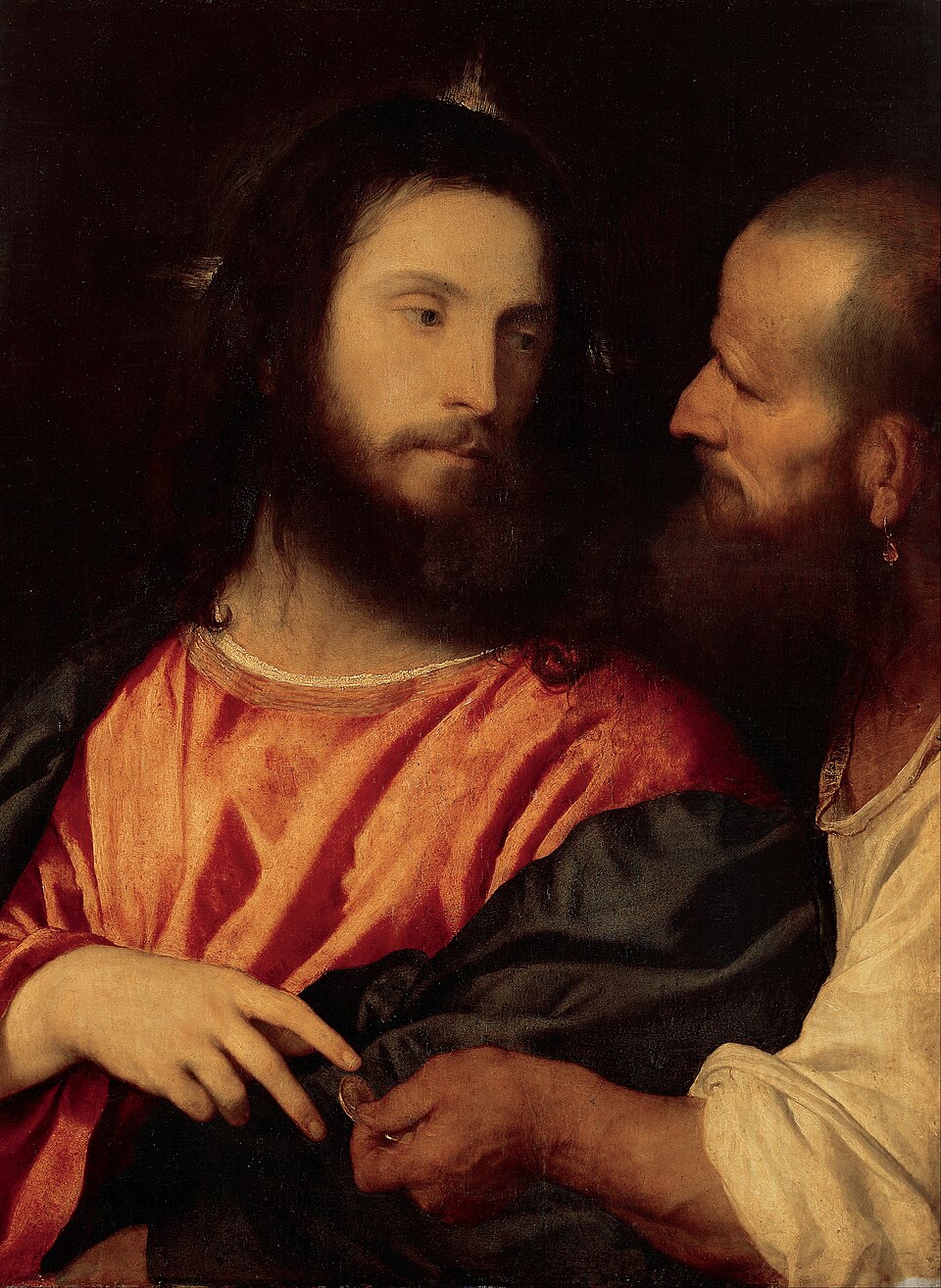
Two faces almost touching: a Pharisee holds out a coin, and Christ answers with a glance and a pointing finger. Titian painted this charged instant for a duke caught between emperor and pope.
The story behind the painting
In 1516 Titian and two assistants spent about five weeks at the Castello Estense in Ferrara, from 22 February to the end of March, working for Duke Alfonso I d'Este. The Tribute Money was made for the door of a cabinet holding the duke's collection of ancient and modern coins and medals, which is why Titian, who usually painted on canvas, used a panel. It is possibly the earliest representation of the scene in art, a subject the duke probably suggested. It is also Titian's earliest signed painting: Ticianus F. appears on the trim of the Pharisee's collar.
What to look for
The panel, 75 by 56 cm, shows the moment in the Gospels when Christ is shown a coin and says: Render unto Caesar the things that are Caesar's, and unto God the things that are God's. Only two half-length figures fill the space, tightly cropped, their faces close together, a type of composition linked to Giorgione that heightens the drama. Christ's calm, luminous face turns toward the Pharisee, whose rougher profile and hand with the coin come in from the side. The finish is smooth; it has been called Titian's sleekest, most polished early work.
Meaning and intent
For Alfonso the subject was personal. His lands lay partly in the Holy Roman Empire and partly in the Papal States, and at the time he had been excommunicated and, at least in theory, stripped of territories by a papacy eager to absorb Ferrara. The trap set for Christ was one the duke had lived in for years. Christ's answer probably carried a message that the Church should attend to spiritual matters rather than expanding its lands. Alfonso even put part of the gospel text on his gold coins.
Legacy
Vasari called the head of Christ stupendous and miraculous, and Carlo Ridolfi reported that an envoy of Charles V marvelled that any artist could rival Albrecht Dürer so well. Some have claimed the Pharisee as a self-portrait of Titian, then in his late twenties. After the Second World War the painting was taken to Moscow, damaged by water and restored by Pavel Korin, then returned to Dresden in 1955. It hangs in the Gemäldegalerie Alte Meister. George Eliot mentioned it in Daniel Deronda, and Julian Barnes gave it a role in The Noise of Time.
Lo sapevi?
- Painted in Ferrara in 1516 for Alfonso I d'Este.
- Titian's earliest signed painting.
- Made as a door for the duke's coin cabinet.
- Gemäldegalerie Alte Meister, Dresden.
L'artista
Titian (1488-1576)
religious art · man · High Renaissance · Jesus Christ · Venetian school · Staatliche Kunstsammlungen Dresden
Altre opere di Titian
 Venus of Urbino - Titian (1538)
 Assumption of the Virgin - Titian (1510s)
 Sacred and Profane Love - Titian (1510s)
 Equestrian Portrait of Charles V - Titian (1548)
 Flora - Titian (1517)
 Allegory of Prudence - Titian (1550)
 Diana and Actaeon - Titian (1550s)
 Bacchus and Ariadne - Titian (1520s)
Dipinti di artisti collegati
 Last Supper - Jacopo Tintoretto (1563)
 Miracle of the Slave - Jacopo Tintoretto (1540s)
 The Wedding at Cana - Paolo Veronese (1560s)
 The Feast in the House of Levi - Paolo Veronese (1573)