The Source
Gustave Courbet · 1862
.jpg)
A woman stands in a stream with her back half turned, letting cold water run over her outstretched hand. Courbet paints not a goddess but a person, at ease in the woods.
The story behind the painting
Gustave Courbet, born in Ornans in 1819, was committed to painting only what he could see, rejecting academic convention and the Romanticism of the generation before him. He painted The Source in 1862, during a decade in which his work became increasingly sensual and at times openly provocative. The identity of the woman who posed is unknown. There has been speculation about whether she had modelled for Courbet before: some say she sat for him twice, others only once. Beyond that, the sources tell us little about how the picture was made.
What to look for
The canvas, about 120 by 74 cm, shows a nude woman standing outdoors in a body of water, in front of a small stream. She reaches into the falling water, which flows onto her arms. Her long brown hair falls down her back, and we see her mostly from behind, the curve of her waist and hip turned toward us. Around her is nature rather than a classical setting. Take a moment with the water on her hand: the whole scene hangs on that small, physical sensation.
Meaning and intent
Many believe Courbet was responding to Jean-Auguste-Dominique Ingres's The Source of 1856, another fully nude woman beside water in a natural scene. The comparison is telling. Where an academic painter might present an idealised figure, Courbet's commitment was to the visible world, to a real body in a real place. The painting has also been compared to Paul Gauguin's The Moon and the Earth of 1893, which suggests how the motif of a woman at a spring continued to speak to later artists.
Legacy
The Source is now in the Metropolitan Museum of Art in New York. Note that Courbet painted the theme of a spring more than once: his Wikipedia biography lists a painting called The Source dated 1868 in the Musée d'Orsay, a different work from this 1862 canvas, and his The Source of the Loue is a landscape. The New York picture remains a quiet example of how Courbet's realism extended to the nude, setting the body in water, light and woodland rather than myth.
Lo sapevi?
- Painted in 1862; about 120 x 74 cm.
- Model unknown.
- Often compared to Ingres's The Source (1856).
- Metropolitan Museum of Art, New York.
Wikipedia · Wikipedia · Wikidata
L'artista
Gustave Courbet (1819-1877)
woman · Metropolitan Museum of Art · nude · waist-length hair · nudity · brown hair · breast
Altre opere di Gustave Courbet
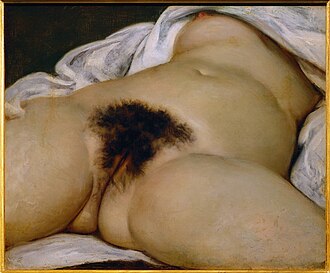 L'Origine du monde - Gustave Courbet (1866)
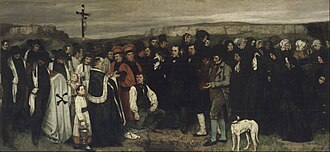 A Burial at Ornans - Gustave Courbet (2020)
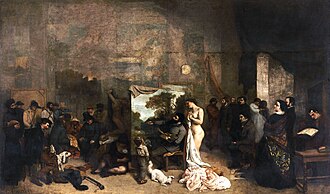 The Painter's Studio - Gustave Courbet (1855)
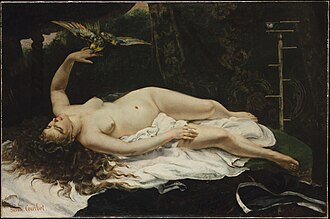 Woman with a Parrot - Gustave Courbet (1866)
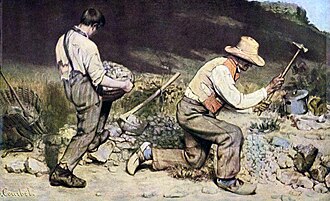 The Stone Breakers - Gustave Courbet (1850)
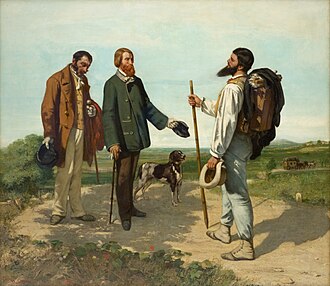 The Meeting, or Bonjour, Monsieur Courbet! - Gustave Courbet (1854)
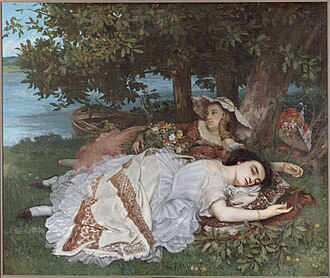 Young Ladies Beside the Seine - Gustave Courbet (1857)
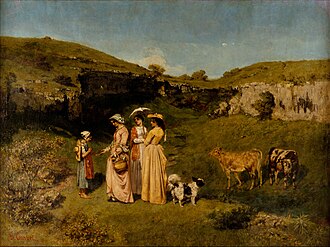 Young Ladies of the Village - Gustave Courbet (1850s)
Dipinti di artisti collegati
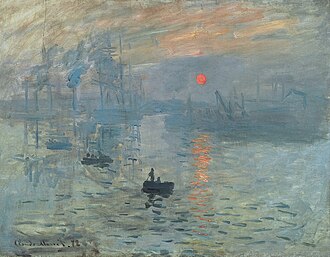 Impression, Sunrise - Claude Monet (1872)
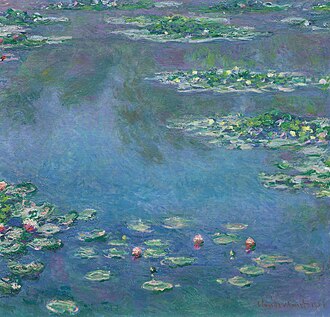 Water Lilies - Claude Monet (1906)
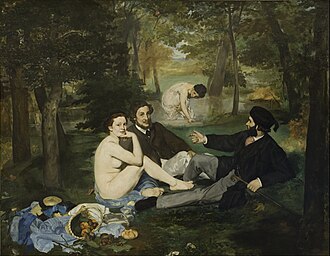 Luncheon on the Grass - Édouard Manet (1863)
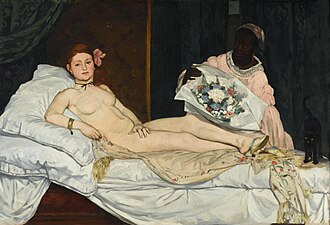 Olympia - Édouard Manet (1863)
 The Starry Night - Vincent van Gogh (1889)
.jpg) Café Terrace at Night - Vincent van Gogh (1888)
Café Terrace at Night - Vincent van Gogh (1888)