The Seven Sacraments
Rogier van der Weyden · 1440s
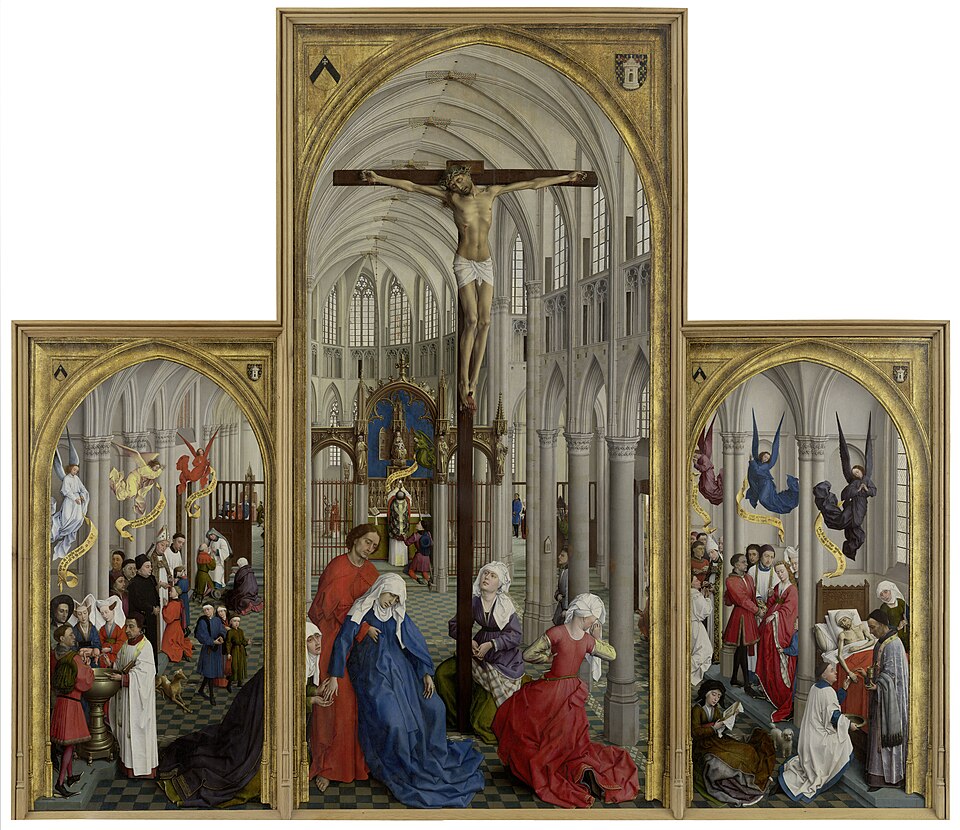
Inside one vast Gothic church, the Crucifixion fills the foreground while, all around, people are baptised, married, ordained and anointed as they die. Rogier van der Weyden gathered all seven sacraments of the Catholic Church into a single triptych.
The story behind the painting
Rogier van der Weyden and his workshop painted this fixed-wing triptych between 1445 and 1450. No commission record survives, but scholars, Max J. Friedlander among them, believe it was ordered by Jean Chevrot, bishop of Tournai. The sources give two possible destinations, reflecting two readings of a coat of arms: Chevrot's private chapel in Tournai, or the chapel of Saint Anthony in the church of Saint Hippolytus at Poligny, which Chevrot, born there, founded in 1445. Restoration showed that Rogier painted the whole central panel and left parts of the wings to assistants.
What to look for
The whole scene is set in a Gothic church looking toward the high altar, with a groin vault, piers, pointed arches, a triforium and a clerestory. In the centre a crucifixion dominates the foreground while, behind, a priest elevates the Host. The left wing shows baptism, confirmation, with a kneeling child before a bishop, and confession. The right wing shows ordination, marriage, with a priest joining a couple's hands, and the last rites, a sick man in bed. Above each sacrament hovers an angel with a Latin scroll, dressed in a colour from white for baptism to black for the last rites.
Meaning and intent
The altarpiece teaches through structure: every sacrament happens inside the same church, beneath the cross, so the whole life of a believer, from birth to death, is shown flowing from the sacrifice at the centre. Real people seem to stand among the figures. Chevrot can be seen as the bishop at confirmation, and the commissioners appear in the side panels, with some portrait heads added shortly before completion. Some faces were painted on pewter sheets later attached to the wooden panel, which supports the idea that they are portraits.
Legacy
In 1681 the altarpiece belonged to Jean Perrault in Paris. In 1826 Chevalier Florent van Ertborn acquired it from the heirs of the last first president of the Parlement of Burgundy in Dijon, and in 1841 his collection was bequeathed to the Royal Museum of Fine Arts in Antwerp, where it remains. A restoration from 2006 to 2009, led by Dr Griet Steyaert, removed a yellowed varnish, secured flaking paint, solved the problem of the faces on pewter, and gave the work a new frame closely resembling the original. The work measures about 200 by 223 cm.
Lo sapevi?
- Painted by Rogier van der Weyden and workshop, 1445-1450.
- Probably commissioned by Jean Chevrot, bishop of Tournai.
- Some faces were painted on pewter sheets attached to the panel.
- In Antwerp's Royal Museum of Fine Arts since 1841.
L'artista
Rogier van der Weyden (1390s-1464)
religious art · Early Netherlandish painting · Royal Museum of Fine Arts Antwerp · Vlaamse Kunstcollectie · Eucharist in the Catholic Church
Altre opere di Rogier van der Weyden
 The Descent from the Cross - Rogier van der Weyden (1440s)
 Portrait of a Lady - Rogier van der Weyden (1460)
 The Last Judgment - Rogier van der Weyden (1443)
 Saint Luke Drawing the Virgin - Rogier van der Weyden (1490)
 Columba Triptych - Rogier van der Weyden (1450s)
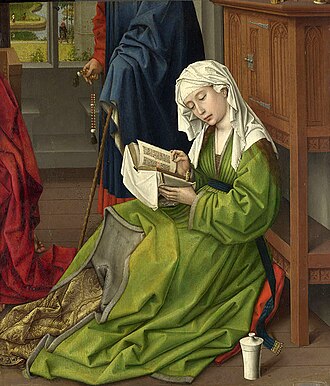 The Magdalen Reading - Rogier van der Weyden (1435)
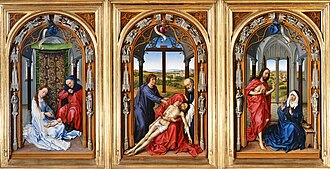 Miraflores Altarpiece - Rogier van der Weyden (1443)
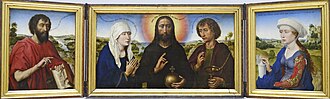 Braque Triptych - Rogier van der Weyden (1452)
Dipinti di artisti collegati
 Arnolfini Portrait - Jan van Eyck (1434)
 Ghent Altarpiece - Jan van Eyck (1432)
 Annunciation - Hans Memling (1480s)
 Scenes from the Passion of Christ - Hans Memling (1470)
 The Garden of Earthly Delights - Hieronymus Bosch
 Ship of Fools - Hieronymus Bosch (1500s)
 The Hunters in the Snow - Pieter Bruegel the Elder (1565)
 Netherlandish Proverbs - Pieter Bruegel the Elder (1551)