The Plague at Ashdod
Nicolas Poussin · 1630
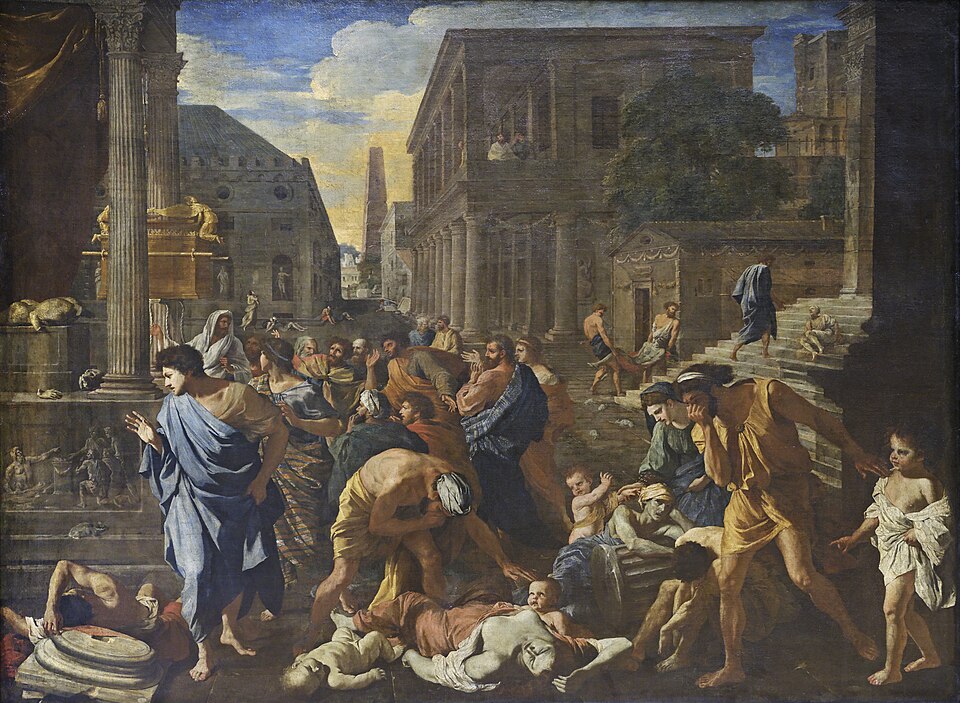
Bodies lie in a sunlit street while men cover their noses and rats run across the stones. Poussin painted The Plague of Ashdod around 1630, while plague swept through Italy.
The story behind the painting
The subject comes from the First Book of Samuel. The Philistines captured the Ark of the Covenant and set it in their temple at Ashdod beside the statue of their god Dagon. The next morning Dagon lay fallen on his face, head and hands broken off, and the people were struck by tumours. Poussin called the picture The Miracle of the Ark in the Temple of Dagon. It was commissioned by Fabrizio Valguarnera, a Sicilian later put on trial and said to have laundered money from stolen jewels through paintings. Poussin was living in Rome during the Italian plague of 1629 to 1631; Rome itself was spared, but the epidemic shaped his picture.
What to look for
On the left rises Dagon's temple with fluted Corinthian columns. Between them gleams the golden Ark, known by the cherubim on its lid, and beside it the statue of Dagon lies prone, its broken head and hand beneath it. In the foreground lie the bodies of a woman and her baby; the men who approach cover their noses against the bad air, or the stench. A man pulls a hungry child away from its dead mother's breast. Rats run among the living and the dead, perhaps from a line found in some translations of the Bible known in Poussin's day. Some figures, such as a relief on Dagon's base, are still unexplained.
Meaning and intent
Plague pictures were rare in the 17th century, since many believed that looking at disease could bring it on. Poussin's knowledge of the epidemic has fascinated scholars. In his unfinished Observations on Painting he discussed Aristotle's example of families turning on each other out of fear of contagion, and the child torn from his mother may express that loss of loyalty. The image is especially disturbing because viewers were used to the comforting Madonna nursing her child. The man saving the baby risks his own life. According to Boeckl, the unexplained figures are Poussin's own interpretation of the epidemic, beyond the biblical text.
Legacy
The original, about 148 by 198 cm, hangs in the Louvre. Wikidata dates it 1630. In the same period Valguarnera had Angelo Caroselli make an exact copy even before Poussin's version was finished; that copy is in London, and Ann Sutherland Harris links it to his laundering scheme. An engraving by Jean Baron in 1631 was one of the few made in Rome during Poussin's lifetime, and another followed in 1677. Edgar Degas and Paul Cézanne made partial drawings after the painting. The Flemish painter Michiel Sweerts made a similar plague scene around 1652 to 1654 that was once attributed to Poussin.
Lo sapevi?
- Painted around 1630, during the Italian plague of 1629 to 1631.
- Commissioned by the Sicilian Fabrizio Valguarnera.
- An exact copy by Angelo Caroselli is in London.
- The original hangs in the Louvre.
L'artista
Nicolas Poussin (1594-1665)
religious art · Department of Paintings of the Louvre · corpse
Altre opere di Nicolas Poussin
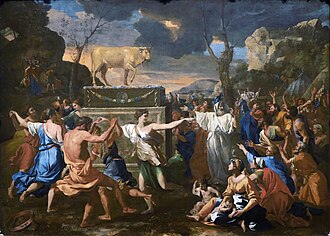 The Adoration of the Golden Calf - Nicolas Poussin (1634)
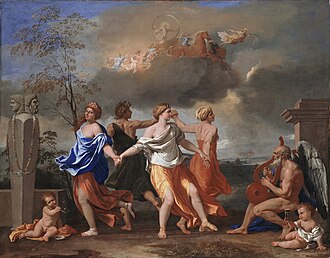 A Dance to the Music of Time - Nicolas Poussin (1630s)
.jpg) The Judgment of Solomon - Nicolas Poussin (1649)
The Judgment of Solomon - Nicolas Poussin (1649)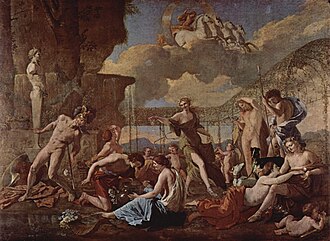 The Empire of Flora - Nicolas Poussin (1631)
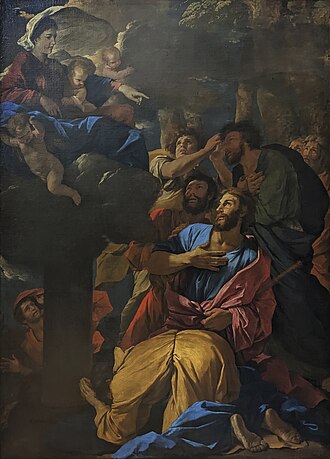 The Apparition of the Virgin to Saint James the Great - Nicolas Poussin (1620s)
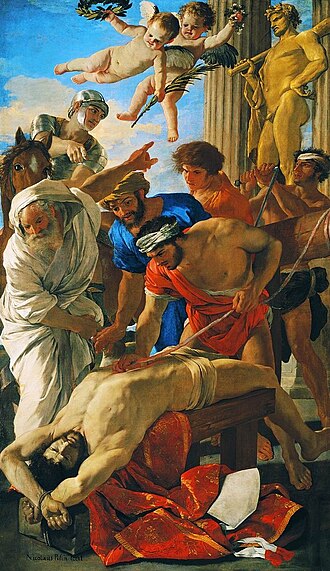 The Martyrdom of Saint Erasmus - Nicolas Poussin (1628)
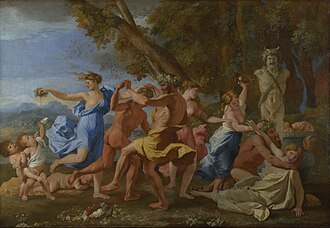 A Bacchanalian Revel Before a Term - Nicolas Poussin (1630s)
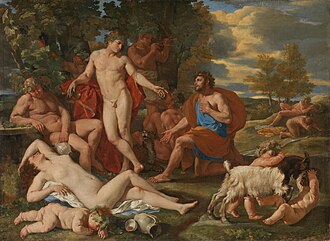 Midas and Bacchus - Nicolas Poussin (1630)