The Crossing of the Red Sea
Nicolas Poussin · 1630s
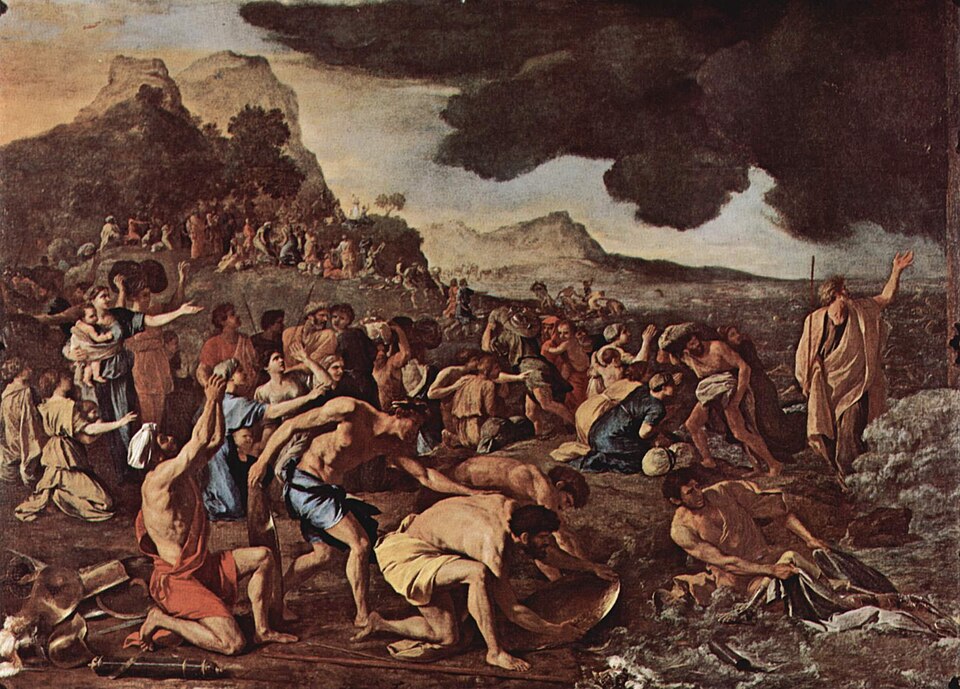
The Israelites stand on the far shore of the parted sea, from chapter 14 of Exodus. Poussin painted the scene as one half of a pair, and for two centuries the two pictures never left each other.
The story behind the painting
Poussin painted The Crossing of the Red Sea for Amadeo dal Pozzo, Marchese di Voghera of Turin, a cousin of Cassiano dal Pozzo, Poussin's main sponsor in Rome. It was made as one of a pair, the other being The Adoration of the Golden Calf. The subject comes from chapter 14 of the book of Exodus, the crossing of the Red Sea by the Israelites. The two paintings were seen as connected even before they were finished, and Poussin made deliberate choices so their contrasts would show when they were viewed together.
What to look for
The canvas measures about 156 by 215 cm and is painted in oil. Wikidata places the painting within the current of Classicism. Because it was conceived as a partner to The Adoration of the Golden Calf, it is worth imagining the two side by side, as their first owners saw them, one showing a people delivered, the other a people turning to an idol. The article notes stylistic features in this work that are absent from Poussin's paintings after the Golden Calf, which fed a long debate.
Meaning and intent
The date has been argued over. For generations it was believed that the painting followed The Adoration of the Golden Calf soon after, in 1635 to 1638, before Poussin left Rome for Paris. A vocal minority argued it should be earlier, on stylistic grounds. Sketches once thought to be preparations for it were later linked by some historians to an unknown work of 1647 to 1648. The debate matters for understanding how Poussin's biblical paintings developed, and the current view dates the work to 1633 to 1634.
Legacy
By 1685 the pair belonged to the Chevalier de Lorraine, and in 1710 they were bought by Benigne de Ragois de Bretonvillers. In 1741 Sir Jacob Bouverie acquired them, and the Earls of Radnor, his descendants, kept them together until 1945, when they were split for the first time and the Golden Calf went to the National Gallery in London. In 1948 Kenneth Clark acquired The Crossing of the Red Sea for the National Gallery of Victoria in Melbourne, through the Felton Bequest. It underwent a major conservation project in 2011.
Lo sapevi?
- Now dated 1633-1634, after a long debate.
- Pair to The Adoration of the Golden Calf.
- Kept together with its pair until 1945.
- In the National Gallery of Victoria, Melbourne, since 1948.
L'artista
Nicolas Poussin (1594-1665)
religious art · National Gallery of Victoria
Altre opere di Nicolas Poussin
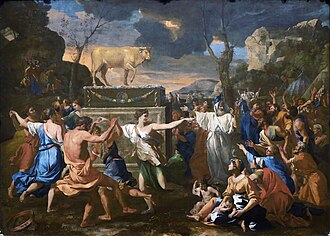 The Adoration of the Golden Calf - Nicolas Poussin (1634)
 A Dance to the Music of Time - Nicolas Poussin (1630s)
 The Plague at Ashdod - Nicolas Poussin (1630)
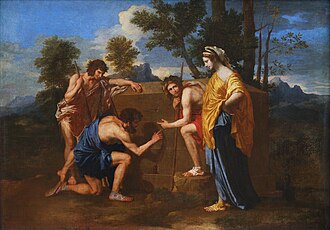 Et in Arcadia ego - Nicolas Poussin (1638)
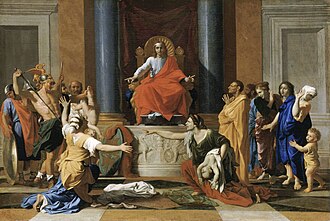 The Judgment of Solomon - Nicolas Poussin (1649)
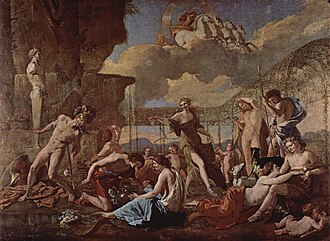 The Empire of Flora - Nicolas Poussin (1631)
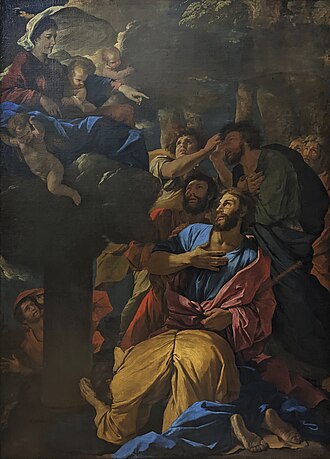 The Apparition of the Virgin to Saint James the Great - Nicolas Poussin (1620s)
 The Martyrdom of Saint Erasmus - Nicolas Poussin (1628)