The Martyrdom of Saint Erasmus
Nicolas Poussin · 1628
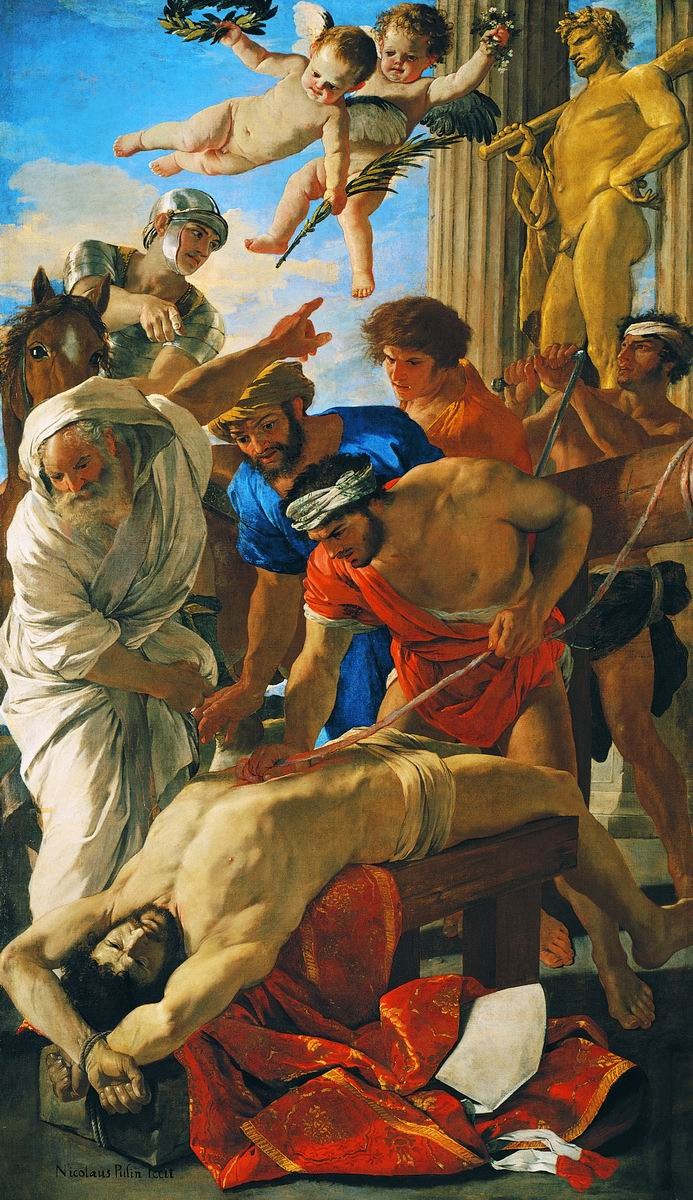
A bishop lies bound to a table while executioners turn a windlass, and a priest in white points to a statue of Hercules. Poussin painted it for Saint Peter's Basilica, and it is the only altarpiece he ever signed.
The story behind the painting
The Fabric of Saint Peter commissioned the painting on 5 February 1628 for the altar of Saint Erasmus of Formia in Saint Peter's Basilica, to the left of the north transept. The Pope first invited Pietro da Cortona, but Poussin was chosen thanks to his protector Cassiano dal Pozzo, secretary of Cardinal Francesco Barberini, for whom Poussin had already painted The Capture of Jerusalem and The Death of Germanicus. The Fabric asked him to follow the composition of the painting being replaced, but to move the white-robed pagan priest to the side. Wikipedia dates the work 1628-1629, Wikidata 1628.
What to look for
The altar was meant to be seen mostly from an angle, and Poussin built the picture on diagonals running from the saint's head at lower left, along his body and the priest's arm, to the statue at upper right. That statue is not Jupiter but Hercules, recalling the nickname of the emperor Maximian Hercules. The canvas is about 320 by 186 cm. Poussin shows the influence of large Venetian altarpieces and the colouring of Pietro da Cortona. Two preparatory drawings survive, in Milan and Florence, and a modello is in Ottawa.
Meaning and intent
The torture comes not from the Roman Martyrology but from the Golden Legend: Erasmus, Bishop of Antioch, was tied to a table and his intestines drawn out with a windlass, the last torture before his death. Ordered to sacrifice to the gods, he is said to have refused to sacrifice to stone gods resembling the emperor, and the statue of Jupiter crumbled to dust. Poussin does not dwell on horror. He paints the stoic resistance of the martyr, a word that means witness, testifying to the strength of his faith.
Legacy
It is the only work by Poussin visible in a public building in Rome since the painter's own time, and the only altarpiece he signed. Its quick success followed directly on The Death of Germanicus. The painting was moved to the Quirinal Palace before 1763, seized by French troops in 1797 and sent to the Louvre, then returned to the Holy See in 1817. It is now in the Pinacoteca Vaticana.
Lo sapevi?
- Commissioned on 5 February 1628 for Saint Peter's Basilica.
- The only altarpiece Poussin signed.
- Taken to the Louvre by French troops in 1797, returned in 1817.
- Now in the Pinacoteca Vaticana.
L'artista
Nicolas Poussin (1594-1665)
religious art · Pinacoteca Vaticana
Altre opere di Nicolas Poussin
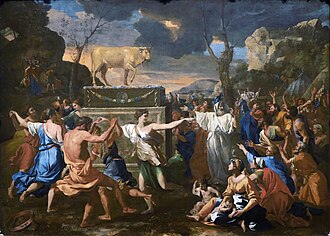 The Adoration of the Golden Calf - Nicolas Poussin (1634)
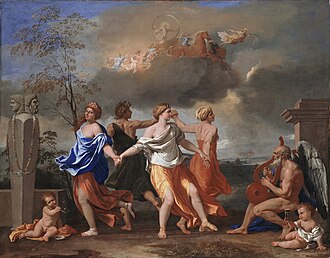 A Dance to the Music of Time - Nicolas Poussin (1630s)
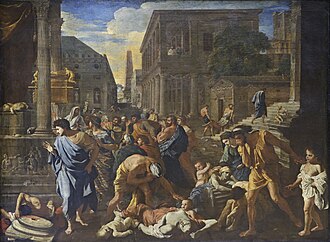 The Plague at Ashdod - Nicolas Poussin (1630)
.jpg) The Judgment of Solomon - Nicolas Poussin (1649)
The Judgment of Solomon - Nicolas Poussin (1649)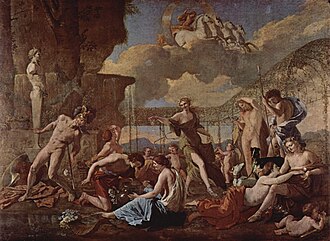 The Empire of Flora - Nicolas Poussin (1631)
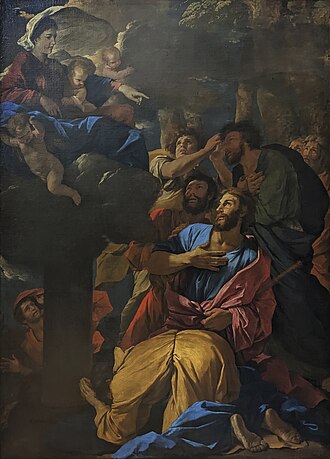 The Apparition of the Virgin to Saint James the Great - Nicolas Poussin (1620s)
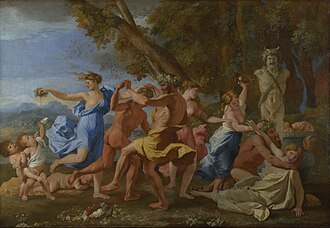 A Bacchanalian Revel Before a Term - Nicolas Poussin (1630s)
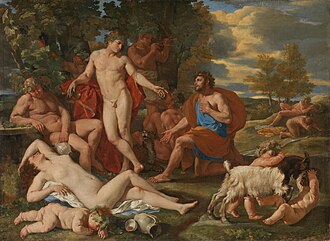 Midas and Bacchus - Nicolas Poussin (1630)